Wednesday, 9 November 2016

holes

John Golden's tweet made me think about pattern blocks and holes again:

There's a nice kind of arithmetic with pattern blocks. For instance, these two houses have the same shape and size:
(Picture created on mathtoybox)
Which tells us that the area of the square is equal to the area of the two rhombuses.

A dodecagon like this
can be made a lot of different ways (try it!) but they will all have an area equivalent to six squares and twelve triangles.

Which brings me to holes. Using these two bits of knowledge, we can say what area this hole in the dodecagon must have.
We've got the twelve triangles. We've got the equivalent of one square (in the form of the two thin rhombuses). So the spiky shape in the middle must be... five squares big. (In this case you can also see how five rhombuses and two squares would fill the space.)
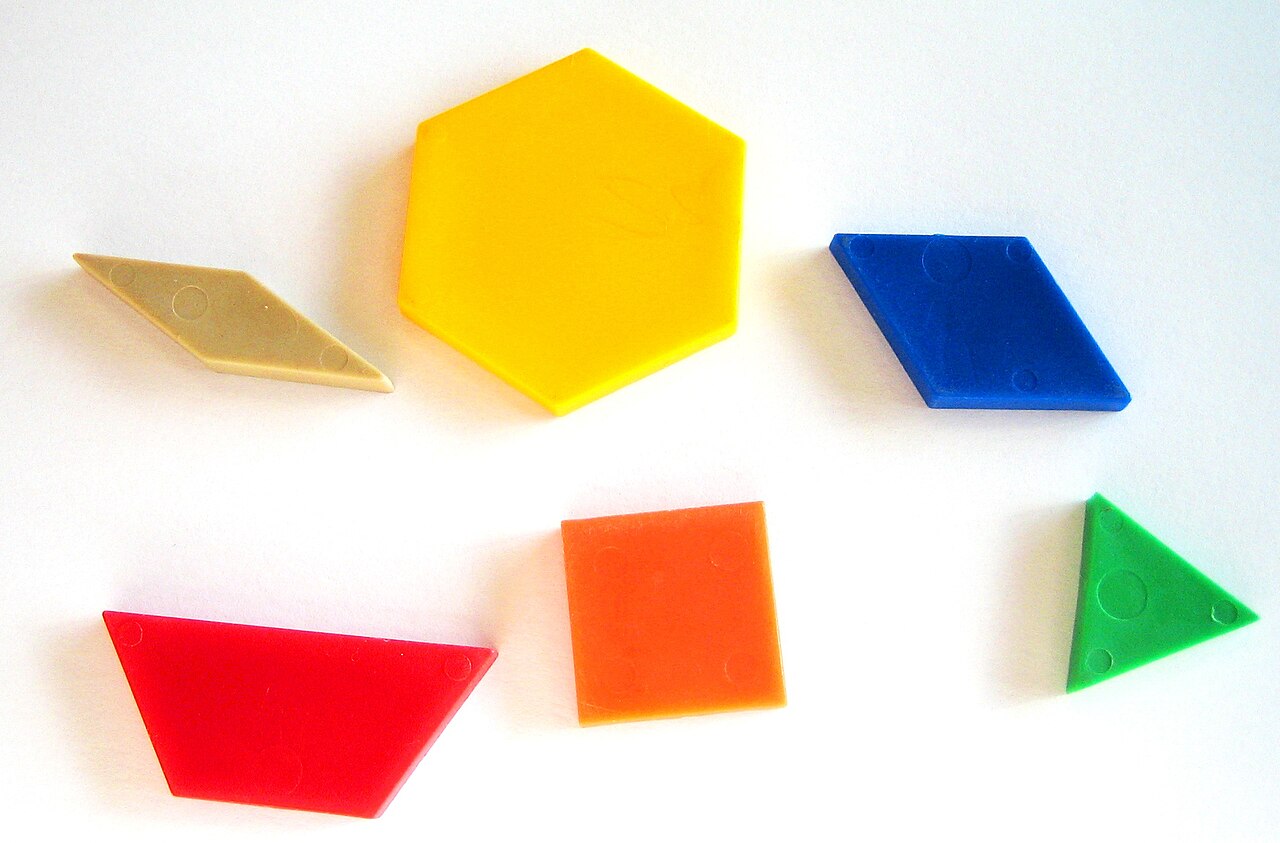
I'm thinking how the triangle family is big (the triangle, the blue rhombus, the red trapezium/trapezoid and the hexagon) - great for all kinds of fraction work and substitution. But the square has only two in its family. Not so interesting, comparison-wise. Plus, it's not immediately apparent that the thin rhombus is half the size of the square.

So, thinking to enlarge the family, if the square is twice the thin rhombus, what would three times the thin rhombus look like? I used holes to find some. Here they are, coloured in non-pattern-block colours:
 The pink S is just the shape of three thin rhombuses next to each other.
I like that purple S-shaped one!

The fuchsia one is the most obvious: a square and a thin rhombus joined.

[edit] Here's a claim. All those 1½-square holes are concave. I think there is no convex pattern-blocks-compatible convex shape (ie with unit-length sides, pattern block angles).

I'm thinking about alternative pattern blocks you see. I recently bought some deci-blocks:
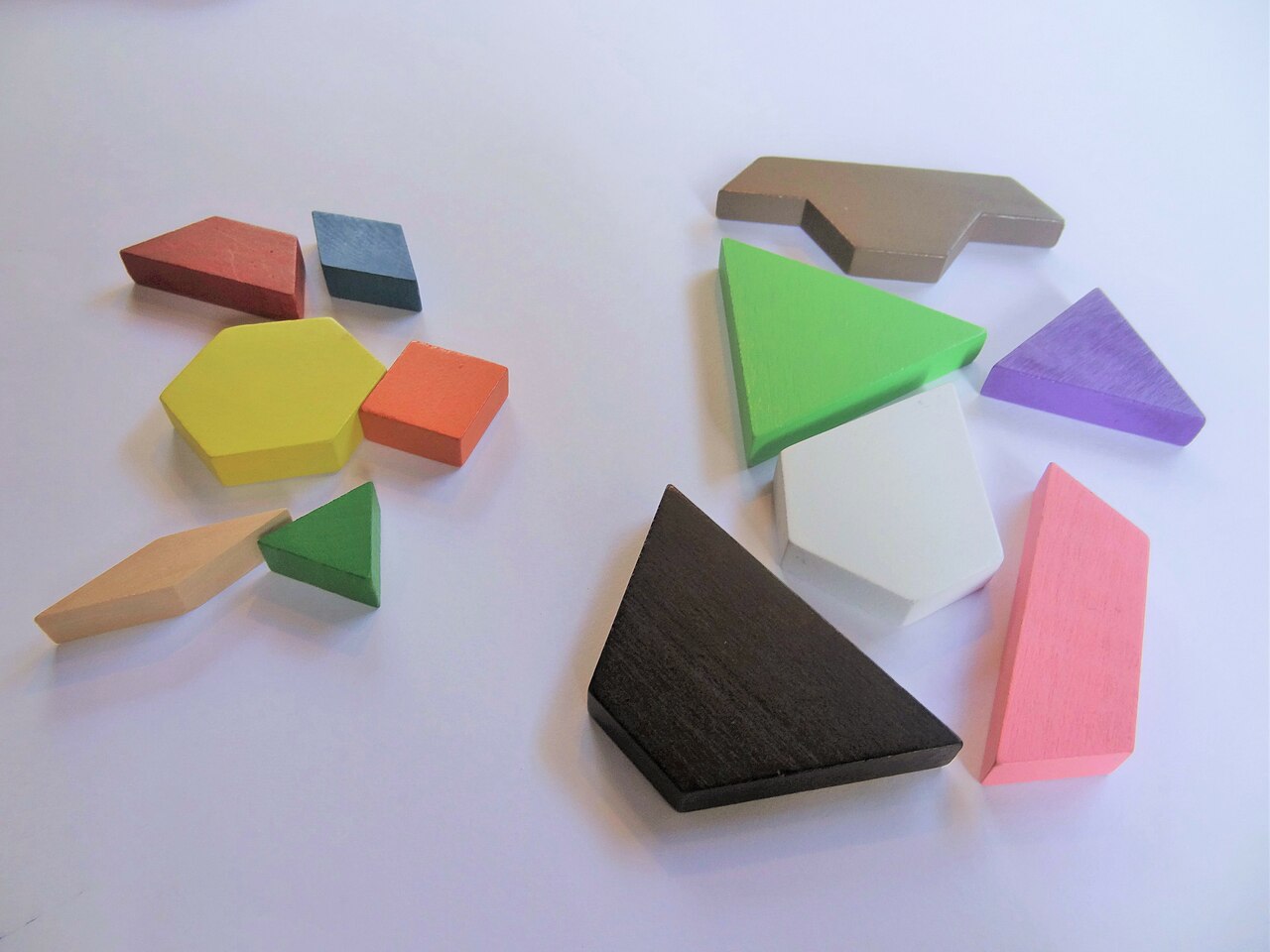
They extend the triangle even further, in interesting ways;
Christopher Danielson is thinking of other ways to create a beautiful new set of 21st century pattern blocks:
What I'm wondering here though, is, if there was a family for the thin rhombus, how would that look? Or should we just go for bigger members of the square family, with a domino, triomino, hexomino?

And then I'm thinking the arithmetic of holes could be a good one for the older years/grades of primary/elementary or even beyond. These three dodecagons all have the same size hole. What size is it?
Then, getting a little harder, what size hole would this hole be?
And what about the two holes in this?
By the way, if you want to use my images yourself, go ahead.

- - - Update, March 2017 - - - 

Looking at this tweet

made me think how "stars" could be good to play with:

Sunday, 16 October 2016

How we've begun using Cuisenaire rods

Kassia Wedekind tweeted:
Knowing Kassia as a writer and blogger with a lot of understanding about young children's explorations of mathematics, I'm a little daunted trying to answer. But I'll have a go anyway.
First of all I'm impressed with just open exploration. My K3 class show no sign of losing enthusiasm for it. At first, when I asked them, they had no idea that the rods were linked with numbers or measurements, but there is so much implicit maths in what they do, and just doing it extends their understanding of it. It's an aesthetic enterprise as much or more than a mathematical one, but that seems right. After all, mature mathematicians often describe their motivation as a kind of aesthetic pleasure they find in it.

I document a lot by taking photos. This makes it easier to break up our creations at the end of a session, because they are not "lost", but more importantly we look again at what we've made, and I refer back to particular ones as starting points for new departures.

Students need a lot of rods. This is true for any material you use where students like either a large scale or want to continue a pattern. The little sets that people usually buy are not enough.

One of the things the teacher can then do is to say, did you see the way Ana made that wall? Do you think you could all make a wall of some kind?

And they have been so creative, there's enough for many sessions of this kind of return. You can see it right from our first meeting.

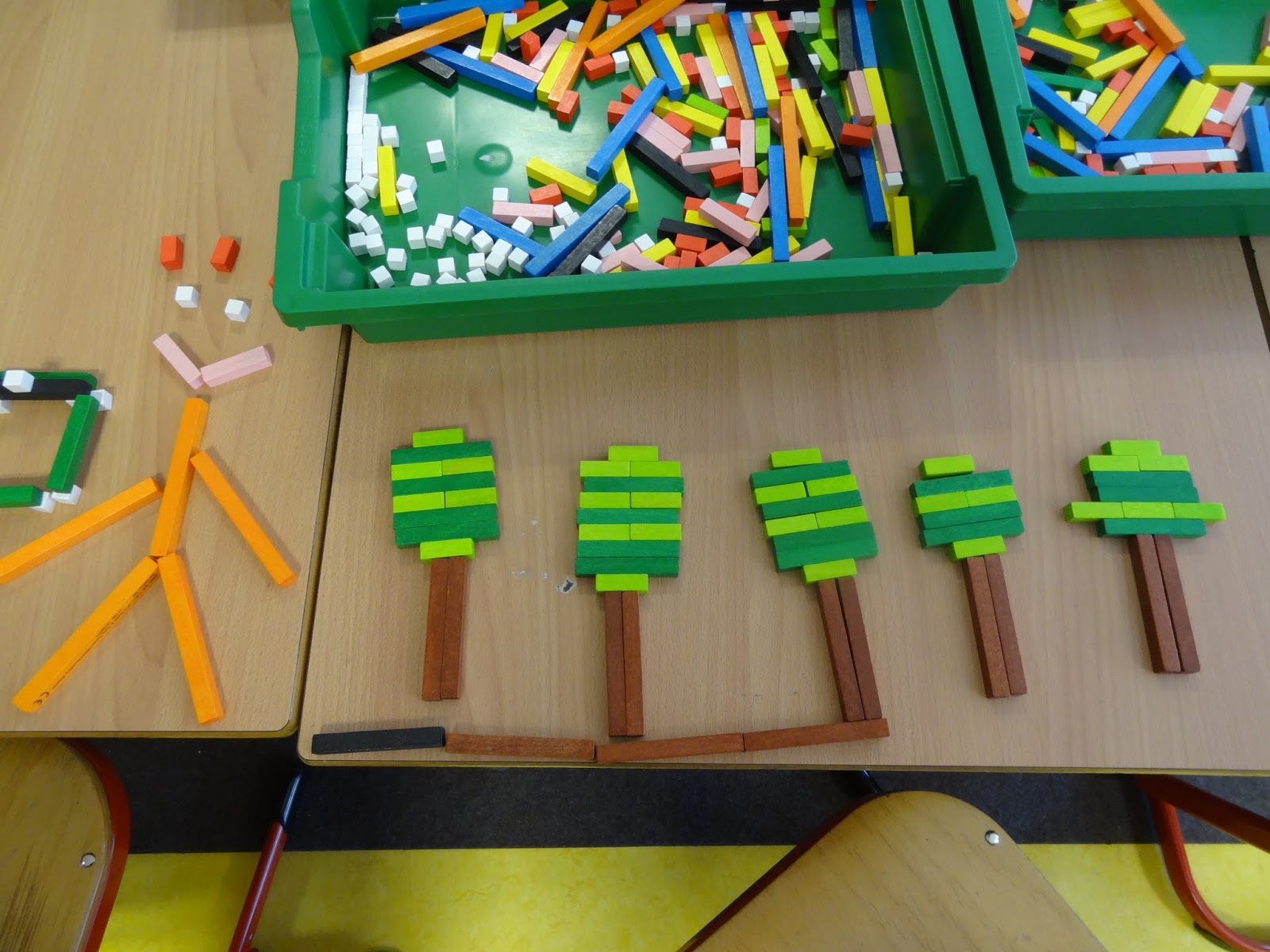
For instance, there's been lots of rectangles and surrounded rectangles:
I've used Cuisenaire trays in sessions after this:
Other things that have appeared are plans, maps really, of roads and carparks, models of houses with walls and chairs of different sizes. All of which could be followed up. Helen Williams suggested using different-sized rods to represent the three bears as the story is told, with students choosing their three sizes of rods, and holding the right one up at the right time. There could be three different chairs made, beds...

Using narrative seems is a great way in. We've been reading and writing stories about rockets, aliens and going to the moon, and T created several beautiful rocket images, which also showed one of the first examples of a staircase. So it got returned to twice. Once for a, "let's all try to make that kind of pattern in some way" session, and once for a "show a way to get to the moon" session!
We've just been making some faces within squares with sides as long as the orange rod - which was challenging but also delightful.

Alongside this, we play games. Rods behind backs, can you take out the red rod? Together and with partners. Or, here's the sandwich with something missing, what  needs to go in to finish it off.

And we're just beginning writing.


As you can imagine, there's been some great opportunities for sitting with students and listening to them talk about what they're doing. But here I think I've go a lot more to learn form Kassia and her colleagues and their students... 

Wednesday, 5 October 2016

Writing!

All our individual work in K3 has been with manipulatives and orally so far, with lots of play and games. Today I tried them with a bit of recording in their books.

"What trains can you make that are the same length as the yellow rod?"

Following Madeleine Goutard's lead, I'm leaning towards - and today I asked for - writing rather than drawing as a way of recording, which I would have gone for more in the past, but I was happy to see the drawing too. The rationale here is that symbols are a quicker and simpler way of recording and so they can allow you to think further.

We talked through using the first letter for the rods:

Impressively, just about everyone got it. (One child who doesn't have much English didn't quite understand what I was asking for. I did sit with him for a while and do one example, but he followed up by drawing around rods in various patterns.)

It was interesting to see the different ways the children demarcated their different trains. We should look together at how they managed that.

Although I'd shown them the + sign before, when on the carpet at first with their whiteboards I asked them to write down a train I showed, that wasn't how children recorded, so we went with a list of letters. One boy did add the +s. He wrote

y+p+w

I suggested that to show p+w was the same as y, he wrote

y=p+w

but this was evidently confusing as he then switched to

y=p=w

Maybe I should have just left it!

Where would you go next with this?

I think they need to do something similar a few more times, look at each other's pages, see how to show what they want to say really clearly.

Any thoughts, suggestions? I'm feeling my way through this...

Saturday, 17 September 2016

Nasrudin's Sermon

So, the five year olds in my K3 class made an amazing start creating whatever they wanted with Cuisenaire rods. Here's just some of the creations. In all the creativity there's a lot of implicit maths - ideas of equality and inequality, of arrays and rectangles, of sequences, of enclosing and aligning... And they're bouncing ideas off each other like crazy.


And now I've reached the point where I'm starting to ask for some very particular things. Make a "train" of pink and green rods:
This seems like a much narrower place. I'm directing the activity, I introduced a bit of arbitrary terminology - "train". What I fear is losing all the creativity. 

After free play in Gategno's book, comes trains. 
Trains take us to a lot of good things. But they're a little... one dimensional, after all the splendour of creation.

Perhaps if I was better at this, more sure-footed, I'd be confident to draw all this out from what has already been created. Certainly that's a kind of ideal. That the children are showing each other and learning from each other, and have the sense that they're doing so. 

There's a famous story about the wise fool Nasrudin that came to mind when I was wondering if I was rushing ahead too fast:
Nasrudin's Sermon 
One day the villagers thought they would play a joke on Nasrudin. As he was supposed to be a holy man of some kind, they went to him and asked him to preach a sermon in their mosque. He agreed.
When the day came, Nasrudin mounted the pulpit and spoke:
‘O people! Do you know what I am going to tell you?’
‘No, we do not know,’ they cried.
‘If you don't know, then you're not ready for what I have to tell you,’ said the Mulla. He got down and went home.
Not daunted, a deputation went to his house after a few days later and asked him to preach the following Friday, the day of prayer. Nasrudin agreed.
When the day came Nasrudin climbed the pulpit and started his sermon with the same question as before.
This time the congregation answered, in unison:
‘Yes, we know.’
‘In that case,’ said the Mulla, ‘there is no need for me to keep you longer. You may go.’ And he returned home.
Having been prevailed upon to preach for the third Friday in succession, he started his address as before:
‘Do you know or do you not?’
The congregation was ready: ‘Some of us do, and others do not.’
‘Excellent,’ said Nasrudin, ‘then let the ones who know tell the ones who don't.’
Adapted from Idries Shah's The Exploit's of the Incomparable Nasrudin 

Saturday, 30 July 2016

naturally ingenious combining

I'm rereading some of the chapters in Madeleine Goutard's Experiences With Numbers in Colour. Something jumped out at me. It was written in 1964, but in a way it's better suited to now, to 2016. The destiny of many if not most sets of Cuisenaire rods around in the 60s was to end up in the bottom of cupboards, along with the Dienes apparatus and Geoboards. What was not there, the ingredient that was needed to make the pedagogy work, was the idea and practice of number talks. Even now this is maybe not that widespread, but at least it's out there, with wonderful books like Intentional Talk leading the way. Now that we are using quick dot images, asking children to look at groups of dots and tell us how they see the total, we understand better the importance of what Goutard below calls "naturally ingenious combining".

I won't be using this particular part for a while as my five year olds will be doing a lot of playing and other things before we get to this stage. But you'll see what's happening. The class is motivated to explore something together, they are creative and playful in the way they find solutions. The emphasis is on doing and trying out rather than having remembered (although they evidently have a lot of experience with rectangles as products of two numbers).

The passage starts with Goutard introducing some rods:


She then introduced a black rod (7 white rods long)...
And not just flexibility of mental calculation. Flexibility in thinking. And also comfort with manipulating numbers. These days too it's easy enough to take photos of what the kids have made , get them up on the whiteboard, and come together to talk about the different representations together.

Friday, 8 July 2016

Meeting my new class

So, last week we all met our new classes for 45 minutes. Mine will be all five years old in September, what up until now we've called Year 1, but come September, we're calling Kindergarten 3 because 1. we're being less British, and 2. we're being much more play-based.

So, after an introduction ("Do you want to call me Mr Gregg, or Simon?") and a song, I introduced - of course - the Cuisenaire rods. I asked them what they thought they were for, and they said making pictures of various kinds, not a mention of maths. I said they were sometimes used for patterns and numbers, and one boy counted to twenty in response.

So - of course - I said, "Make anything you like out of them, pictures, patterns, whatever you like!"

And they did!
a blue-black pattern
We'll return to this, and explore lots more patterns.
a gate
A lot of people made things in 3D, like for instance this house:
a house with a chair
 I wonder what other-size chairs we can make...?
a face - we know where this leads
 And here's an interesting rectangle...
 Here is the beginning of lining things up, measuring them up against each other neatly. We're going to follow up with a lot of this.
a sun shining!

When I look at these pictures, and all the others, I see the kind of things the children are interested in. They like houses, and roads, car parks and castles. Some made abstract patterns of rectangles, or spelled out their name. And I see lots of starting points for further exploration.

(The next day a couple of the girls came to me with a home-made envelope with some nice messages and pictures inside, like this one of that first meeting. Those yellow trays on the tables are the ones with the Cuisenaire rods in.)