Showing posts with label Fibonacci. Show all posts

Sunday, 24 January 2016

How we wrote numbers

So, we've completed our couple of weeks around how we write numbers. How did it go?

There was lots of good stuff in there. I was particularly pleased that we got to look together at how important India and the Muslim world were in the story of our number system. In particular, at this time when Islam is being viewed so negatively in Western media, it's important to see how figures such as Al Khwarizmi (from whom, as a garbled version of his name, we get the word algorithm; and from whose book we get our word algebra) contributed to the 'rebirth' of Europe.

We had a brilliant response to the piece of homework (you can see these as some of the posts labeled 'Numbers') which asked the students to blog about numbers, in a different language or with different symbols or from a different time. It was a real celebration of different cultures, of similarities and differences.

Lots of students were grabbed by Roman numerals. E kept writing them out for me on a whiteboard
And I don't know when B and M practiced this to show me, but it seems to me that there's a lot of understanding in being able to count like this, even with a few slips.

The book, Blockhead! was ideal, and really had the students attention. I've also been reading occasional pages from Johhny Ball's colourfully illustrated book, Think of A Number:
As for working in bases, it went well. The students understood it with Cuisenaire rods
even though sometimes writing the numbers was a bit tricky!

One of the surprises was the discussion around this, slightly modified version of a Fibonacci question:
I'd shared it with the original idea of situating the new Hindu-Arabic numerals within the early-capitalism of thirteenth century Pisa, Our 'central idea' is that there are discoveries that change the world, and I wanted them to see the sorts of questions Fibonacci was interested in, maybe see that the new numbers would help with trade. But they could see this quickly. So, instead we discussed how to share the profit. I wish I'd written it all down, there were so many great arguments and ideas! T for instance thought that if they all had fair shares, next time there would be no reason to put more money in. R on the other hand thought they should all get fair shares because they all needed the same amount of money!

The pattern on dress of the "Mathematics Fairy" too generated some good thinking.
It really hit the spot for K, who made his own book about the pattern at home;

There was a late entry just as we were finishing. Someone tweeted about Which Script? This lesson was all about place value, and also about scripts, and generated so much reasoning and discussion! 

Monday, 28 December 2015

How we write numbers

I'm thinking to start off with this image*:
And the questions are - of course - What do you notice? What do you wonder? 

I don't know which way it will go then.

But I know there are lots of great ways to go from this image. I'm hoping for some observations that are historical, and perhaps some mathematical ones.

One area I'd like to explore - historically and mathematically is the changeover from Roman numerals to Hindu-Arabic numerals. It could show us how a change in the way we think brings about changes in society. It could show us the importance of cultures outside Europe. And there's some potential great exploration of different number systems and numbers in different bases.

Already F has been writing some equations in Roman numerals, and R has been talking about how our system comes from India.

I like what Graeme Anshaw has done with this:

I think we'd probably want to get our heads round how Roman numerals work. Here's a good way:
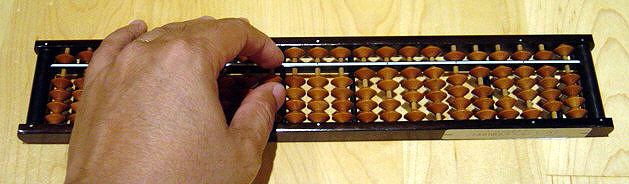
Arithmetic wasn't so easy for the Romans, so they used a counting board or abacus:
It would be interesting to make, and try to use one of these. It looks like they work like a Japanese soroban:
File:Soroban.jpg
source
And then, how did they do this on a counter with jetons?

Here we could investigate other ways of representing numbers from different cultures, and at different times.

Now for Hindu-Arabic numerals...
File:Bakhshali numerals 2.jpg
source
How did they make that journey, from India to the Muslim world, to Europe? Lots of stories in there, and I'm pleased there's such a strong cross-cultural element.

I've just been reading Keith Devlin's Man of Numbers, about how Fibonacci introduced them into Europe. There's lots worth finding out in that story too.

And thanks to Tracy, I have a nice little picture book about him to read and contemplate with the class:

Part of why this all seems more do-able to me now, is partly that I've seen there is lots of maths that can be explored by the students, rather than simply being told about. Reading Madeleine Goutard on our base system, and other bases, I see more clearly how we could represent them:

from Madeleine Goutard, Mathematics and Children
The bottom one is perhaps how three-toed sloths might represent numbers, in base six.
Three-toed sloth (source: wikimedia)
How would those numbers in base six be written?

How about other bases? They could be represented by Dienes' blocks too:
source
Only problem is, even though there's loads of sets gathering dust in maths cupboards everywhere, they're not used any more, and not sold in the catalogs. Maybe I'll make some...

So, lots of directions to explore from that first image.

And then there's that dress, with that mysterious pattern of numbers.

See How We Wrote Numbers for reflections on how this went.

*Calculating-Table by Gregor Reisch: Margarita Philosophica, 1503. The woodcut shows Arithmetica instructing an algorist and an abacist (represented as Boethius and Pythagoras). There was keen competition between the two from the introduction of the Algebra into Europe in the 12th century until its triumph in the 16th. Source