Showing posts with label geometry. Show all posts

Sunday, 24 November 2024

things counter, original, spare, strange

As an IB school, "inquiring" is pretty much the first word that comes up as a statement of principles. But somehow, in mathematics especially, it doesn't usually end up in first place.

It's that old thing of teachers feeling they need to cover the material (in our case it's called the 'scope and sequence') and not knowing that inquiry will go much deeper and in fact cover more.

Teachers do of course ask students to discuss things before moving on, activating prior knowledge, sharing vocabulary, and bringing learnt-but-a-little-forgotten concepts back to the front of the mind.

But this time of discussion can also be one of the best places to find the starting points for student-initiated inquiry.

I was visiting a Grade 3 class (Year 4 in terms of the English system) a few weeks ago. The teacher was getting the students to talk about what they remembered from their investigations into 2D and 3D shapes so far. They had made 2D nets for 3D shapes.

One student, L, asked, 'What about 1D shapes... and 4D shapes?'

The teacher is very attentive and responsive and saw an opportunity here. 'We should write down that question.'

It's a question I love, and I suggested I come back the next morning and address it a little. The teacher welcomed that and so I did.


I started by writing L's question, and complementing her for taking something the class were learning about and going on another step with it. Then I asked what the students had to say about this. S said that a line was 1D. He also wondered what 1.5D might be (funnily enough, this is not a crazy question, as I learnt watching this 3Blue1Brown video a while back).

A said that a circle was 1D, and I agreed that the line part of the circle was. L said she thought that a point was either 0D or 1D, and the consensus was that 0D was correct. N said that he'd heard that 4D was a 3D thing that interacts with you.

I then did a bit of talking and showing. I said we could look at the cube and at how the number of points goes up as we go up dimensions, the ones we know about, going from a point to a line to a square to a cube as in the diagram below. I'd brought the straws and connectors along, and I used those to show this. Some of the students could see it was doubling, so we might expect a four dimensional version of the cube to have 16 points or vertices on it.

I said we only have 3 dimensions in our space, and went through what they were in that room.

I asked if they wanted to see a 2D or 3D picture of one. There was a definite desire to do that, and we looked at some representations of the tesseract (the 4D cube).

images from the Wikipedia Tesseract page

It is a kind of wow thing, I think you'll agree.

We talked about a few other things: touched very lightly on Einstein and spacetime. And then I had to go back to Moon Class. I left the straws and connectors and they tried to make their own versions of the tesseract. The teacher sent me some pictures later:


It wasn't an ideal lesson - there was too much talking from me.

But there were some very good aspects to it:
  1. The teacher was creating space for conversation where students thinking and questions could emerge. A lot of us are doing this. Some also get students using whiteboards so that the thinking isn't only verbal but diagrammatic and written too.
  2. The teacher documented some individual thinking that wasn't in the direction of the planned lesson, but 90° to it. Fewer of us are doing this. We tend to have a plan in mind that we're getting on with and moreover that time of sharing takes quite a lot of attention to orchestrate. There isn't a lot of headspace for things counter, original, spare, strange.
  3. The teacher thought some follow-up on the question was worth giving time to. Admittedly, things 4D isn't everyone's expertise, but that is one of the powers of documentation, of writing questions down in this case - it buys time - to talk to colleagues, to think, to google.
  4. My best moves in the event were asking the students for their answers to L's question, and bringing the straws along. Those were two things that put the ball in the court of the students themselves.
If there is one thing I think we need to move forward on as a team, it's probably number 2 in the list. We need to be documenting more, to be preserving more of what the students say and do for future discussion and exploration. 

Wednesday, 28 December 2022

Folding, cutting, sticking, drawing

I want to write a little about one of the hubs of the classroom.

It's what we call the writing table or drawing table. Which is maybe not the right name for it. A lot more happens than writing and drawing. It could perhaps be called the paper table. It's got a lot of stationery on it. Bits of paper of various sizes, glues, scissors. A lot of cutting, gluing, sticking, folding, stamping and printing happens. A lot of colouring in too. But, these names and simple descriptions aren't really adequate.

It’s 'continuous provision', as we call it: it’s always there, and used every day. I imagine that it extends beyond school too: children often have stationery at home.

Most early years classes have got something like this table. Certainly all four of our pre-K and Kindergarten classes have. This is what continuous provision is all about: a place where children can return again and again and make something, trying out new ideas, combining things they’ve done before, learning from each other.

Since they came to the school when they were three, R and K have been doing this. They're not the only ones, but let's focus on them for now. They're four years old; they've been in Moon class for 15 months. R at first stood out as leader of the duo, always inventive, always relishing what she does. But K seems to be inspired by her to be similarly creative, making things that are distinctive to her, having her own strengths and emphases.

An example, back in September: R's envelope-picture:

What kind of mathematics are present in creating this? An awareness of bringing the corners into the middle of the paper to reorient the square and create triangular flaps. A lot of spatial thinking. An example might be the awareness that when you fold the paper over once, the back of the folded paper faces the same way as the front.  She is probably aware that the orientation of the square changes too: first it was in a 'diamond' orientation, now it's in the conventional orientation. She'll be aware that the small square is made up of four triangles. And that there are diagonal lines across the square that meet in the centre. She's aware that some things can be undone, or almost undone. Pencil can be rubbed out. Cuts can be taped together again. And some things can't be undone. The felt pen drawing can't be rubbed out very easily.

At the same time, K was doing some folding too:

These paper explorations contrast with art activities that use specifically 'art' materials, painting in particular. There seems to be more of a tinkering feel, more mixing. Take R here, where she’s decided to draw round the scissors, drawn and colored in a pill shape, written a little, filled a rectangle…

There's a really strong social element in this. There was a group of girls in Star Class two years ago who all tuned into each other with their drawing and colouring, got more and more confident in that, and continued it into Kindergarten.

There’s also the sense of self-efficacy, of choosing a project, seeing it through to completion, working alongside others and learning from each other. There’s a kind of joy in the workshop ambience, in having control and making together and separately.

Here's some more, this time involving cut-outs:
With this must come some sense of how when you fold and cut, the hole you achieve is not like the cut you made. And a developing understanding of the relationship between the two.

There can be folded-and-cut shapes inside other folded-and-cut shapes:
The smaller shape suggested a watermelon to the girls. It's rare for these creations to be completely abstract; they usually represent something. This is a general feature of a lot of play - mathematics is mixed with creation is mixed with representation is mixed with narrative is mixed is mixed with language is mixed with sociability...

Another day, a butterfly:
^
Another day, a bird:
Another day, flowers composed of four punched hearts rotated:
What is the role of the adult here? Obviously, we keep the table stocked, and help the students to keep it tidy and organised. In the moment, we chat if it doesn't interrupt the flow of the play and conversation. We appreciate what the students are doing, how they're thinking and experimenting, again in a way that doesn't distract from the flow. We document and share with parents on Seesaw, and often with the class in our meeting times. Sometimes we play alongside too; this usually doesn't lead to much in itself, but allows us to be in the workshop too.

This time I started playing with R's leftovers (I'd asked if that was OK). I started making little 'windows' with the heart holes. R quite liked what I was doing this time, and together we made a picture, incorporating a bear on a trampoline, and also some of the folded and cut squares  that were being made at the table at the same time.
But, it's really not necessary for me to be adding anything in to this process: there's so much happening already: theories being refined, interests pursued, skills honed, and much more. 

We leave approximately the same materials on the table most of the time, and that's its power really. The little squares, the A4 sheets, the scissors, glue, tape and pens are enough for an endless range of operations, and combinations of operations that, the way children use them playfully, become more and more sophisticated.

Other things we provide in the class are more one-off. Putting some flowers in a vase to be sketched, along with the sketching materials. This is valid too, but is not a familiar arena that encourages the independence and agency of the students to develop.

In November, R gave a folded-and cut-out character to P, a boy she hasn't had much direct play or conversation with. One of them stuck the character to a sheet of paper, and P added lots of line drawing background. He carried it around with him for half the day.
I was surprised and delighted that this paper play had become a way of reaching out in friendship.

But maybe I shouldn't have been so surprised. These spaces that the students own, which become for them both a laboratory and a language are the natural places for the real events of the class to happen in.

Saturday, 24 September 2022

From back behind them

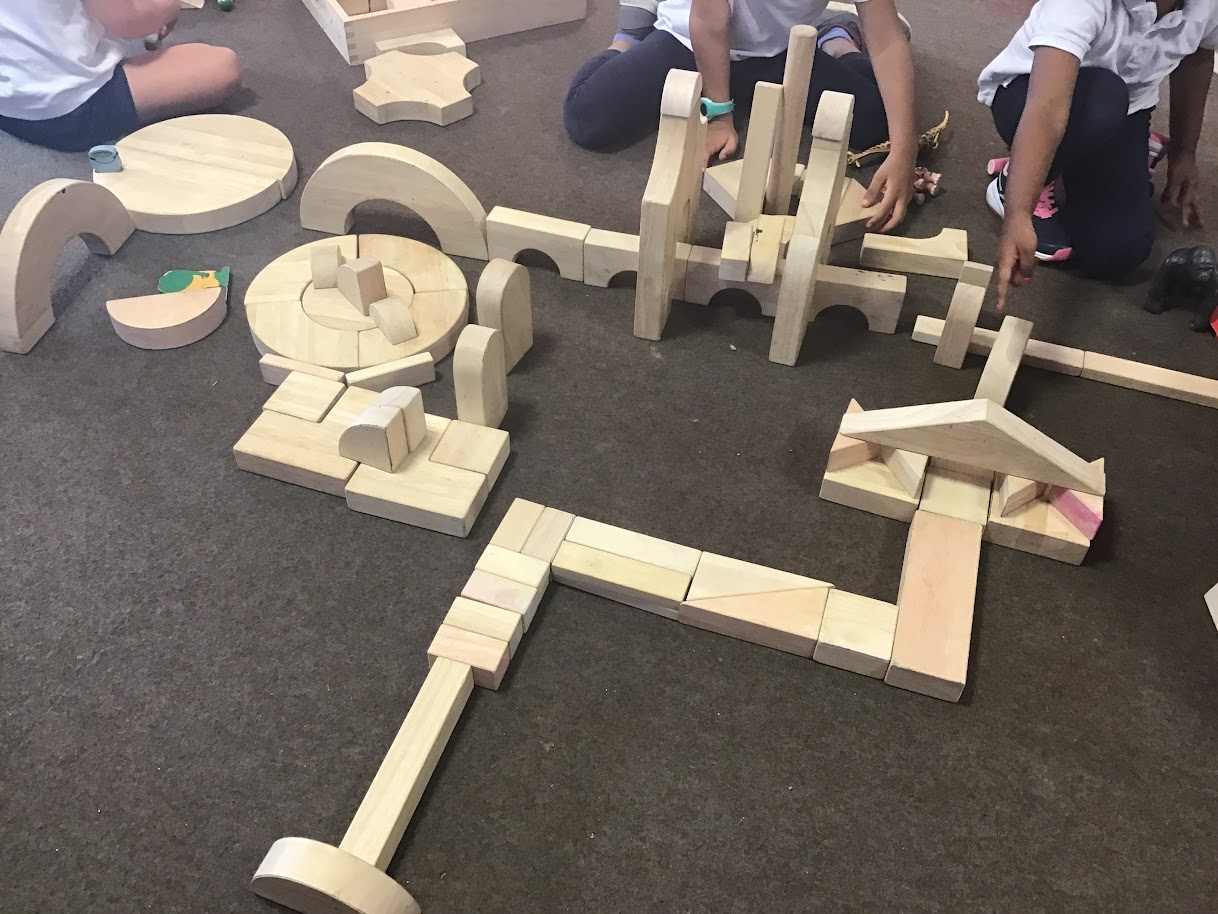
 We've got a set of Unit Blocks in Sun Class and a set in Moon Class.

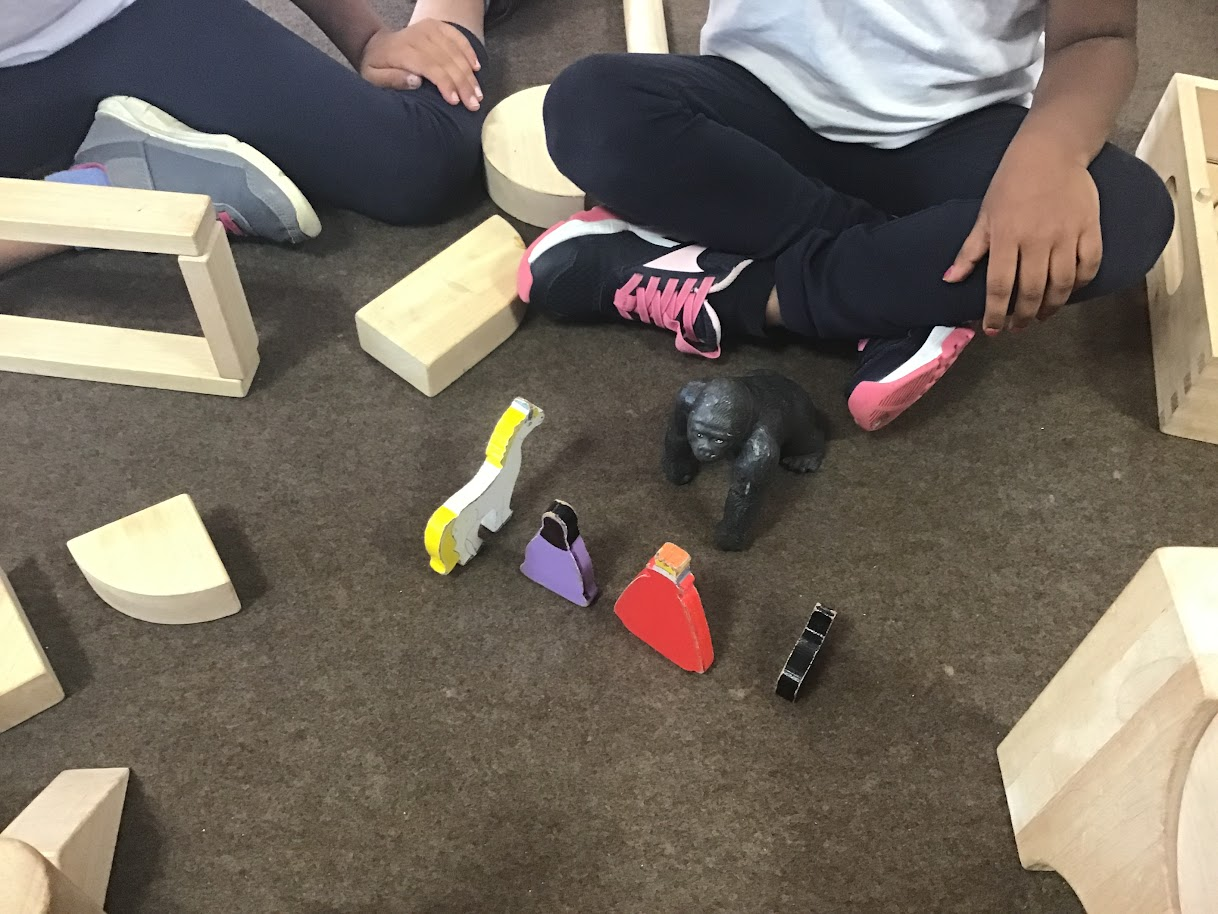
R and K were playing with them, and also with some of the wooden story figures, and a gorilla.

Sometimes, the building came to the fore.
Sometimes, it was the story telling and acting out with the small-world figures. R's mum later told me that R had watched King Kong in the summer.

Other people, including me, were also contributing to the Unit Block construction.
R was kind of telling a story as the characters acted it out.
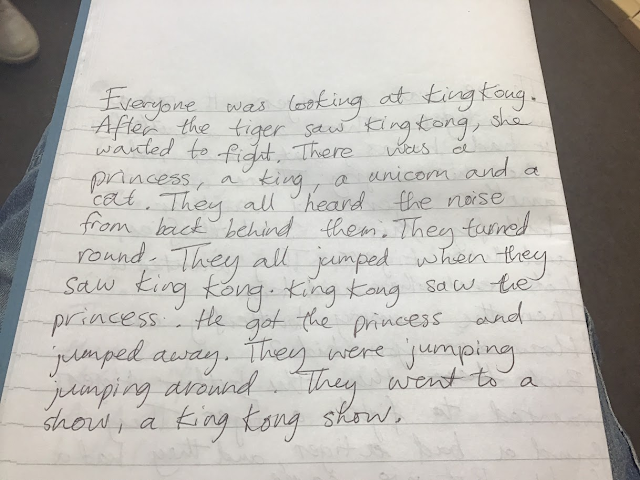
Normally, it's the students who ask me if I can write down stories for them ("helicopter stories"). This time I asked. R and K told this story together, with R leading the way:

"They all heard the noise from back behind them. They turned round. They all jumped when they saw King Kong."

I was really struck by this part. It describes a moment of surprise in a way that the PK students stories usually don't. And the surprise hinges on a spatial arrangement. At first the character blocks were facing away from King Kong, not conscious of his presence. Then they turn around, and only then do they realise to their shock that King Kong is there.

We often act out our stories together, and acted out this one as I read it out. Again, there was the dramatic moment of all turning round and seeing that King Kong was there.

And this is what I wonder: Did the small world enactment of the story - the staging of it together -  help to introduce this dramatic - and geometric - moment into the story telling?

Friday, 25 March 2016

Make a Fraction Talk Square

Nat Banting got me working out how to screencast with the Smartboard (and spotlit it too). The sound's still not good, but I'm hoping I'll work that out.

One of my first recordings was this, during a fraction talk.

I was glad I followed up Beatriz's question and we made them with Geogebra:
It was a great way into Geogebra apart from anything else - simply using Midpoint and Segment tools (Click on the tools second and third from the left.)

We only used the two tools and yet the students had a lot of freedom - they produced some interesting squares. We talked about two of them, that involved halving in particular.
The other two involve an interesting feature of triangles.

I'm wondering if someone will say that the triangles on the left of Maria's square are the same area? Or the small ones on the top right of Beatriz's? And where do we go from there?

Code to embed the Geogebra app:

<iframe height="556px" scrolling="no" src="https://www.geogebra.org/material/iframe/id/WUtYR9Mf/width/1007/height/556/border/888888/rc/false/ai/false/sdz/true/smb/false/stb/true/stbh/true/ld/false/sri/true/at/auto" style="border: 0px;" width="1007px"> </iframe>

Wednesday, 17 February 2016

Quadrilateral Sets - the lesson

In my last post I shared an idea for a lesson. So, how did it go?

First of all, I checked that we understood the idea of a set. Showing this,
students responded that it was a set of animals. When I asked them to be more specific, they observed that it was a set of rainforest animals. I tried another, this time with some of the girls' names, and again it seemed to be straightforward; the students at first said 'girls' and then 'girls in our class'. So onto the sets of shapes:

1. Students look in pairs at what the members of each set have in common . What are its defining features?
 
We paired up and got looking and annotating.

2. Students share what they think

While this was going on, Estelle, Laura and I circulated and asked children to talk to us about what they had noticed. It was good to hear them attributing some of the observations to their partner, and set us up for asking for hands up if they could say something their partner had noticed. Almost everyone did this, while I scribed some of the observations on the whiteboard. 
I was pleased when K said, "E saw something really cool..." and made sure I emphasised not just the listening but also the appreciation K was giving.
There was plenty noticed. Some things I'd hoped for didn't come up; no-one pointed out the parallel lines in the shapes in the bottom right. No-one saw the features of kites in the top right. But there was lots else. A lot of students commented on the fact that the shapes could be split into triangles. And quite a few talked about how some shapes were like squares that were distorted.

That was quite a lot of articulating our thinking together, so I called it a day, and we played a few games of Aggression to finish off (which involves thinking of its own kind).

Today I returned to it. Rather than try to clarify or introduced terms, I decided to just go with what the students had noticed.

One of the things was that the four-sided shapes could be split into triangles. We looked at that using Geogebra.
"Do you think all four-sided shapes can be split like this?' - everyone agreed with
 this generalisation.

The other thing that had stood out was their way of seeing parallelograms as "twisted", or "tilted" squares. Again using GeoGebra, I showed how a square could be viewed in a 3D space and by changing the point of view seen as different shapes.

It was as if, I said, we were turning a square in the sunlight and seeing different shadows. Someone asked if we could do that, so at the beginning of break time we took down some squares and spent a couple of minutes drawing shadows before the other classes came down:
I've not really thought  of teaching projective geometry before, but the lesson gave me the impression that the students understood the idea more readily than they did the categorisation of quadrilaterals. Perhaps something to return to?

3. After we've got a thorough feel for the four sets, we do the normal Which One Doesn't Belong?

Knowing that the picture was more complex than normal, I didn't push this for too long; in fact I stopped after four observations:
And there's "squares and rectangles! "No rectangle." Strawberries and fruit.

Where next? Afterwards I talked with Estelle about how the lesson went. We both thought the quality of the students' listening and reporting to the class while they were working in pairs was great. How to build on that, and get them listening even better and building on each others ideas, that will be part of our project. I'm looking forward to reading, adopting and adapting some of the thinking moves suggested in Making Thinking Visible.

It's given me a picture of which ideas about these shapes are within reach of and appealed to the students. Aside from the projective geometry and splitting into triangles, which I'm not sure how I would approach, the top left set seemed the most approachable, with the idea of right angles featuring. I wonder if we should return to Mondrian with this lovely Mondrian geometry tool, and use the idea of perpendicular lines to construct digital Mondrians?
What would you do next?

Monday, 15 February 2016

Quadrilateral Sets - Which One Doesn't Belong?

Teaching 2D shape, I often go for hexagons rather than quadrilaterals. There's less history, less convention, more space for student thinking rather than finding out what things are called. Have a look at Christopher Danielson's video about using hexagons for proof.

But Kristin's latest post about a Which One Doesn't Belong image (again there's a Christopher Danielson element), made me think that this might be a viable way to approach quadrilaterals:

This was really to address that we call the rhombus a diamond, without getting all vocabulary-ish in the process.

It made me wonder...

Could we make a WODB about sets of shapes?

The aim: look at categories, and the idea of inclusion and exclusion based on a criterion, starting with not vocabulary but the students observations and thinking.

So I've rustled up four sets of quadrilaterals:
I'm planning to do this tomorrow in three stages:
  1. Students look in pairs at what the members of each set have in common . What are its defining features?
  2. Students share what they think.
  3. Then, after we've got a thorough feel for the four sets, we do the normal Which One Doesn't Belong?

I don't know how it's going to work. Am I putting too much in? First of all looking for what's the same, then looking for what's different?

Or will it be a feast of thinking and generalisation-making?

I'm encouraged that everyone's got a good grasp of how WODBs work, and can make their own, justifying the inclusion of each corner.
and I was really pleased when a student came in with her own home-made WODB this morning, and wanted to run it with the class (she's got another one, but one a day is enough):
So, if the class were ever stoked up for this challenge, it's now.

Just in case dealing with sets is too much of a stretch, or in case students go down the vocabulary road, I'm going to keep in the wings a few statements from the Always, Sometimes, Never list, and we'll switch to these if it's what's needed:
  • A square is a rectangle.
  • A rectangle is a square.
  • A rectangle has two long sides and two short sides.
  • All four sides of a square have the same length.
  • Parallelograms are slanted rectangles.
--o--

There's another dimension to the lesson. I'm looking, with Estelle, at how to design talk that helps learning. We're reading Making Thinking Visible, and I'm really impressed by the tone and content of the book, and before I'm even on to the book's thinking moves, I want to try to use its analysis as a guideline, to set up talk that around different kinds of thinking:

Naturally, there's
  • Observing
 Closely 
and
 Describing
 What’s
 There 
  • Building
 Explanations 
and 
Interpretations 
  • Reasoning 
with 
Evidence
But I'm also keen to get the students' listening going with 
  • Considering 
Different 
Viewpoints 
and 
Perspectives
I'm hoping that the pair work will give lots of opportunity for this.  I'm going to ask them to pay especial attention to what their partner says, and note this down, so that they can report back on this.

Estelle's coming in to observe the lesson, and I'm hoping she'll pick up on ways the students are talking to each other that are helping their thinking.

I've just started a system for making sure everyone works with (almost) everyone at some point. Each student had to choose a 'Bucharest partner', then a 'Bangalore partner', then a 'London partner' and so on and note down all these 'Place Partners' on a list. The result (after me going through the choices) is a matrix that looks like this (with the names taken off):

(There's a few gaps (black) but I'll try and pair those up another time.) It's important that the students can and do work with everyone in the class, not just he ones that they get on with. So tomorrow it will be the London partners.

After the paired work looking at the sets, we'll come together to share and look at the WODB. I think they might need steering through this.