Showing posts with label squares. Show all posts

Tuesday, 28 January 2025

Making Numberblocks

We have two students in our pre-K classes, Y in Star Class and G in Moon Class, both five years old now, who are fanatical about fairly large Numberblocks numbers. "I love rectangles!" G exclaimed the other day!

I've blogged about this series before and I - along with all our students - think it's brilliant! There's a page I go to to access all the episodes. As my students are between three and five years old, we're leaning towards the small numbers.

At the start of the year G's parents told me he really loved the series, and moreover, knew the square numbers and 'Step Squad' numbers (Numberblocks-speak for triangle numbers). I waited, but he didn't seem to be showing it much in class. It was really in December that he discovered a fellow enthusiast in Y, that he started to talk about it.

Most of what happens in Star and Moon classes is voluntary - the students choose which play they engage in. We adults put out things that we think will interest and engage them, and we also have a couple of 'meetings' a day with our classes, but for most of the day the students choose from what's provided.

We've noticed that influence is a really important factor in what the students try out, and what they persist in. I wrote a blog post about this - 'Copycats'. So it's to be expected that it would be social factors that would really bring the enthusiasm out into the open.

At first they were asking to see pictures of Numberblocks numbers on the Internet. Then they were making them with Multilink cubes.

On the 19th December, G made these:

That's 24, seen as two twelves, 18, seen as two nines, and 27, seen as three nines.

On the same day, Y was telling Estelle a story to write down, all about Numberblocks.


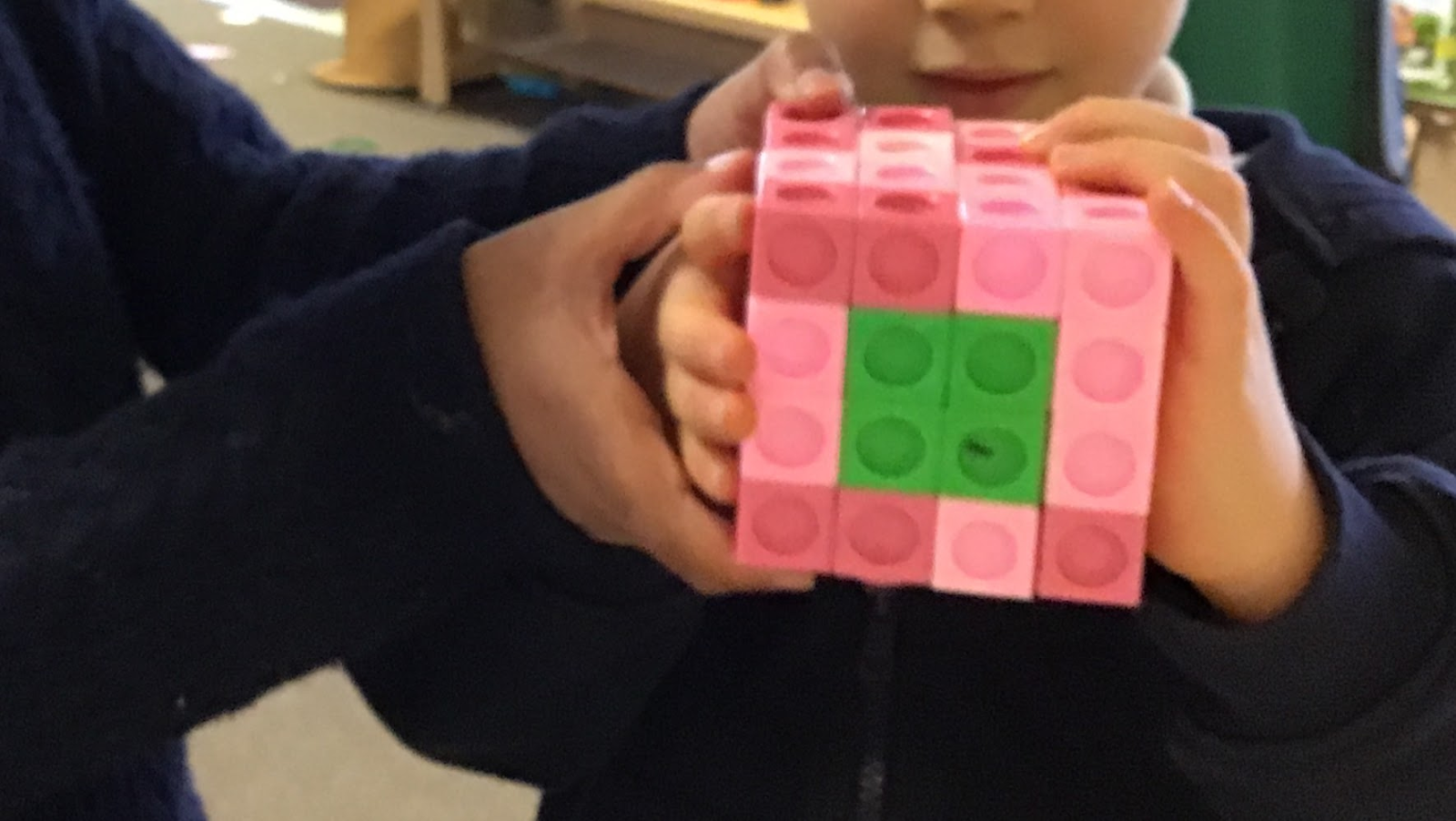
And also putting together 30, 40 and 48:


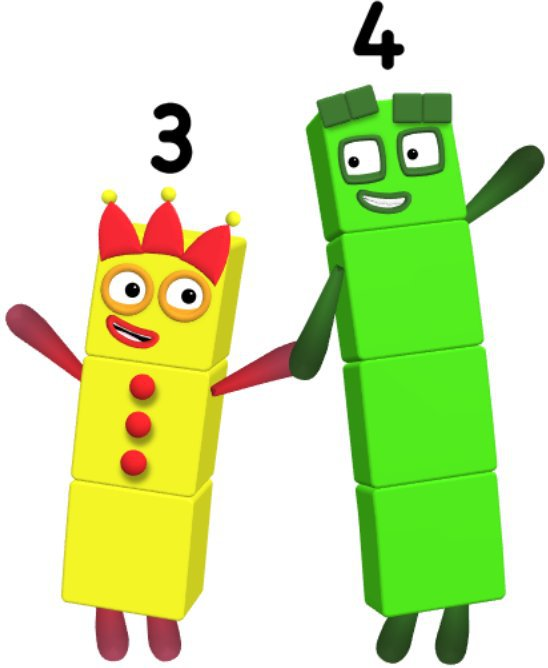
These are regular Numberblocks colours. 30 is yellow because 3 is yellow, 40 is green because four is green. And eight is pink.
There followed a flurry of number-building, which continued in the new year.
We allowed them to display their creations.
There's always a mathematical structure in these. For instance, here's 64 as a cube:
There's the sixty, which should be purple really, but we don't have many purple cubes, and the four, which is green.

A new kind of story began:

We act out lots of our stories - and this one was a challenge - but we did it! A whole series of similar 'times table' stories followed from both students.

A concern though. These students are outliers. Would there be any way for the 'copycat' thing to happen? These two were so deep into their number inquiry - would there be a way for the others to access what they were doing? I was giving a lot of time to them- a pleasure for me - but I wanted to be giving that time to more students.

Luckily - the answer seems to be... yes.

W, who is only telling brief stories, told me this:
Ar., one of our three-year olds, told me this one:

G and Y were pressing on... with 125, as a cube. You can see it's structure here:
and 49, as a square:

One way to spread the goodness was to put out the Unifix cube stairs. They seem to always get filled with the Numberblocks colours.

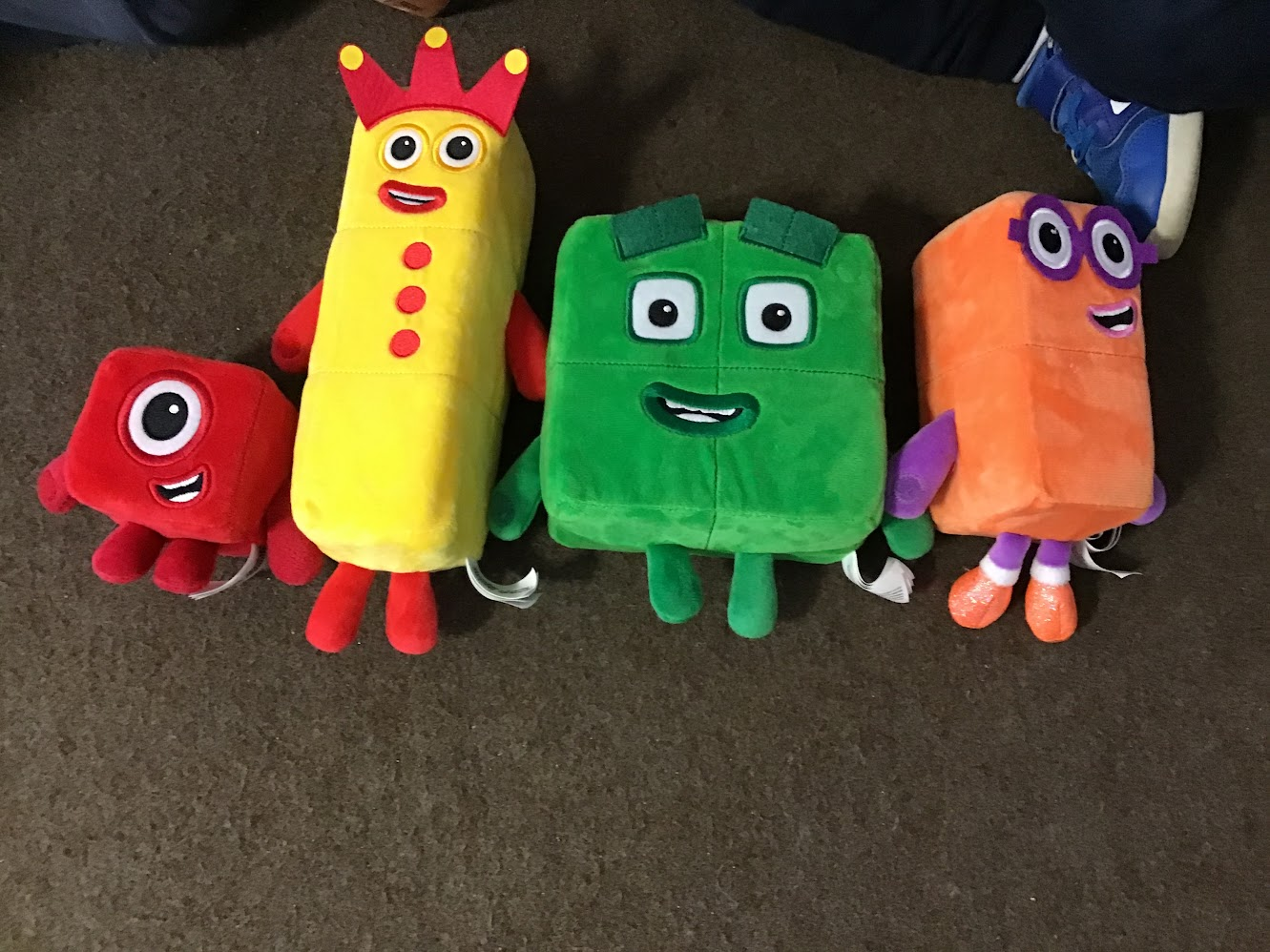
Our furry versions help too!

Then we hit gold. I put out squared paper and black pens. Somehow it was a lot easier to draw them than make them.

Al. drew this one:

Students were enjoying just drawing the grids - five or six new ones joined in, some of them just enjoying reproducing the grid:
An. wrote this story:

We scanned the drawings and let the students colour in digitally. And now there seems to be momentum building, with lots of them engaging in some way. 


W. drew this one - I helped him start off as he's done hardly any drawing this year:
An. did these:
K was very pleased with this. Though he needed me to tell him the size of the rectangles, it was G and Y who advised on the colouring:

I'm excited about the contagion and I'm hopeful that we'll find more ways to build bridges to allow the student-to-student influence that happens in our classes to do its thing.

I'll keep you posted.

Sunday, 22 February 2015

Squares in Rectangles

As it's half term, I've had a chance to think about some lessons a bit more carefully. Here's one:

Gordon Hamilton's Squaring and Subtracting is a great activity, and just right for 8 and 9 year olds. It gets them subtracting, and adding, but more than that reasoning about number relationships in a geometric context that means minimal explanation is necessary, language or symbols have a very small part.

I know that we want children to articulate their mathematical thinking, but it seems to me that part of building up number sense, or intuition about numbers is also working without symbols or language for a while (obviously the numbers themselves are symbols, but you know what I mean).

Another nice thing about these rectangles is they give their own feedback - a bit like with a jigsaw puzzle, where if you squeeze the wrong piece in, the rest doesn't work.


I used the worksheet PDF last time, which was great for giving different difficulties to different people.

The only problem I found was that it was over a bit too quickly! It felt too much like a race, and I want to slow it down.

So this time I think we should get out the Cuisenaire rods. Make squares that fit together first of all:
They could do this in small groups or pairs. Just keep on growing your squares. Can you limit the sizes?
Then, perhaps, can you make a rectangle out of squares?
Then I think it's time to come together, and look at one example. Say,
Adapted from here.
And it's going to be, "What do you notice?' Think on your own. Tell a partner. Someone tell all of us.
And together we can fill it out, step by step.

Then, in pairs, have a go at solving lots, one of these:
(I think also, that making one of these in Cuisenaire rods would be worthwhile too. Just to be sure everyone has a really solid feel for what's going on.)

Then, I think is the time to use the PDF - with perhaps a choice of how hard you go?

And to finish, coming together for the story of finding squares packed in a square. This one is the smallest possible with all the squares different:

As mathematicians were so pleased with this, it's been made in all sorts of materials:
Source
And here it is in wool:
Source
And here it is as a cupboard!