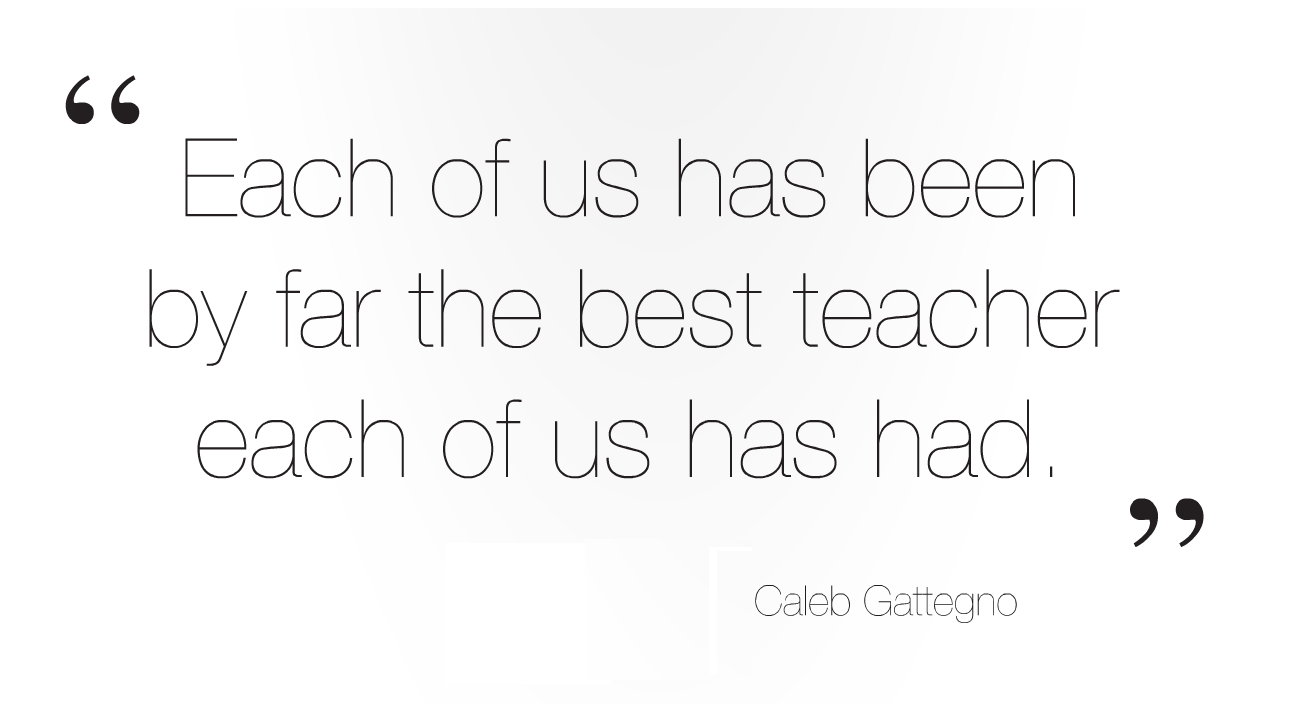
The #elemmathchat conversation is always at the slightly difficult hour of 3 am. here in France. I did set my alarm this Thursday, and did manage to wake up to turn it off, but that's as far as it went. So I caught up with it on Storify and favourited and commented a little. Here's one I liked.
and then it went like this:
 Gattegno was saying, the knowledge (K) doesn't get poured into the student (S) by the teacher (T); the teacher communicates what they want to communicate by pointing them towards something that will give them the knowledge directly.
This is especially true when the affordances of a manipulative and the way the student has been asked to explore it give the student instant feedback.
Although Gattegno cuts a slightly odd figure to us now, and his "lesson" is evidently a kind of performance that is at the end of a series of lessons, because he's at the root of how (and that!) we use Cuisenaire rods, we owe him a lot. This second clip is where things really start to get going:
(I wonder, how did Gattegno make that link between "one third of" and x 1/3? Also, how did he get the children comfortable with thirds? I find that's often puzzling for children.)
I feel that his diagram isn't quite right. I want to put conversation into it. Gattegno is talking with the students a lot. But, for me, it's especially student to student conversation - which is notably absent in this video, but needn't be for Cuisenaire rods to be used to give students access to the logic of maths. My diagram would look more like:
I love how Gattegno goes off from the rods into writing equations about 27. Again, this can be done with students making their own equations.
Caroline Ainsworth, following Madeleine Goutard's lead, gets students to write lots of equations about a number. You can see how this could follow on from some version of that 27 discussion:

This seems a really fruitful direction, that I'd like to make my own. I've headed off that way before, but there's a lot further to go.
And have I answered Mark's question? I'm not sure. But I was struck recently, how at Toulouse's "Nuit des Chercheurs", how even a University Professor, Arnaud Chéritat, and his students are using 3D printed models to understand something that's too illusive without something to handle and look at:
@MarkChubb3 Everyone should have a ladder of abstraction handy. https://t.co/9j0XlN5xMD
— Simon Gregg (@Simon_Gregg) October 23, 2015
and then it went like this:
@MarkChubb3 Can you give me a particular instance of that?
;-)
— Simon Gregg (@Simon_Gregg) October 23, 2015
and
@Simon_Gregg
Dividing fractions... How many understand what's going on here?
Some don't see need for concrete if Ss can get an answer
— Mark Chubb (@MarkChubb3) October 24, 2015
Tracy quoted this from Making Sense in her blog post recently:“In traditional systems of instruction, teachers are asked to provide feedback on students’ responses, to tell them whether or not they are right…this is almost always unnecessary and usually inappropriate. Mathematics is a unique subject because…correctness is not a matter of opinion; it is build into the logic and structure of the subject…There is no need for the teacher to have the final word on correctness. The final word is provided by the logic of the subject and the students’ explanations and justifications that are built on this logic” (Hiebert et al. 1997, 40).It's a bit like Gattegno had it in his picture I've shown before:

This is especially true when the affordances of a manipulative and the way the student has been asked to explore it give the student instant feedback.
 |
| 27 allows you to fit three nines exactly along next to it. They fit really neatly! |
(I wonder, how did Gattegno make that link between "one third of" and x 1/3? Also, how did he get the children comfortable with thirds? I find that's often puzzling for children.)
I feel that his diagram isn't quite right. I want to put conversation into it. Gattegno is talking with the students a lot. But, for me, it's especially student to student conversation - which is notably absent in this video, but needn't be for Cuisenaire rods to be used to give students access to the logic of maths. My diagram would look more like:
 |
| My elaboration of Gattegno's picture |
Caroline Ainsworth, following Madeleine Goutard's lead, gets students to write lots of equations about a number. You can see how this could follow on from some version of that 27 discussion:
And more Year 2 maths free writing that they are bringing in from home. @stocklandschool #YesUCan pic.twitter.com/HDvP6SLPUR
— stocklandmaths (@stocklandmaths) October 14, 2015
Here's a page of a child's writing from Goutard:
This seems a really fruitful direction, that I'd like to make my own. I've headed off that way before, but there's a lot further to go.
And have I answered Mark's question? I'm not sure. But I was struck recently, how at Toulouse's "Nuit des Chercheurs", how even a University Professor, Arnaud Chéritat, and his students are using 3D printed models to understand something that's too illusive without something to handle and look at:
& these are the models Arnaud Chéritat made to understand how to turn a sphere inside out! (https://t.co/havucDig4Z) pic.twitter.com/EpfSdioxjn
— Simon Gregg (@Simon_Gregg) September 26, 2015
____________________________________________________________________________
Illustrations added for my reply to Joe's comment below: |
| Illustration A: What can you say about this picture? |
 |
| Illustration B: What can you say about this picture? |