Showing posts with label learning. Show all posts

Sunday, 24 November 2024

things counter, original, spare, strange

As an IB school, "inquiring" is pretty much the first word that comes up as a statement of principles. But somehow, in mathematics especially, it doesn't usually end up in first place.

It's that old thing of teachers feeling they need to cover the material (in our case it's called the 'scope and sequence') and not knowing that inquiry will go much deeper and in fact cover more.

Teachers do of course ask students to discuss things before moving on, activating prior knowledge, sharing vocabulary, and bringing learnt-but-a-little-forgotten concepts back to the front of the mind.

But this time of discussion can also be one of the best places to find the starting points for student-initiated inquiry.

I was visiting a Grade 3 class (Year 4 in terms of the English system) a few weeks ago. The teacher was getting the students to talk about what they remembered from their investigations into 2D and 3D shapes so far. They had made 2D nets for 3D shapes.

One student, L, asked, 'What about 1D shapes... and 4D shapes?'

The teacher is very attentive and responsive and saw an opportunity here. 'We should write down that question.'

It's a question I love, and I suggested I come back the next morning and address it a little. The teacher welcomed that and so I did.


I started by writing L's question, and complementing her for taking something the class were learning about and going on another step with it. Then I asked what the students had to say about this. S said that a line was 1D. He also wondered what 1.5D might be (funnily enough, this is not a crazy question, as I learnt watching this 3Blue1Brown video a while back).

A said that a circle was 1D, and I agreed that the line part of the circle was. L said she thought that a point was either 0D or 1D, and the consensus was that 0D was correct. N said that he'd heard that 4D was a 3D thing that interacts with you.

I then did a bit of talking and showing. I said we could look at the cube and at how the number of points goes up as we go up dimensions, the ones we know about, going from a point to a line to a square to a cube as in the diagram below. I'd brought the straws and connectors along, and I used those to show this. Some of the students could see it was doubling, so we might expect a four dimensional version of the cube to have 16 points or vertices on it.

I said we only have 3 dimensions in our space, and went through what they were in that room.

I asked if they wanted to see a 2D or 3D picture of one. There was a definite desire to do that, and we looked at some representations of the tesseract (the 4D cube).

images from the Wikipedia Tesseract page

It is a kind of wow thing, I think you'll agree.

We talked about a few other things: touched very lightly on Einstein and spacetime. And then I had to go back to Moon Class. I left the straws and connectors and they tried to make their own versions of the tesseract. The teacher sent me some pictures later:


It wasn't an ideal lesson - there was too much talking from me.

But there were some very good aspects to it:
  1. The teacher was creating space for conversation where students thinking and questions could emerge. A lot of us are doing this. Some also get students using whiteboards so that the thinking isn't only verbal but diagrammatic and written too.
  2. The teacher documented some individual thinking that wasn't in the direction of the planned lesson, but 90° to it. Fewer of us are doing this. We tend to have a plan in mind that we're getting on with and moreover that time of sharing takes quite a lot of attention to orchestrate. There isn't a lot of headspace for things counter, original, spare, strange.
  3. The teacher thought some follow-up on the question was worth giving time to. Admittedly, things 4D isn't everyone's expertise, but that is one of the powers of documentation, of writing questions down in this case - it buys time - to talk to colleagues, to think, to google.
  4. My best moves in the event were asking the students for their answers to L's question, and bringing the straws along. Those were two things that put the ball in the court of the students themselves.
If there is one thing I think we need to move forward on as a team, it's probably number 2 in the list. We need to be documenting more, to be preserving more of what the students say and do for future discussion and exploration. 

Monday, 3 October 2022

The design cycle, sped up

(just four) began her time with us with a torrent of paintings. She’s now broadened out, and shows a lot of interest in arranging blocks.

On Tuesday she got some of the Unit Blocks out and began making little ‘houses’ - combinations of shapes that went together. She was making, knocking down, sweeping them to one side, and remaking anew, again and again. I sat down and tried to add to the houses, but she was mostly not happy with my additions and my adding them only seemed to speed up the sweeping away and remaking!

Finally, she had a house shape that pleased her.


I was struck anew by something about children’s play that this seemed to exemplify: the rapid movement through iterations, making, destroying, making…

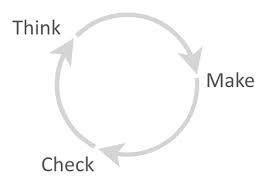
If the results weren’t right, pieces were adjusted, rearranged, added or subtracted, up to a point where, if the whole was unsatisfying it was swept to the side and the ground laid bare to build a new thing. It’s like the design cycle, but speeded up:

The checking and thinking is so fast, so much during the making, that it doesn’t stand out as a distinct stage, it’s all there in the making. The only other - brief - stage that is separate is the knocking down and sweeping blocks to the side.

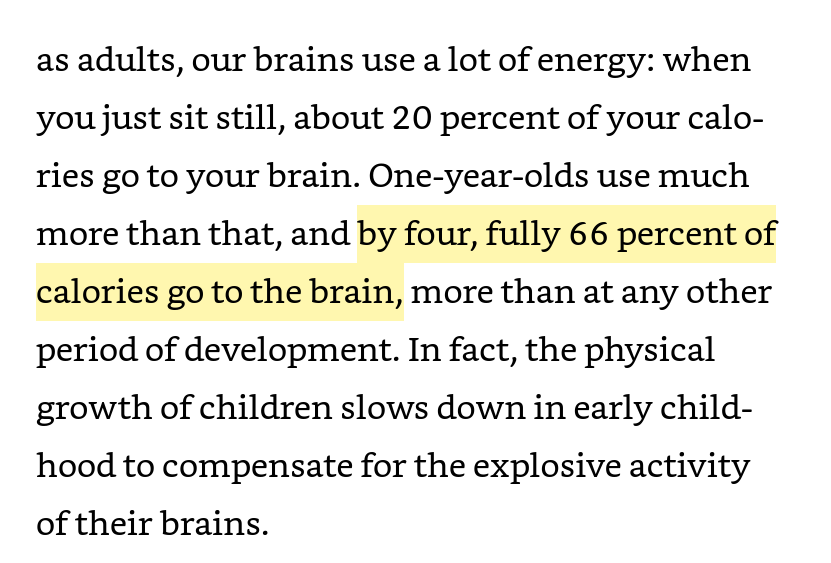
I’m thinking of this, from Alison Gopnick’s great book, The Gardener and the Carpenter: "by four, fully 66 percent of calories go to the brain". Children are thinking fast, making connections rapidly. And they’re doing a lot of the thinking with their hands. 


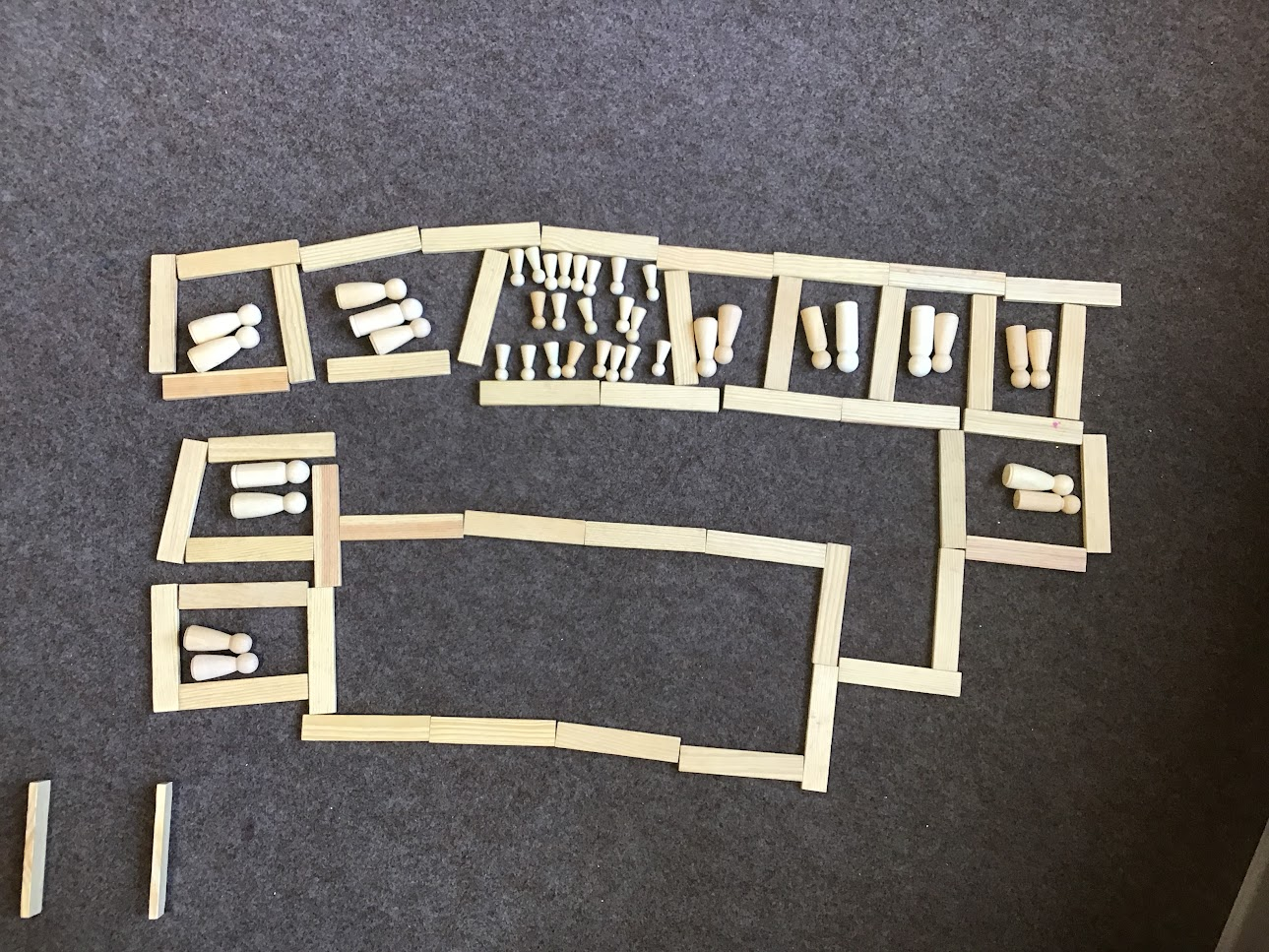
Again, on Friday, this time working with Kapla and little wooden people, A was creating and recreating, remodeling her house again and again  to better please her. 

After about twenty-five minutes, the finished house satisfied her. There were bedrooms for all the adults to sleep in, in groups that she found satisfying. The children appear to have some kind of dormitory thing going on:

This rapid-fire remodelling is maybe a kind of superpower of the four-year old. While 66% of their energy is going to the brain, they can move quickly between experiences, ‘breaking’ (or leaving) whatever doesn’t seem to work. 


Though there was a rapid movement in the making,  A stuck with the project from 9:52 to at least 10:16 - there’s a time stamp on the photos.


It strikes me that this is characteristic of young children, how they move from one activity to another quickly. Maybe it’s a quick evaluation: is this the optimal possibility now? Could I be getting more from doing something else? We adults might mistake this for an inability to concentrate, or some kind of hyperactivity. But it seems to be just the brain’s optimal learning path. There’s no need to leave a trail, to have a distinct and visible evaluation or planning stage. Both are integrated into the making. There’s no need to document the process. We teachers might see a reason to do this, but children tend to just move on quickly. A doesn’t even seem to care too much about the ‘end’ product being put away. 


I would propose that A is demonstrating all these IB PYP "attitudes to learning" below, all almost at the same time in the course of her selection and placement of the blocks and people, and the conversation she has as she does it. The separate elements are not visible as separate but they are all present as she places and replaces elements:

Skills

Subskills

What students do

Thinking skills


Critical thinking

Analysing

►Observe carefully.

►Find unique characteristics.

►Consider meaning taken from materials and events.

►Synthesize new understandings by seeing relationships and connections.


Evaluating

►Organize information

►Evaluate evidence.

►Test generalizations, strategies or ideas.


Forming decisions

►Revise understandings based on new information and evidence.

►Draw conclusions and generalizations.

►Apply rules, strategies and ideas from one context to another.

Creative thinking

Generating novel ideas

►Use discussion and play to generate new ideas and investigations.

►Make unexpected or unusual connections between objects and/or ideas.

    Practice some “visible thinking” routines (Ritchhart, Church and Morrison 2011).


Considering new perspectives

►Seek information.

►Consider alternative solutions, including those that might be unlikely or impossible, in play and other situations.

►Ask “what if” questions. Practise some “visible thinking” routines.


Monday, 20 December 2021

Building mathematics

 One of my students, A, has been with me for over a year now. He was just three years old when he started, and without much English. His favourite thing was to get the Playmobil cars out, fill them with people, and quietly act out stories with them on his own.

He did lots of other things too. Here he is in the playground, back then in September 2020, with two other students, making a house with the giant Polydron:

We've watched lots of Numberblocks (see my post on this), where numbers are represented by blocks.
I haven't asked anyone to do this - most of the things that happen in our pre-K (Early Years) classes are child-initiated and developed - but A has been spending a lot of time exploring numbers by building cuboids out of Polydron. While others were content to use our pre-existing interlocking cubes, A wanted to make the cubes himself from squares. He makes other things too, like this house with an interesting floor plan:
But here's 8 (called 'Octoblock' in Numberblocks), built by A from individual cubes:
There is a Numbrblocks episode called Terrible Twos, where 4 splits into two 2s who tickle the other numbers while they sleep which makes them split into ones. Here is A's version in magnetic Polydron, a 4 made of two 2s.
It even comes into his story writing, which is usually about T. rexes and triceratopses:
The building continues:
Recently he's developed an interest in writing. Here he is practicing writing the numbers:
Children also play with the Numicon and tell me equations. They've heard a lot of these on Numberblocks. Here's one from A:
What I really am pleased about is that all this learning is initiated by him (in a climate of appreciation and encouragement of course). It is very much his own and at his pace. I'm pleased that all the four year old students in my class have also found their own different ways to this, enjoying representing numbers and equations. A has also influenced younger students in the class too. T in particular is a real enthusiast for creating the same kind of Polydron 3D numberblocks.
As the students do, T told me some equations linked with what he was doing, and then told me a few more he knew:
I think it's from these landmarks that young students begin to build their number sense, so what he's doing seems just right to me.

Thursday, 24 September 2020

The Gardener and the Carpenter

I've just discovered the work of Alison Gopnik, and it's very interesting. These two paragraphs from a review of her book The Gardener and the Carpenter jumped out at me:

I

n 2011, a team of psychologists did an experiment with some preschool children. The scientists gave the children a toy made of many plastic tubes, each with a different function: one squeaked, one lit up, one made music and the final tube had a hidden mirror. With half the children, an experimenter came into the room and bumped – apparently accidentally – into the tube that squeaked. “Oops!” she said. With the other children, the scientist acted more deliberately, like a teacher. “Oh look at my neat toy! Let me show you how it works,” she said while purposely pressing the beeper. The children were then left alone to play with the toy.


In the “accidental” group, the children freely played with the toy in various random ways. Through experimenting, they discovered all the different functions of the tubes: the light, the music, the mirror. The other group, the children who had been deliberately taught how to use the toy by the teacher, played with it in a much more limited and repetitive way. They squeaked the beeper over and over again, never discovering all the other things the toy could do.

For us teachers, this is momentous. Just by the act of 'being a teacher', in the sense of demonstrating something, we can close something down.

Here's another similar experiment from a talk by Alison Gopnik. (I suggest you just watch to the end of the part about the Thingamibob experiment and variations, or maybe carry on a bit to listen to implications.)


Two things come out of this: the impressive causal reasoning of three and four year old children, and how the stance of the adult ('clueless' or knowledgeable) influences whether children bring their powers to bear on the subject.

I'm still trying to work out what this means exactly for us teachers, especially us teachers of young children, but teachers of all ages - and I'd be interested in your thoughts.

So - I haven't read the book yet - I think the distinction between the gardener and the carpenter, is that a gardener creates conditions for the shaping of the garden (the plants themselves will create the garden), whereas the carpenter does all the work on the wood, shaping it themselves.

This reminds me of Socrates, who said his mother was a midwife and his father was a sculptor, and that he aimed in his conversations to be more like the midwife, to help his conversation partners to bring to birth their own ideas.

There's this thing called Socratic Ignorance. Partly it seems to be a genuine understanding of the limits of our knowledge, partly a device for getting back to the 'clueless' way of operating in a conversation. For instance this, edited for brevity from the beginning of the Meno dialogue:

Meno: Can you tell me, Socrates, whether virtue is acquired by teaching or by practice; or if neither by teaching nor practice, then whether it comes to man by nature, or in what other way?

Socrates (edited to keep the quote short):  ...And I myself, Meno, confess with shame that I know literally nothing about virtue...

Meno: No, Indeed. But are you in earnest, Socrates, in saying that you do not know what virtue is? And am I to carry back this report of you to Thessaly?

Socrates: Not only that, my dear boy, but you may say further that I have never known of any one else who did, in my judgment.

So, lots to think about.

I recommend this TED talk by Alison Gopnik too:

Friday, 14 July 2017

Going Sideways

A problem with the metaphor of 'progress' in learning is that the 'journey' becomes roughly linear:
If that's extended to an individual lesson, students will be making 'progress' through the lesson. They won't all make as much 'progress' as each other.
Some of them have shot forwards, others are tarrying back nearer where they started.

And what to do with them then, in the next lesson? Put those three shoot-aheaders in a separate group? Ask them to hang around for a bit? Teach them and hope the tarriers will keep up?

This is a real challenge for us all, and I don't claim to have the answer. But I do recommend Going Sideways.
Take a detour, a road less travelled, follow a student's deviation, make room for the unfamiliar embodiment, for variation and investigation. After the number lines, try hopscotch.
Read a story about a hundred ants.
Look at a strange picture:
Solve an unusual problem.
Because maths isn't just forwards, it's sideways too. Maybe it's like this:
Or perhaps it's like this:

But whatever it's like, it's not in a straight line. So when the students go sideways,
make sure to show the ones on the left what the ones on the right did. And the ones on the right should see what the ones on the left did too.

Saturday, 17 September 2016

Nasrudin's Sermon

So, the five year olds in my K3 class made an amazing start creating whatever they wanted with Cuisenaire rods. Here's just some of the creations. In all the creativity there's a lot of implicit maths - ideas of equality and inequality, of arrays and rectangles, of sequences, of enclosing and aligning... And they're bouncing ideas off each other like crazy.


And now I've reached the point where I'm starting to ask for some very particular things. Make a "train" of pink and green rods:
This seems like a much narrower place. I'm directing the activity, I introduced a bit of arbitrary terminology - "train". What I fear is losing all the creativity. 

After free play in Gategno's book, comes trains. 
Trains take us to a lot of good things. But they're a little... one dimensional, after all the splendour of creation.

Perhaps if I was better at this, more sure-footed, I'd be confident to draw all this out from what has already been created. Certainly that's a kind of ideal. That the children are showing each other and learning from each other, and have the sense that they're doing so. 

There's a famous story about the wise fool Nasrudin that came to mind when I was wondering if I was rushing ahead too fast:
Nasrudin's Sermon 
One day the villagers thought they would play a joke on Nasrudin. As he was supposed to be a holy man of some kind, they went to him and asked him to preach a sermon in their mosque. He agreed.
When the day came, Nasrudin mounted the pulpit and spoke:
‘O people! Do you know what I am going to tell you?’
‘No, we do not know,’ they cried.
‘If you don't know, then you're not ready for what I have to tell you,’ said the Mulla. He got down and went home.
Not daunted, a deputation went to his house after a few days later and asked him to preach the following Friday, the day of prayer. Nasrudin agreed.
When the day came Nasrudin climbed the pulpit and started his sermon with the same question as before.
This time the congregation answered, in unison:
‘Yes, we know.’
‘In that case,’ said the Mulla, ‘there is no need for me to keep you longer. You may go.’ And he returned home.
Having been prevailed upon to preach for the third Friday in succession, he started his address as before:
‘Do you know or do you not?’
The congregation was ready: ‘Some of us do, and others do not.’
‘Excellent,’ said Nasrudin, ‘then let the ones who know tell the ones who don't.’
Adapted from Idries Shah's The Exploit's of the Incomparable Nasrudin 

Friday, 26 September 2014

Even more...

As I said, the UK government wants "harder sums". It wants rigour. Picture phalanxes of Roman centurions - very comfortable with their Roman numbers - marching rigorously up very straight roads, their shields held close together. Nothing gets past them.

My strategy for conquest is different. I've made a list of some of its components. Like Caesar's Gaul, so far it's got three parts:

First part:

I. Pick subjects that give power.

II. Find the subjects where kids can be creative,

III. Go into history and biography

Second part:

IV. Enthusiasm

V. Discussion

VI. Presentation

Third part:

VII. Climb up and down the ladder of abstraction 

- § - § - § - § - § - § - § - § - 

But now I'm going to add another part:

VIII. Estimation

I asked my friend Charlie who works as an engineer what maths he thought really needed to be taught at school. Estimation, he said, you need that all the time. And luckily it's become more accessible and more engaging than ever with Andrew Stadel's estimation180.com . I've used this with my Y4 class last year, and we're going to start again next week. What's so great about it, is that the kids are interested in the estimation and they like the challenge. They especially like it when there's a video "reveal" at the end.

I have this idea that if we like it, we'll start creating estimation challenges in the Year 4 classrooms, maybe begin an estimation blog, perhaps begin to find estimations to do at home too, photo or video.After that we get other classes to have a go.  Nothing too ambitious. First we take Manhattan, then we take Berlin.

My trial challenge was not a complete success, but it's helped me to get the measure of what's involved:


Anyway, here's Mr Stadel talking about what he does:


IX. The real world

To be honest, this is something I know I don't do enough of. Using real things, real places, things you might find at home. We've just been looking at reading scales, and for the first time we've got the classes to look for dials and scales at home this week. The range is amazing: weighing scales, a barometer, pressure gauges on pumps, a metronome, the rpm and the speedometer in car, a clock... and some things from an aeroplane: how level you are and speed. There is just so much to talk about.
In fact I can't stick to the real world. We did a bit of not-so-real world with our creation of meters to measure things not normally measured. The idea was to create a bit more attachment to our dial by investing more in it than usual.
It gave us a good chance to talk about what kind of units you might invent, as well as looking what the un-numbered marks represented. It also meant we could spend a bit more time on dials and still be doing fresh things.

X. Modelling!

This as Turtle Gunn Toms says in a comment on Graham Fletcher's excellent post on modelling, means taking a situation and mathematising it.

It's another thing I really don't do enough of. Probably none of us do enough of it! The ideal is a situation where you have a question, you put numbers to it, out comes some kind of answer.

It's a lot harder to find good examples for the primary / elementary classroom. I'd like to have a collection of this kind of mathematical modelling question.

Here's one I'm thinking of trying soon: I was talking to the kids: "Here I am, standing in the middle of the room..." and it occurred to me, "Where  exactly is the centre of the room? How would you work that out?" I said my thoughts out loud of course.

Not a very natural question perhaps, but I'd be interested to see how the class go about answering that. Some estimation first of all of course...

Sunday, 27 April 2014

Stealing ideas

This week, in maths lessons with my Year 4 class I've been using "stolen" ideas. At least three things that I got from somewhere else.

This kind of theft has a lot going for it, not least:
  • The stolen things doesn't get taken away; in fact they get multiplied;
  • It is so very easy to do now - no need to attend training, or snoop round classrooms - we have the Internet;
  • It means that ideas keep flowing, lessons stay fresh.
1.

The first of my thefts was Five Rectangles. This came from Gary Antonick's great Numberplay column in the New York Times. (A while back I got another great lesson from Gary's column, one that originally came from Steve Humble, Triangle Mysteries.)

Five Rectangles (aka "Sol Golomb’s Rectangle Puzzle") is basically very simple: create a set of five rectangles that have sides of length 1, 2, 3, 4, 5, 6, 7, 8, 9 and 10 units. I added Cuisenaire rods, which seemed the perfect vehicle for this - they mean you can handle this question, literally; they save time in trying out options; and they make the length x width = area nature of rectangles very obvious.


The arithmetic is just right - times tables up to 9 x 10. And the addition - five numbers adding up to a number between 100 and 200 is right too. And best of all, there are more intriguing questions - what are the maximum and minimum areas? - that take the children into unfamiliar territory, and call on their mathematical intuitions.

The original puzzle was for adults - but using a manipulative - the rods - means that it's well within the children's abilities to do some of it. It even adds new possibilities, which I hadn't foreseen, like splitting the rectangles up to make a square.

2.

The second lesson, followed on from our work on percentages perfectly.


We'd had had the computer generate a chart for us, using our data, but we needed more.

Children get to hear about a hundred percent, and know that it means "all of it". But they should experience other percentages without any confusing arithmetic coming in the way, and get to know the concept of a percentage first by examples (just as we understand "red" by examples of red things). And they should get to make pie charts without grappling with dividing by a total and multiplying by 360°. So I was really pleased when I saw this tweet:

Pie charts without the calculation! It was apparent to me that we could add a circle divided into a hundred divisions around the Smarties circle - and we would have percentages without calculation too! So that's what we did: Pie Charts and Percentages with Smarties.

pie charts made simple
Percentages made simple
Don't get me wrong: I think the calculation should come, that eventually children should learn how to do it. I just want them to get a feel for what it's all about first. And to not get bogged down or addled. A little struggling to get the Smarties into their circle is OK...

3.

Seeing that he obviously had stuff to nick, I put on my cat burglar suit and snuck into Mike Ollerton's website. There was no security at all, and there were all sorts of valuable goods that had been left there. More than I could fit into my sack in fact. The one I came away with was Being a Number.


I've printed up the exact same cards, and started using them. I know I'm going to get a lot of mileage out of them in terms of mathematical thinking.

+

So all in all, I've had a good cache this week. If you'd like to throw any of my stolen goods into your own sack, be my guest - I can recommend this life of crime!