Showing posts with label making sense. Show all posts

Tuesday, 28 January 2025

Making Numberblocks

We have two students in our pre-K classes, Y in Star Class and G in Moon Class, both five years old now, who are fanatical about fairly large Numberblocks numbers. "I love rectangles!" G exclaimed the other day!

I've blogged about this series before and I - along with all our students - think it's brilliant! There's a page I go to to access all the episodes. As my students are between three and five years old, we're leaning towards the small numbers.

At the start of the year G's parents told me he really loved the series, and moreover, knew the square numbers and 'Step Squad' numbers (Numberblocks-speak for triangle numbers). I waited, but he didn't seem to be showing it much in class. It was really in December that he discovered a fellow enthusiast in Y, that he started to talk about it.

Most of what happens in Star and Moon classes is voluntary - the students choose which play they engage in. We adults put out things that we think will interest and engage them, and we also have a couple of 'meetings' a day with our classes, but for most of the day the students choose from what's provided.

We've noticed that influence is a really important factor in what the students try out, and what they persist in. I wrote a blog post about this - 'Copycats'. So it's to be expected that it would be social factors that would really bring the enthusiasm out into the open.

At first they were asking to see pictures of Numberblocks numbers on the Internet. Then they were making them with Multilink cubes.

On the 19th December, G made these:

That's 24, seen as two twelves, 18, seen as two nines, and 27, seen as three nines.

On the same day, Y was telling Estelle a story to write down, all about Numberblocks.


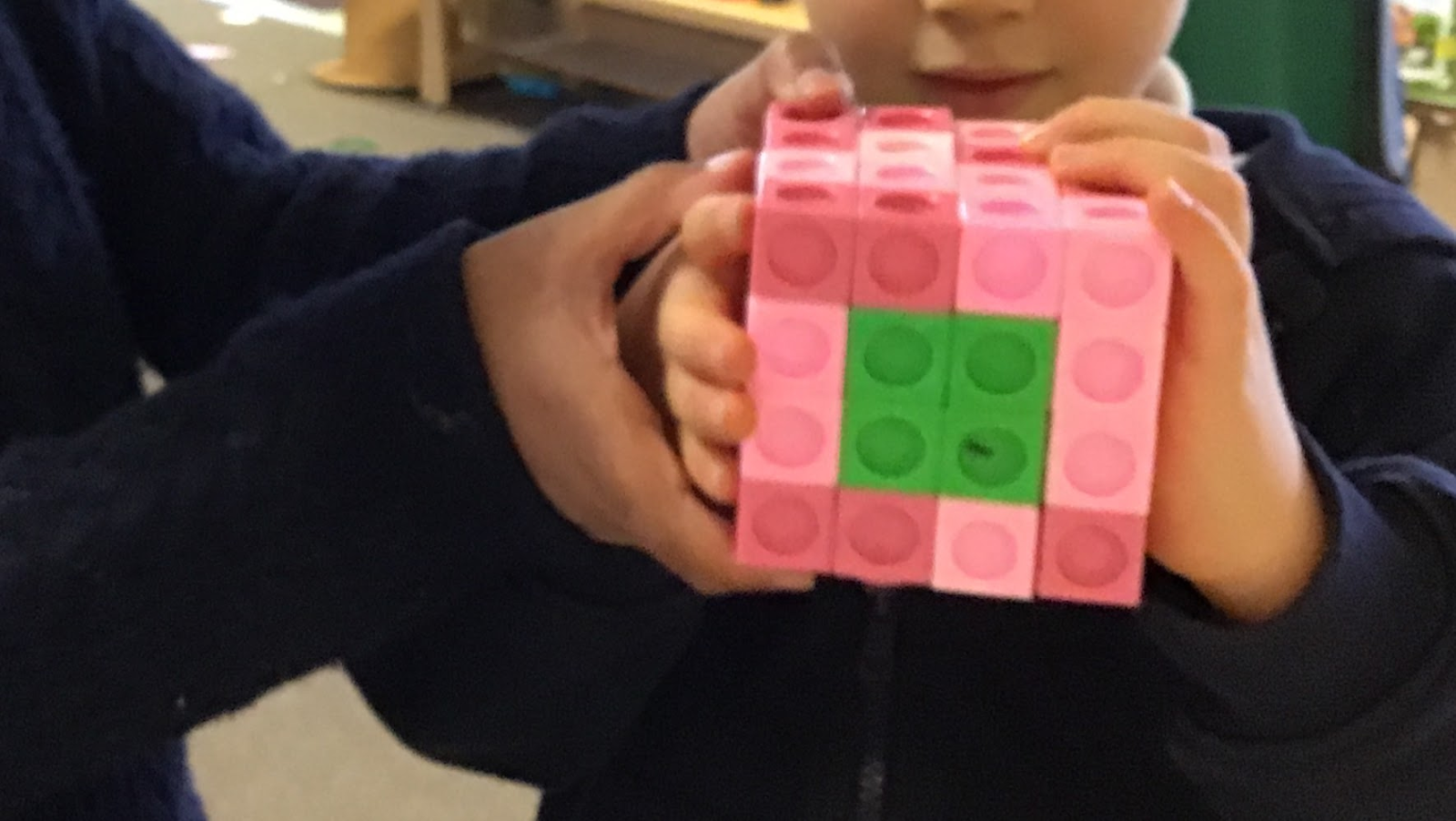
And also putting together 30, 40 and 48:


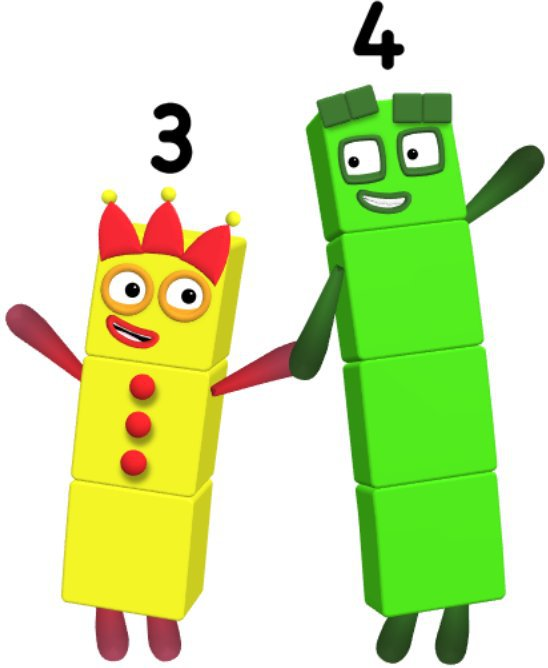
These are regular Numberblocks colours. 30 is yellow because 3 is yellow, 40 is green because four is green. And eight is pink.
There followed a flurry of number-building, which continued in the new year.
We allowed them to display their creations.
There's always a mathematical structure in these. For instance, here's 64 as a cube:
There's the sixty, which should be purple really, but we don't have many purple cubes, and the four, which is green.

A new kind of story began:

We act out lots of our stories - and this one was a challenge - but we did it! A whole series of similar 'times table' stories followed from both students.

A concern though. These students are outliers. Would there be any way for the 'copycat' thing to happen? These two were so deep into their number inquiry - would there be a way for the others to access what they were doing? I was giving a lot of time to them- a pleasure for me - but I wanted to be giving that time to more students.

Luckily - the answer seems to be... yes.

W, who is only telling brief stories, told me this:
Ar., one of our three-year olds, told me this one:

G and Y were pressing on... with 125, as a cube. You can see it's structure here:
and 49, as a square:

One way to spread the goodness was to put out the Unifix cube stairs. They seem to always get filled with the Numberblocks colours.

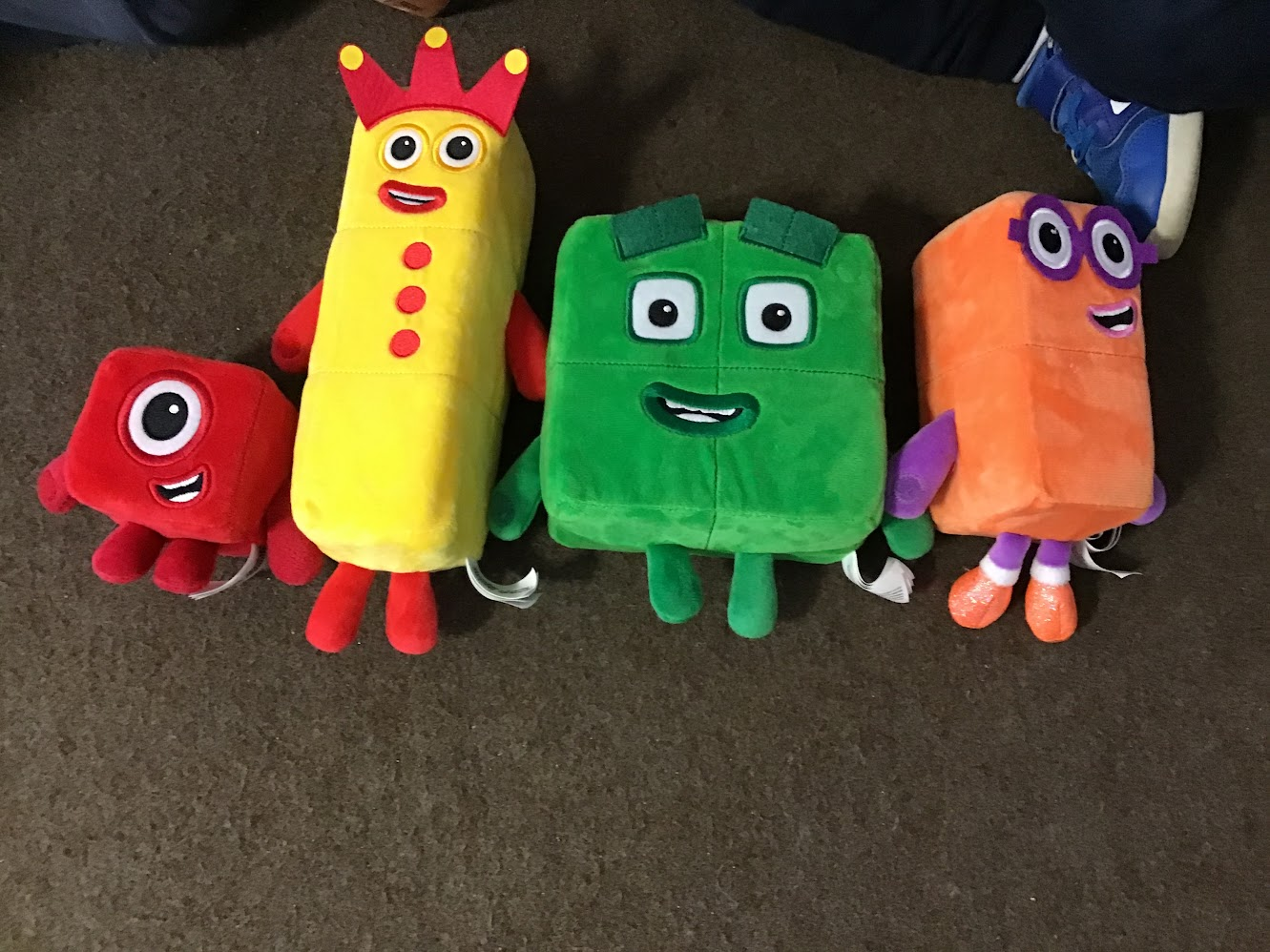
Our furry versions help too!

Then we hit gold. I put out squared paper and black pens. Somehow it was a lot easier to draw them than make them.

Al. drew this one:

Students were enjoying just drawing the grids - five or six new ones joined in, some of them just enjoying reproducing the grid:
An. wrote this story:

We scanned the drawings and let the students colour in digitally. And now there seems to be momentum building, with lots of them engaging in some way. 


W. drew this one - I helped him start off as he's done hardly any drawing this year:
An. did these:
K was very pleased with this. Though he needed me to tell him the size of the rectangles, it was G and Y who advised on the colouring:

I'm excited about the contagion and I'm hopeful that we'll find more ways to build bridges to allow the student-to-student influence that happens in our classes to do its thing.

I'll keep you posted.

Thursday, 10 December 2015

Making sense

I mentioned before this question about the age of the teacher:
Last year all 30 children in my Year 4 (Gr 3) class gave me a numerical answer to it.

This response seems so amazing to me that I was determined to do it again this year.

But first of all, yesterday, we watched the famous Asch conformity experiment:


It's now a classic psychology experiment and I was interested in what the class would make of it.
The experiment is so simple, that children this age can appreciate it, and the design really appealed to the class. We talked about what the results might mean

We talked about what might motivate people to just say what everyone else is saying rather than what they could plainly see. Most people thought they wouldn't do the same thing in that situation.

We talked more, and discussed how sometimes you really need to just go along with what other people are saying, even if you don't want to. Like when you want to play a game together at break time. You don't always get to play the game the others want to. But you want to play together.

We didn't really get to a conclusion, and I didn't add too much to what the class said. I would prefer the students had the chance to ponder this themselves and think their own thoughts about it.

So today I asked about the age of the teacher. I said, think about the question; if you want to, write something down. And... almost everyone wrote "30"!

Here they are:

Afterwards, I told them that I didn't think what they'd written was reasonable. They hadn't got the information to write a number down. Why should there be a link between the number of tables and chairs and the age of the teacher?

While the children had been answering on their whiteboards I'd overheard J saying, "But it's not true", before he wrote down 30, so I asked him now what he'd meant by that. He said he hadn't thought the question made sense. "Why did you write 30 then?" I asked. "Because I saw everyone else doing it and thought I should write something." Quite a few people sat up at this. There was some laughter of recognition. M said immediately, "It's just like that experiment with the lines."

I asked if others had thought like J who had thought that the question didn't give them enough information to have an answer. About six put their hand up. One said they didn't want to leave their whiteboard empty, and subtraction and division gave numbers that were small, and multiplication gave an answer that was too big.

As before, I told them that most people answer like this when they're given this kind of question, even older children. As a debrief, I showed them Robert Kaplinksy's video, How Old is the Shepherd?
They liked this, and I think it made them feel a bit better.

What do you think? Is there a place for this kind of mini-lesson?

Sunday, 28 December 2014

Intuition and slow thinking

This post is going to be more questions than answers...

Some things have been going through my head. There's Kassia's post, Is There Room For Math That Isn't Hard? Also, a conversation on Twitter, one strand in a bigger conversation about intuition in maths learning. Things can get a bit abstract when you're down to 140 characters including names, but there were a lot of great points. Here's one definition of intuition that Kristin posted that I liked:
"your insights and intuitions as a native speaker..."
Somehow, it links for me too with a moment in our maths classes in Year 4 this term. I'd read a really interesting post, Making Sense, on Tracy's blog. I had all the Year 4s and I showed them this question:
I asked them to write their thoughts on their whiteboards. All of them, all of them, gave me a numerical answer! That really surprised me. I thought lots would, but all? I showed the classes the video on Tracy's blog afterwards, and very briefly talked about how some questions don't have answers.

Somehow, these things link, in my mind at least, because we need a solid base of intuitions about maths - partly what we call "number sense" - that helps us to deal with both meaningful and meaningless questions, and to tell the difference!

I also reached down Guy Claxton's brilliant book Hare Brain, Tortoise Mind from the bookshelf.

Claxton says there are three processing speeds in the brain. The fastest, faster than thinking, is the kind of response we have when we skid on ice and just do the right thing. It's the sort of processing a concert pianist or an Olympic fencer has to do. Then there's thinking itself, deliberation, which he calls d-mode. But "below this, there is another mental register that proceeds more slowly still. It is often less purposeful and clear-cut, more playful, leisurely or dreamy."

It maybe helps to look at deliberation, the familiar kind of thinking, first. Claxton lists some of its features:

D-mode
1. is much more interested in finding answers and solutions than in examining the questions.
2. treats perception as unproblematic.
3. sees conscious articulate understanding as the essential basis for action, and thought as the essential problem-solving tool.
4. values explanation over observation
5. likes explanations and plans that are 'reasonable' and justifiable, rather than intuitive.
6. seeks and prefers clarity, and neither likes nor values confusion.
7. operates with a sense of urgency and impatience.
8. is purposeful and effortful rather than playful.
9. is precise.
10. relies on language that appears to be literal and explicit
11. works with concepts and generalisations
12. must operate at the rates at which language can be received, produced, and processed.
13. works well when tackling problems which can be treated as an assemblage of nameable parts.
So, d-mode is how we operate in maths lessons. You could even see mathematics as the place in which it shines most brilliantly.

But what of the slower thinking?

There is evidently a place for it. Here's Henri Poincaré:
"Most striking at first is this appearance of sudden illumination, a manifest sign of long, unconscious prior work. The role of this unconscious work in mathematical invention appears to me incontestable, and traces of it would be found in other cases where it is less evident. Often when one works at a hard question, nothing good is accomplished at the first attack. Then one takes a rest, longer or shorter, and sits down anew to the work. During the first half-hour, as before, nothing is found, and then all of a sudden the decisive idea presents itself to the mind. It might be said that the conscious work has been more fruitful because it has been interrupted and the rest has given back to the mind its force and freshness."
(Claxton also gives lots of experimental results from cognitive psychology that demonstrate the effect of slow thinking. I'm glad he does this because words like intuition can sound unscientific, which they're evidently not.)

How to descend from this abstractness then? Is there a place for encouraging slow thinking and intuition in the primary classroom?

A few tentative answers. One: when you ask children what they notice, the pace slows down. There's time for a bit of pondering. Developing this as a regular part of lessons, and the respectful listening and responding that goes with it, allows half-formed and ill-expressed ideas space to breathe and develop.
Two: games. I got the classes playing Daniel Finkel's Prime Climb three times this term. There was no "teaching", apart from, briefly, how to play the game. But I feel that time when students aren't thinking, "I must learn this," is precious. Their hare brain's can be off duty. The games weren't physically slow. Lots of the kids were standing up! But... I hadn't "taught" anything. Slow in that way.

Maybe there's not time for slow thinking in your class. I understand. There's more pressure than ever to pack the learning in, to get the results. And we know ultimately, results will lead to jobs...

So, is there time to slow down?
Is it worth it?
If there is, and it is, what are good ways to do it?
Does it link with number sense?
Does it link with intuition?
Does this help with my meaningless number question?

Do you have any answers? Or more questions?

UPDATE - July 2015
I was really pleased when Gracia, towards the end of the year, came up with this question in class:
She knew it linked back to that "how old is the shepherd?" question we'd looked at before. Still, some people were not getting it.  But some were now. As Gracia put it, all that information distracts you; it's like a magic show.

I recently watched Jordan Ellenberg talking about this kind of thing in another guise. I liked what he said:
Also, in The Joy of X by Steven Strogatz:
Other classic word problems are expressly designed to trick their victims by misdirection, like a magician’s sleight of hand. The phrasing of the question sets a trap. If you answer by instinct, you’ll probably fall for it.
Try this one. Suppose three men can paint three fences in three hours. How long would it take one man to paint one fence?
It’s tempting to blurt out “one hour.” The words themselves nudge you that way. The drumbeat in the first sentence — three men, three fences, three hours — catches your attention by establishing a rhythm, so when the next sentence repeats the pattern with one man, one fence, hours, it’s hard to resist filling in the blank with “one.” The parallel construction suggests an answer that’s linguistically right but mathematically wrong.
The correct answer is three hours.
If you visualize the problem — mentally picture three men painting three fences and all finishing after three hours, just as the problem states — the right answer becomes clear. For all three fences to be done after three hours, each man must have spent three hours on his.
The undistracted reasoning that this problem requires is one of the most valuable things about word problems. They force us to pause and think, often in unfamiliar ways. They give us practice in being mindful.