Showing posts with label fractiontalk. Show all posts

Thursday, 31 March 2016

Claim Challenge Convince

The last two posts have been about discussion that's come up in class about the fraction talk squares that two students, Beatriz and Maria, made.
They both have some interesting triangles, where the students are really not sure of the fraction. It turned out even better than I hoped because one of the students made a claim about this:
The claim went up on the Mathematical Claims Board, and we returned to it twice. (I've blogged this on the class blog too.)

I asked on Twitter:

And got some helpful replies, like this one from Daniel Scher:

Some people referred me to the area = 1/2 height x base rule, but this is something my class doesn't know and don't need to know yet. (It seems to me further on than the thing we're trying to prove.)

John Golden suggested on Twitter that we see how you can get same-area triangles (if you start with the same "base"):


We also had a look at this:


This convinced a lot of the students that Maryam's claim was true.

But Miguel was still not convinced. He said:
"Technology isn't perfect. Is that really a proof?"
Yes, he really did say that! Christmas came early to 4G.

Dan Finkel suggested on Twitter that we change our triangle into a parallelogram and it will make it easier to see the truth:


We had a really good discussion about this, and quite a few students tried to persuade Miguel. There were a number of really good arguments to show how the two parts of the triangle in fact have equal areas. Hannah, for instance, suggested further splitting the pink parallelogram and the green parallelogram with their other diagonals. A lot of people thought this helped to see it.

After this, I asked the students to write about what had happened with this claim, to write what they thought about it all. Mostly great results:


Tuesday, 29 March 2016

Looking at Beatriz's Fraction Talk Square

So, we made some fraction talk squares.

I thought I'd document today's fraction talk lesson in a bit more detail, as we did a longer, 45-minute lesson on this rather than our usual ten minutes.

We started off working with a partner, looking at Beatriz's design:

One pair was measuring.
Some pairs made a little triangle


I circulated asking for explanations, and chipping in here and there. For instance:


Then we came together and shared what we'd decided:


We were divided in our opinion about whether the top right triangles were the same fraction or not (this was what I was hoping for), and so I moved on to Maria's square. This time, straightforward for most of the square, but what about those two on the left? Opinion was even more divided.
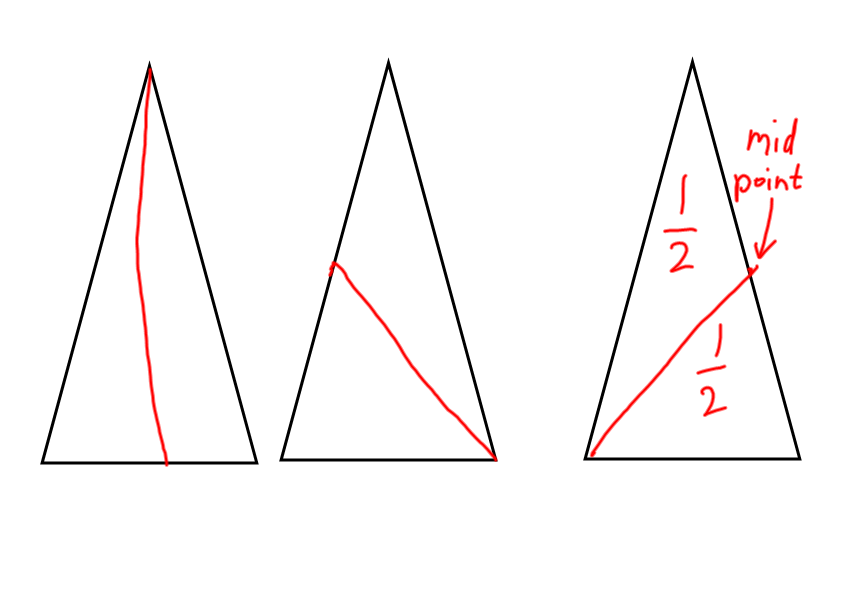
Then Maryam made her claim: "As long as it's the midpoint, it doesn't matter how you split the triangle; it will always be half." Yay! That will go on the claims board, and it's even more what I was hoping might happen!
 To help people consider her claim, I drew this on the whiteboard:
Some students said it wasn't clear because of my drawing. OK then, I said, how about I draw it on Geogebra? 

I used the midpoint tool. Maryam was still persuaded the two half-triangles were the same.

This time most people thought they were different. I said perhaps we'd need to come back to this. K. said that we needed to call Albert Einstein back from the grave to tell us. I was doubtful about both the possibility and necessity of that. 

I was planning for them tomorrow to have a look at this image, made on an online geoboard, looking generally at all the fractions, and later focusing on the yellow triangle:
But, now Maryam has framed her claim differently to how I had, perhaps this diagram would be a better one to anatomise:
I think maybe we can see that whichever way we cut up the yellow triangle, we cut it in half.

Watch this space...


Friday, 25 March 2016

Make a Fraction Talk Square

Nat Banting got me working out how to screencast with the Smartboard (and spotlit it too). The sound's still not good, but I'm hoping I'll work that out.

One of my first recordings was this, during a fraction talk.

I was glad I followed up Beatriz's question and we made them with Geogebra:
It was a great way into Geogebra apart from anything else - simply using Midpoint and Segment tools (Click on the tools second and third from the left.)

We only used the two tools and yet the students had a lot of freedom - they produced some interesting squares. We talked about two of them, that involved halving in particular.
The other two involve an interesting feature of triangles.

I'm wondering if someone will say that the triangles on the left of Maria's square are the same area? Or the small ones on the top right of Beatriz's? And where do we go from there?

Code to embed the Geogebra app:

<iframe height="556px" scrolling="no" src="https://www.geogebra.org/material/iframe/id/WUtYR9Mf/width/1007/height/556/border/888888/rc/false/ai/false/sdz/true/smb/false/stb/true/stbh/true/ld/false/sri/true/at/auto" style="border: 0px;" width="1007px"> </iframe>