Showing posts with label pedagogy. Show all posts

Tuesday, 28 January 2025

Making Numberblocks

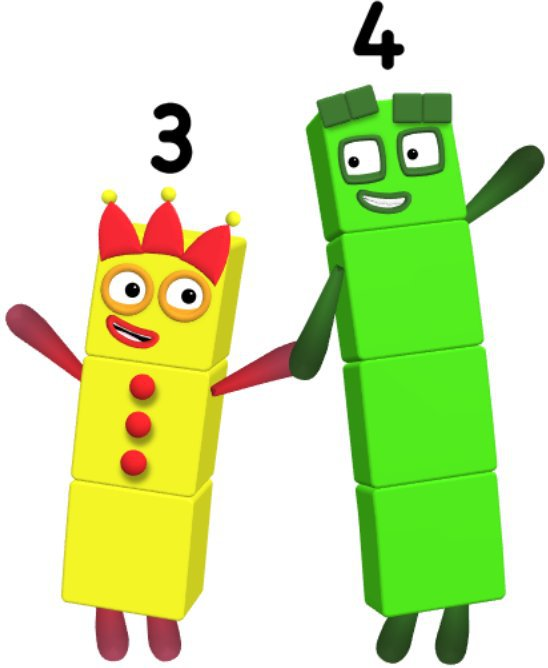
We have two students in our pre-K classes, Y in Star Class and G in Moon Class, both five years old now, who are fanatical about fairly large Numberblocks numbers. "I love rectangles!" G exclaimed the other day!

I've blogged about this series before and I - along with all our students - think it's brilliant! There's a page I go to to access all the episodes. As my students are between three and five years old, we're leaning towards the small numbers.

At the start of the year G's parents told me he really loved the series, and moreover, knew the square numbers and 'Step Squad' numbers (Numberblocks-speak for triangle numbers). I waited, but he didn't seem to be showing it much in class. It was really in December that he discovered a fellow enthusiast in Y, that he started to talk about it.

Most of what happens in Star and Moon classes is voluntary - the students choose which play they engage in. We adults put out things that we think will interest and engage them, and we also have a couple of 'meetings' a day with our classes, but for most of the day the students choose from what's provided.

We've noticed that influence is a really important factor in what the students try out, and what they persist in. I wrote a blog post about this - 'Copycats'. So it's to be expected that it would be social factors that would really bring the enthusiasm out into the open.

At first they were asking to see pictures of Numberblocks numbers on the Internet. Then they were making them with Multilink cubes.

On the 19th December, G made these:

That's 24, seen as two twelves, 18, seen as two nines, and 27, seen as three nines.

On the same day, Y was telling Estelle a story to write down, all about Numberblocks.


And also putting together 30, 40 and 48:


These are regular Numberblocks colours. 30 is yellow because 3 is yellow, 40 is green because four is green. And eight is pink.
There followed a flurry of number-building, which continued in the new year.
We allowed them to display their creations.
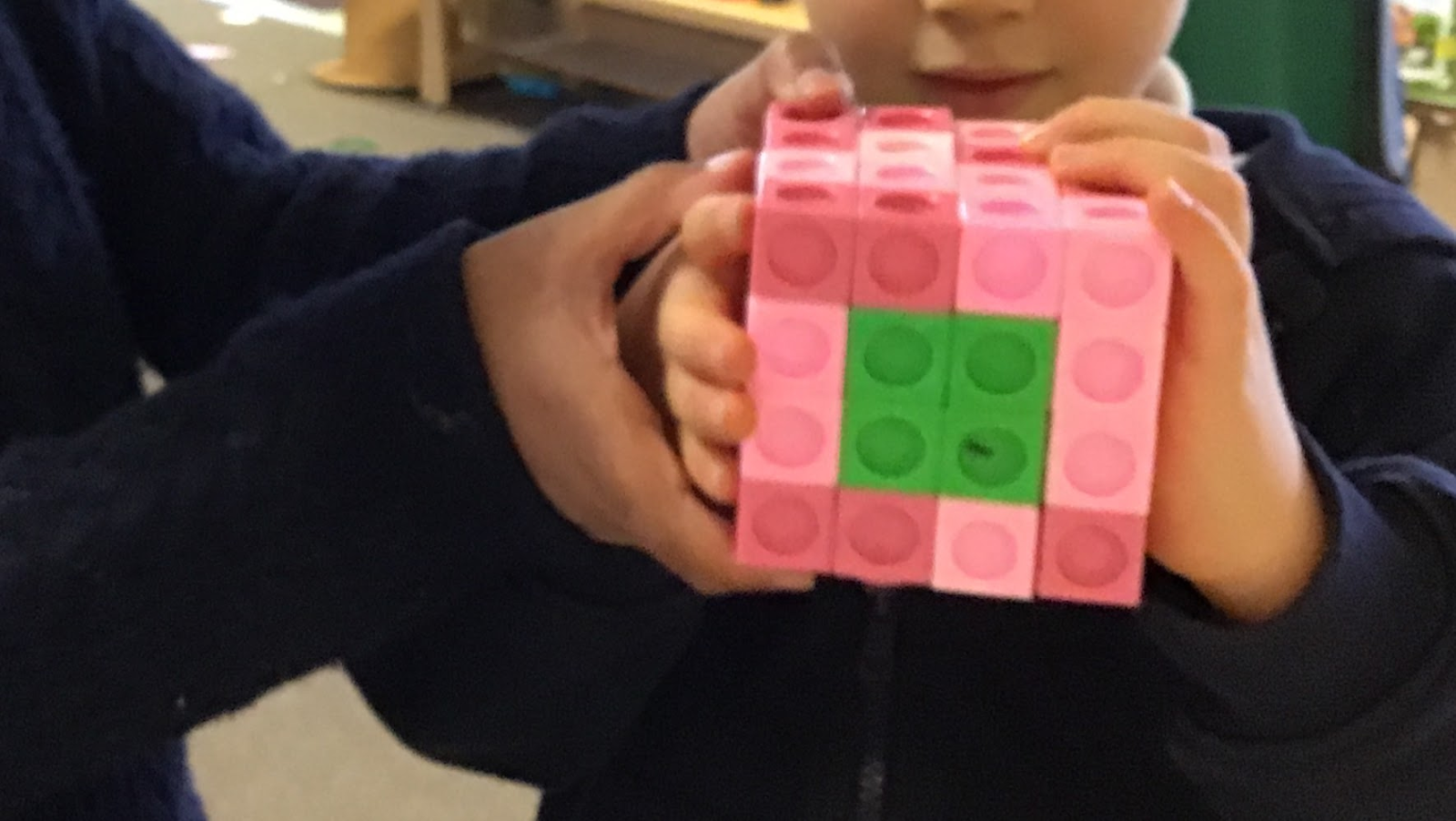
There's always a mathematical structure in these. For instance, here's 64 as a cube:
There's the sixty, which should be purple really, but we don't have many purple cubes, and the four, which is green.

A new kind of story began:

We act out lots of our stories - and this one was a challenge - but we did it! A whole series of similar 'times table' stories followed from both students.

A concern though. These students are outliers. Would there be any way for the 'copycat' thing to happen? These two were so deep into their number inquiry - would there be a way for the others to access what they were doing? I was giving a lot of time to them- a pleasure for me - but I wanted to be giving that time to more students.

Luckily - the answer seems to be... yes.

W, who is only telling brief stories, told me this:
Ar., one of our three-year olds, told me this one:

G and Y were pressing on... with 125, as a cube. You can see it's structure here:
and 49, as a square:

One way to spread the goodness was to put out the Unifix cube stairs. They seem to always get filled with the Numberblocks colours.

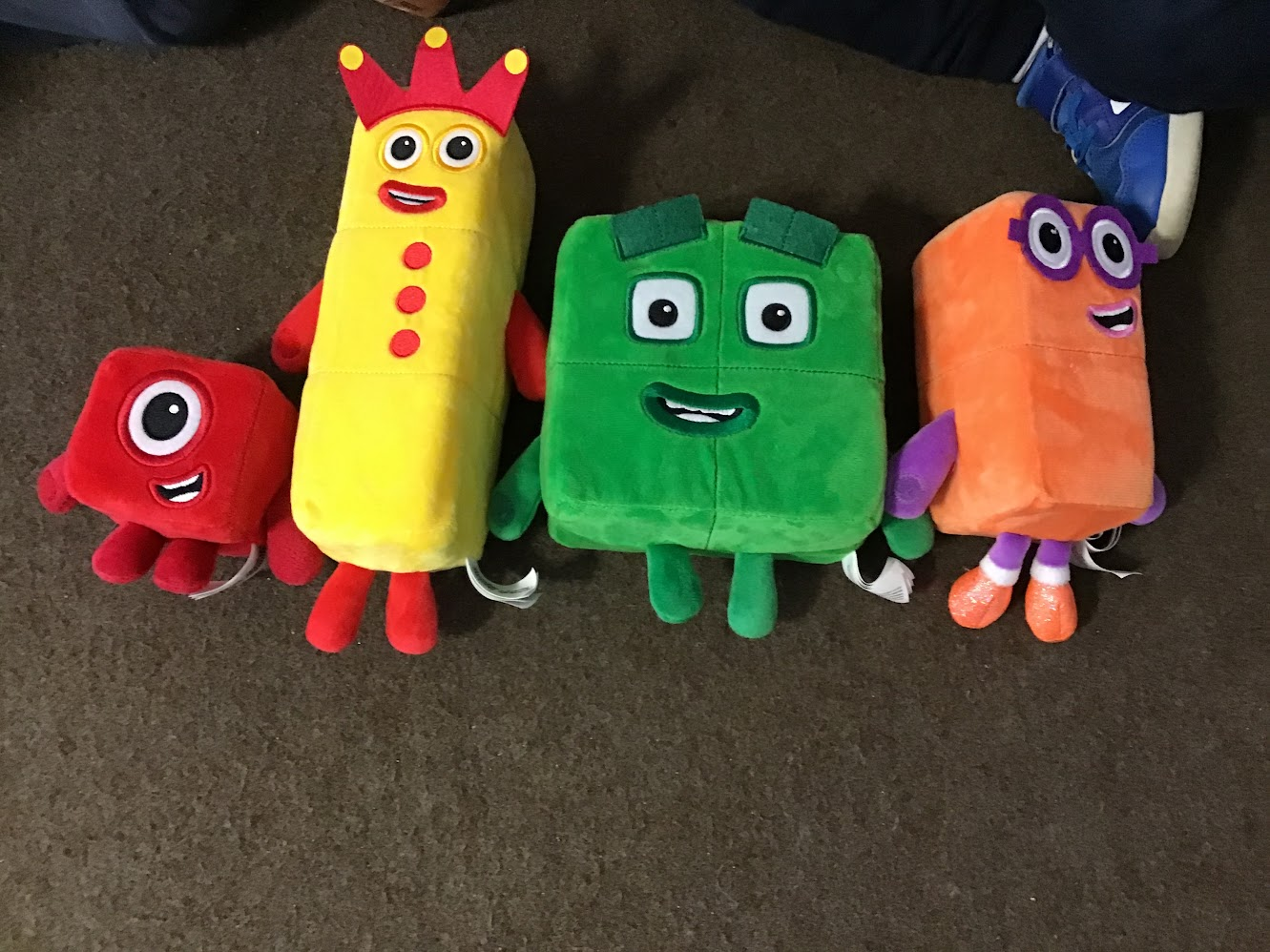
Our furry versions help too!

Then we hit gold. I put out squared paper and black pens. Somehow it was a lot easier to draw them than make them.

Al. drew this one:

Students were enjoying just drawing the grids - five or six new ones joined in, some of them just enjoying reproducing the grid:
An. wrote this story:

We scanned the drawings and let the students colour in digitally. And now there seems to be momentum building, with lots of them engaging in some way. 


W. drew this one - I helped him start off as he's done hardly any drawing this year:
An. did these:
K was very pleased with this. Though he needed me to tell him the size of the rectangles, it was G and Y who advised on the colouring:

I'm excited about the contagion and I'm hopeful that we'll find more ways to build bridges to allow the student-to-student influence that happens in our classes to do its thing.

I'll keep you posted.

Sunday, 24 November 2024

things counter, original, spare, strange

As an IB school, "inquiring" is pretty much the first word that comes up as a statement of principles. But somehow, in mathematics especially, it doesn't usually end up in first place.

It's that old thing of teachers feeling they need to cover the material (in our case it's called the 'scope and sequence') and not knowing that inquiry will go much deeper and in fact cover more.

Teachers do of course ask students to discuss things before moving on, activating prior knowledge, sharing vocabulary, and bringing learnt-but-a-little-forgotten concepts back to the front of the mind.

But this time of discussion can also be one of the best places to find the starting points for student-initiated inquiry.

I was visiting a Grade 3 class (Year 4 in terms of the English system) a few weeks ago. The teacher was getting the students to talk about what they remembered from their investigations into 2D and 3D shapes so far. They had made 2D nets for 3D shapes.

One student, L, asked, 'What about 1D shapes... and 4D shapes?'

The teacher is very attentive and responsive and saw an opportunity here. 'We should write down that question.'

It's a question I love, and I suggested I come back the next morning and address it a little. The teacher welcomed that and so I did.


I started by writing L's question, and complementing her for taking something the class were learning about and going on another step with it. Then I asked what the students had to say about this. S said that a line was 1D. He also wondered what 1.5D might be (funnily enough, this is not a crazy question, as I learnt watching this 3Blue1Brown video a while back).

A said that a circle was 1D, and I agreed that the line part of the circle was. L said she thought that a point was either 0D or 1D, and the consensus was that 0D was correct. N said that he'd heard that 4D was a 3D thing that interacts with you.

I then did a bit of talking and showing. I said we could look at the cube and at how the number of points goes up as we go up dimensions, the ones we know about, going from a point to a line to a square to a cube as in the diagram below. I'd brought the straws and connectors along, and I used those to show this. Some of the students could see it was doubling, so we might expect a four dimensional version of the cube to have 16 points or vertices on it.

I said we only have 3 dimensions in our space, and went through what they were in that room.

I asked if they wanted to see a 2D or 3D picture of one. There was a definite desire to do that, and we looked at some representations of the tesseract (the 4D cube).

images from the Wikipedia Tesseract page

It is a kind of wow thing, I think you'll agree.

We talked about a few other things: touched very lightly on Einstein and spacetime. And then I had to go back to Moon Class. I left the straws and connectors and they tried to make their own versions of the tesseract. The teacher sent me some pictures later:


It wasn't an ideal lesson - there was too much talking from me.

But there were some very good aspects to it:
  1. The teacher was creating space for conversation where students thinking and questions could emerge. A lot of us are doing this. Some also get students using whiteboards so that the thinking isn't only verbal but diagrammatic and written too.
  2. The teacher documented some individual thinking that wasn't in the direction of the planned lesson, but 90° to it. Fewer of us are doing this. We tend to have a plan in mind that we're getting on with and moreover that time of sharing takes quite a lot of attention to orchestrate. There isn't a lot of headspace for things counter, original, spare, strange.
  3. The teacher thought some follow-up on the question was worth giving time to. Admittedly, things 4D isn't everyone's expertise, but that is one of the powers of documentation, of writing questions down in this case - it buys time - to talk to colleagues, to think, to google.
  4. My best moves in the event were asking the students for their answers to L's question, and bringing the straws along. Those were two things that put the ball in the court of the students themselves.
If there is one thing I think we need to move forward on as a team, it's probably number 2 in the list. We need to be documenting more, to be preserving more of what the students say and do for future discussion and exploration. 

Wednesday, 28 December 2022

Folding, cutting, sticking, drawing

I want to write a little about one of the hubs of the classroom.

It's what we call the writing table or drawing table. Which is maybe not the right name for it. A lot more happens than writing and drawing. It could perhaps be called the paper table. It's got a lot of stationery on it. Bits of paper of various sizes, glues, scissors. A lot of cutting, gluing, sticking, folding, stamping and printing happens. A lot of colouring in too. But, these names and simple descriptions aren't really adequate.

It’s 'continuous provision', as we call it: it’s always there, and used every day. I imagine that it extends beyond school too: children often have stationery at home.

Most early years classes have got something like this table. Certainly all four of our pre-K and Kindergarten classes have. This is what continuous provision is all about: a place where children can return again and again and make something, trying out new ideas, combining things they’ve done before, learning from each other.

Since they came to the school when they were three, R and K have been doing this. They're not the only ones, but let's focus on them for now. They're four years old; they've been in Moon class for 15 months. R at first stood out as leader of the duo, always inventive, always relishing what she does. But K seems to be inspired by her to be similarly creative, making things that are distinctive to her, having her own strengths and emphases.

An example, back in September: R's envelope-picture:

What kind of mathematics are present in creating this? An awareness of bringing the corners into the middle of the paper to reorient the square and create triangular flaps. A lot of spatial thinking. An example might be the awareness that when you fold the paper over once, the back of the folded paper faces the same way as the front.  She is probably aware that the orientation of the square changes too: first it was in a 'diamond' orientation, now it's in the conventional orientation. She'll be aware that the small square is made up of four triangles. And that there are diagonal lines across the square that meet in the centre. She's aware that some things can be undone, or almost undone. Pencil can be rubbed out. Cuts can be taped together again. And some things can't be undone. The felt pen drawing can't be rubbed out very easily.

At the same time, K was doing some folding too:

These paper explorations contrast with art activities that use specifically 'art' materials, painting in particular. There seems to be more of a tinkering feel, more mixing. Take R here, where she’s decided to draw round the scissors, drawn and colored in a pill shape, written a little, filled a rectangle…

There's a really strong social element in this. There was a group of girls in Star Class two years ago who all tuned into each other with their drawing and colouring, got more and more confident in that, and continued it into Kindergarten.

There’s also the sense of self-efficacy, of choosing a project, seeing it through to completion, working alongside others and learning from each other. There’s a kind of joy in the workshop ambience, in having control and making together and separately.

Here's some more, this time involving cut-outs:
With this must come some sense of how when you fold and cut, the hole you achieve is not like the cut you made. And a developing understanding of the relationship between the two.

There can be folded-and-cut shapes inside other folded-and-cut shapes:
The smaller shape suggested a watermelon to the girls. It's rare for these creations to be completely abstract; they usually represent something. This is a general feature of a lot of play - mathematics is mixed with creation is mixed with representation is mixed with narrative is mixed is mixed with language is mixed with sociability...

Another day, a butterfly:
^
Another day, a bird:
Another day, flowers composed of four punched hearts rotated:
What is the role of the adult here? Obviously, we keep the table stocked, and help the students to keep it tidy and organised. In the moment, we chat if it doesn't interrupt the flow of the play and conversation. We appreciate what the students are doing, how they're thinking and experimenting, again in a way that doesn't distract from the flow. We document and share with parents on Seesaw, and often with the class in our meeting times. Sometimes we play alongside too; this usually doesn't lead to much in itself, but allows us to be in the workshop too.

This time I started playing with R's leftovers (I'd asked if that was OK). I started making little 'windows' with the heart holes. R quite liked what I was doing this time, and together we made a picture, incorporating a bear on a trampoline, and also some of the folded and cut squares  that were being made at the table at the same time.
But, it's really not necessary for me to be adding anything in to this process: there's so much happening already: theories being refined, interests pursued, skills honed, and much more. 

We leave approximately the same materials on the table most of the time, and that's its power really. The little squares, the A4 sheets, the scissors, glue, tape and pens are enough for an endless range of operations, and combinations of operations that, the way children use them playfully, become more and more sophisticated.

Other things we provide in the class are more one-off. Putting some flowers in a vase to be sketched, along with the sketching materials. This is valid too, but is not a familiar arena that encourages the independence and agency of the students to develop.

In November, R gave a folded-and cut-out character to P, a boy she hasn't had much direct play or conversation with. One of them stuck the character to a sheet of paper, and P added lots of line drawing background. He carried it around with him for half the day.
I was surprised and delighted that this paper play had become a way of reaching out in friendship.

But maybe I shouldn't have been so surprised. These spaces that the students own, which become for them both a laboratory and a language are the natural places for the real events of the class to happen in.

Thursday, 24 September 2020

The Gardener and the Carpenter

I've just discovered the work of Alison Gopnik, and it's very interesting. These two paragraphs from a review of her book The Gardener and the Carpenter jumped out at me:

I

n 2011, a team of psychologists did an experiment with some preschool children. The scientists gave the children a toy made of many plastic tubes, each with a different function: one squeaked, one lit up, one made music and the final tube had a hidden mirror. With half the children, an experimenter came into the room and bumped – apparently accidentally – into the tube that squeaked. “Oops!” she said. With the other children, the scientist acted more deliberately, like a teacher. “Oh look at my neat toy! Let me show you how it works,” she said while purposely pressing the beeper. The children were then left alone to play with the toy.


In the “accidental” group, the children freely played with the toy in various random ways. Through experimenting, they discovered all the different functions of the tubes: the light, the music, the mirror. The other group, the children who had been deliberately taught how to use the toy by the teacher, played with it in a much more limited and repetitive way. They squeaked the beeper over and over again, never discovering all the other things the toy could do.

For us teachers, this is momentous. Just by the act of 'being a teacher', in the sense of demonstrating something, we can close something down.

Here's another similar experiment from a talk by Alison Gopnik. (I suggest you just watch to the end of the part about the Thingamibob experiment and variations, or maybe carry on a bit to listen to implications.)


Two things come out of this: the impressive causal reasoning of three and four year old children, and how the stance of the adult ('clueless' or knowledgeable) influences whether children bring their powers to bear on the subject.

I'm still trying to work out what this means exactly for us teachers, especially us teachers of young children, but teachers of all ages - and I'd be interested in your thoughts.

So - I haven't read the book yet - I think the distinction between the gardener and the carpenter, is that a gardener creates conditions for the shaping of the garden (the plants themselves will create the garden), whereas the carpenter does all the work on the wood, shaping it themselves.

This reminds me of Socrates, who said his mother was a midwife and his father was a sculptor, and that he aimed in his conversations to be more like the midwife, to help his conversation partners to bring to birth their own ideas.

There's this thing called Socratic Ignorance. Partly it seems to be a genuine understanding of the limits of our knowledge, partly a device for getting back to the 'clueless' way of operating in a conversation. For instance this, edited for brevity from the beginning of the Meno dialogue:

Meno: Can you tell me, Socrates, whether virtue is acquired by teaching or by practice; or if neither by teaching nor practice, then whether it comes to man by nature, or in what other way?

Socrates (edited to keep the quote short):  ...And I myself, Meno, confess with shame that I know literally nothing about virtue...

Meno: No, Indeed. But are you in earnest, Socrates, in saying that you do not know what virtue is? And am I to carry back this report of you to Thessaly?

Socrates: Not only that, my dear boy, but you may say further that I have never known of any one else who did, in my judgment.

So, lots to think about.

I recommend this TED talk by Alison Gopnik too:

Sunday, 8 April 2018

Number of the Day

How to encourage agency in mathematics learning?

I would say:
  • Connect to play, inquiry, choice
  • Have materials available that give lots of options and connect with mathematical structure
  • Activities that encourage thinking and talk
  • Students writing to express their mathematical ideas
I'm impressed by how Madeleine Goutard got her students writing maths. It was important to her that her students had agency, had their own thoughts and mathematical experiences, which they wanted to express.

On Twitter I saw classes celebrating their hundredth day. I'd never done that, but it comes about the right time of the year for my 5 and 6 year olds; just as lots of them are really ready to think about numbers around 100. We celebrated last year, and it was good. 

I'd also heard of people doing a kind of number of the day thing, where every day the students got to say something about that number. I had mixed feelings about it. I didn't want the students who were still not sure of their teens numbers to feel out of their depth or not contribute when we got to the bigger numbers. But, on balance, I thought it would give the students lots of experience with gradually increasing numbers, giving them a predictable format, and a supportive context for writing their own equations, scribed by me. I would try not to 'steer' them too much, just watching what developed. We'd give about ten minutes to it each day, more if we did some practical work linked to it.

So we began with 1. I wrote what they said on the whiteboard and usually tweeted it and kept it.

I added the subsequent days to that thread. It's hard to follow on Twitter because it's branched. The days are also here in this album. A vital tool in all this was our magnetic hundred square, which we gradually filled with the numbers, swapping the blue-red sides as we discussed different aspects.
At the beginning there were a lot of 'it looks like'-type observations. After a few weeks of them, it was getting a bit repetitive, and I wanted to see more of those equations and I gently discouraged them. We also had a lot of inequalities, bigger than, smaller than. I wrote this out at in words at first, and then thought, actually, > and < is easier for the students to read than the words. It's funny, inequalities hardly came up at all with my class last year. This year they like them. I didn't manage to scribe everything. For instance, for 9, SB said he knew 4+5=9 because 8 is 4+4. (Why didn't I make more of that?!)

I made an effort to write equations with the sum at the beginning sometimes. Students often get the idea that = means "and here comes the answer", like when you press equals on a calculator. Sometimes I'd say "is the same as" instead of "equals" too.

I added in manipulatives at various points, to keep it different, to make connections with other knowledge, and to provoke different ways of looking at the number. At eighteen, we arranged eighteen pegs on pegboards
and I asked how they had arranged them:
At 19, a little number-writing practice. I didn't call it that. We looked at different ways we could number these hexagons.
Some people did it in various spirals, some in lines.

For ten and twenty, we got the ten frames out first:
For twenty-four, we first counted out twenty-four pattern blocks.
You can see a thing starting to develop here. Perhaps it was the materials and the counting in tens, but the students began to express the numbers as a number of tens plus a single-digit number. I wasn't asking for this particularly, but, despite the reduction in variety, I was pleased because that way of seeing numbers reflects our place value system and helps to make sense of what we say and write.

For twenty-five we gave them homework over the weekend (we don't give this often): to number the square tiles any way they liked.
It seemed to help to tune in to equations. (Now, looking at AF's response, I wonder why I didn't make more of that!)

For twenty-nine and thirty, I threw in a tray of eggs. The students were starting to see numbers in different kinds of groups now.

I think I added in that 30-1=29. We hadn't seen any subtraction yet, and I wanted to open up that possibility.

On day 30 there was a flood of ways of seeing:
(Here X arrives. SB said it and explained it both ways, so I introduced the sign. Early I know, but it turned out to be useful. I was conscious, as we progressed, that there would be children who wouldn't grasp this, so I often paraphrased it as "lots of" and gave the choice of writing it either as repeated addition or as a multiplication.)


This was hotting up! I quickly printed out an empty tray of eggs and got everyone to write their way of grouping the eggs as an equation.

We sometimes counted our numbers. (I'd do that thing we do where they had to follow my finger which would trick them sometimes by going  backwards.)
At thirty-six, a good opportunity to count in twos came up:
At day 44, AA and EV both said an equation that had a subtraction in it. I highlighted them:
Most days there was something to remark on. Look at this lovely series:
HA enjoyed the tautology 45=45. MM was enjoying big numbers, something that was to continue, and spread. Infinity!
We often got the little whiteboards out first, so that everyone was writing now.
(Look at that 47 <>47 at the top. Inventive.)

By fifty-six, the equations were starting to get a little unwieldy.
and the next day, I asked if I could just write 5x10 to say 5 lots of ten. 

I wanted to make sure this tens and ones thing was making sense to everyone. We used the rekenrek to represent numbers a few times:
 And also the Dienes tens and ones inside a 100 square:
At sixty-three we shook it up a bit, using Cuisenaire rods:
We looked at how the ones, threes and sevens fitted exactly:
 The next day, sixty-four, I asked if the blacks would fit exactly again:
 And what about green?
Seventy-five came, and MC was on fire, first of all talking about patterns in the hundred square:
 then counting the empty green squares at the top:
Students were very particular about it being an equation, not just an expression. But they were cool about whether the = came near the end or near the beginning.
We had to take numbers off our hundred square to keep track of TT's meandering. Putting them back on is always interesting:
The excitement at approaching one hundred was building.

We arranged a hundred things. For homework over the holidays, we asked students to arrange a hundred things at home. We were getting books ready for the big day too, and beginning to read them.

We weren't going to fit this all in in one day - there would have to be at least a week of celebrations and investigatins!

One is a Snail, Ten is a Crab is a great book - all about seeing numbers in different ways. We made some more ourselves, finding ways to make ten with just the animals in the book:
We counted to twenty using Cuisenaire rods to represent the animals:
and then made one hundred, using Cuisenaire rods:
We did similar things with the wonderful All the Little Ones and a Half.
'It's day one hundred!"
It's been a joyful ride. And I've been able to see my students develop in their thinking and inventiveness. Of course we went a little beyond 100. But that's another story. There's lots I've left out and it's already a long post. (See the album if you want to see all the days.)

You must have a certain endurance if you've made it this far in the blog post. As always, I'm interested in your thoughts. Just writing this, I've seen things I might have done differently. Maybe there's something you don't agree with - I'd be interested in that too!