Saturday, 24 September 2022

From back behind them

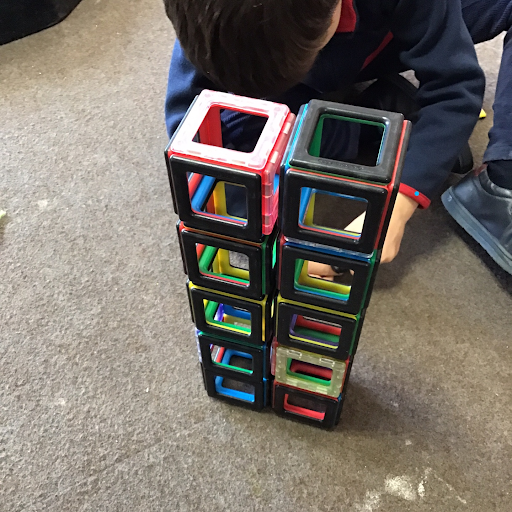
 We've got a set of Unit Blocks in Sun Class and a set in Moon Class.

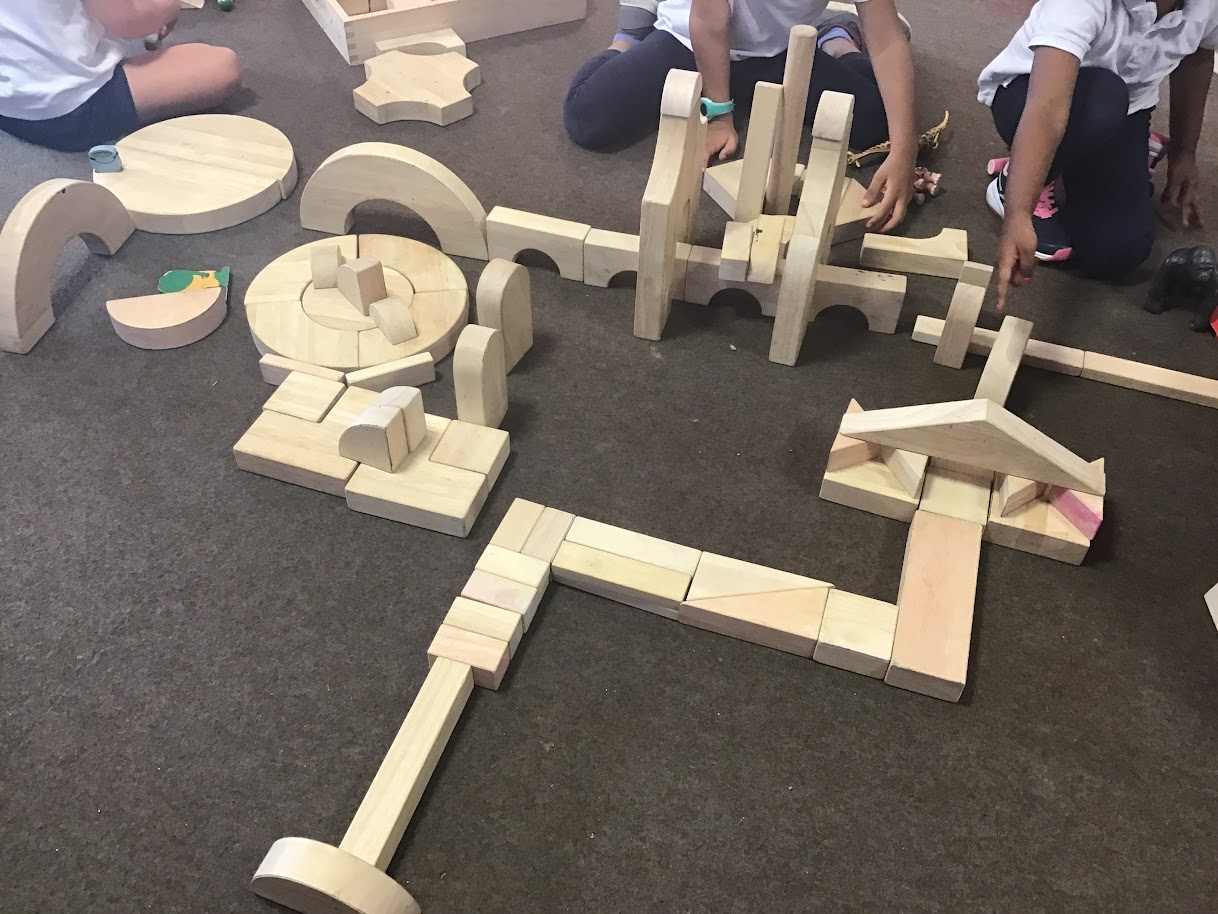
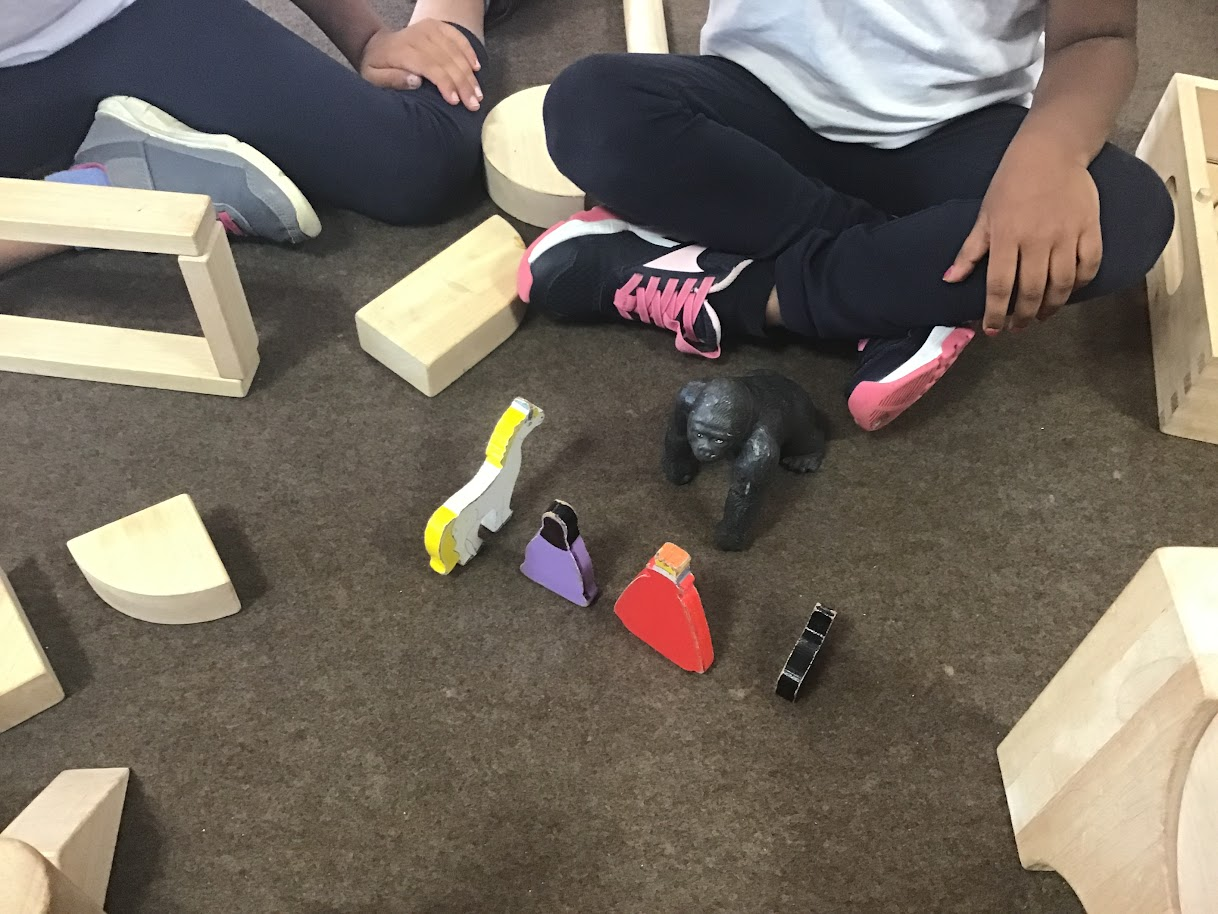
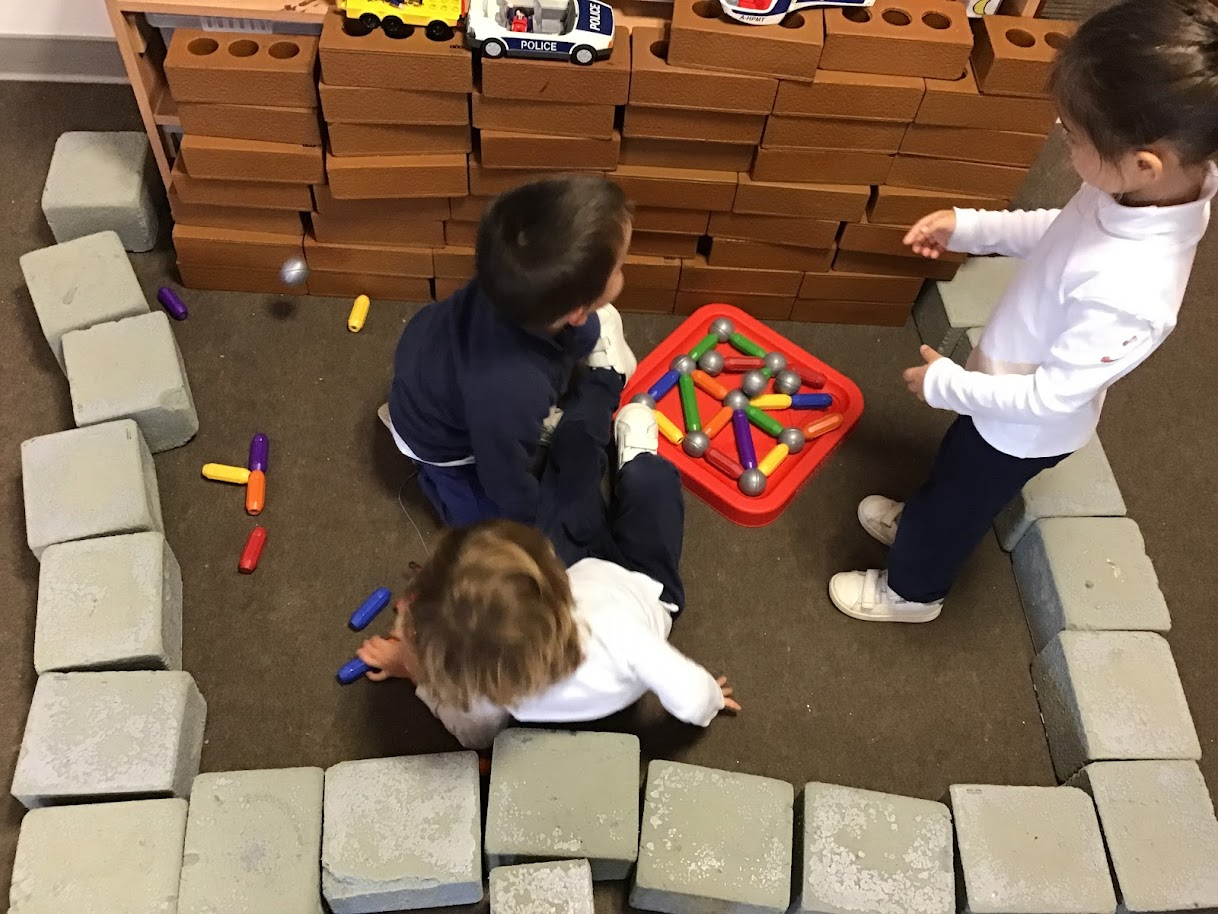
R and K were playing with them, and also with some of the wooden story figures, and a gorilla.

Sometimes, the building came to the fore.
Sometimes, it was the story telling and acting out with the small-world figures. R's mum later told me that R had watched King Kong in the summer.

Other people, including me, were also contributing to the Unit Block construction.
R was kind of telling a story as the characters acted it out.
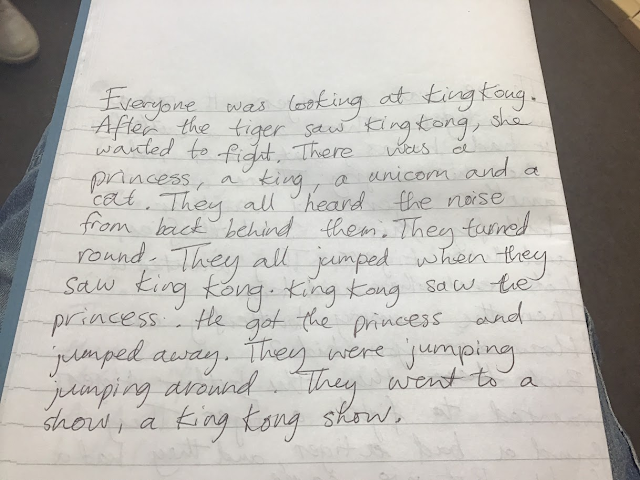
Normally, it's the students who ask me if I can write down stories for them ("helicopter stories"). This time I asked. R and K told this story together, with R leading the way:

"They all heard the noise from back behind them. They turned round. They all jumped when they saw King Kong."

I was really struck by this part. It describes a moment of surprise in a way that the PK students stories usually don't. And the surprise hinges on a spatial arrangement. At first the character blocks were facing away from King Kong, not conscious of his presence. Then they turn around, and only then do they realise to their shock that King Kong is there.

We often act out our stories together, and acted out this one as I read it out. Again, there was the dramatic moment of all turning round and seeing that King Kong was there.

And this is what I wonder: Did the small world enactment of the story - the staging of it together -  help to introduce this dramatic - and geometric - moment into the story telling?

Tuesday, 19 July 2022

Block play - an interview with Sofia Wallace

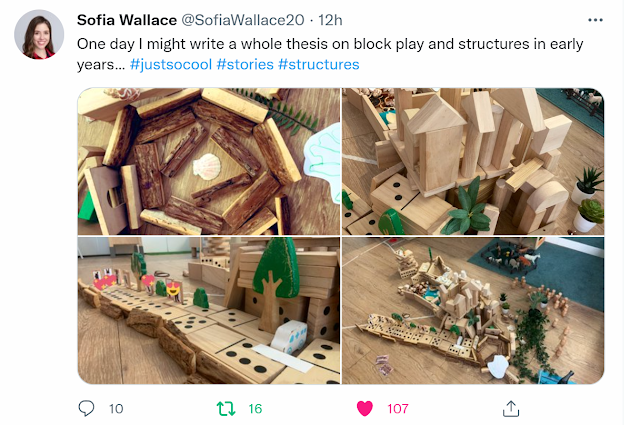
I am fascinated by our young (3-5 yo) students' block play. So, when Sofia Wallace, who posts delightful and inspiring things happening in her early years class in Milan, posted this, I wanted to know more:


I asked Sofia if she might be interested, if not in a thesis, at least in a short conversation about block play.


She liked the idea, and the idea of sharing it with you here.


Simon - Hi Sofia. #justsocool I find block play endlessly fascinating too, so I’m interested! I’d love to talk about it a little more…


I see already there are some hashtags. They might be good starting points.


#stories and #structures - It’s amazing how block play brings together engineering and narrative. Can you say a little more about that?


Sofia - Hi Simon! Thank you for putting this together! I love block play because it's such an accessible storytelling medium in early years. I’ve found that in my mostly EAL classrooms, children will often get intimidated with more traditional storytelling that requires them to draw or to speak. Blocks are different. All the students I’ve ever taught have been attracted to block play in one form or another. Whether solo exploring, testing how they can use them or sharing in elaborate narratives, there really is something for everyone in block play. 


I used the hashtags structure and stories because they seem to be umbrella terms for the two ways I generally see children explore with blocks. Even as young as 1 or 2 children explore structure when they are putting them in their mouths and discovering the texture or shape or physics of how a block drops, or rolls or sounds when it’s thrown. Then as they begin having that ability to use blocks to represent other things they move into being more storytellers. It’s the interplay of stories and structure that allow a child to create these amazing things. 

Simon - Yes, it’s amazing how #story and #structure brings so much together! The world of people and the world of things!


Blocks are such a powerful tool, language, material!  I’m struck that you say all the students you’ve taught are attracted to block play! I’m not sure we could say the same, with our 3 to 5 year olds. Let’s take it back a bit… Can you tell me a little more about the actual blocks that your students use in the block play, how they’re stored and accessed, and… how the attraction works? Is it just a matter of the blocks attracting, or is it seeing each other play too? Also, what is the place of the teacher in this? What would you advise early years educators like us who aren’t seeing this attraction in all the students?


Sofia - Oh great questions! I’ve been really fortunate to work in lots of different settings, all of which had different blocks and building materials available. Currently, my students have access to a combination of Kaplan, Lego, traditional wooden building blocks, Magnatiles and large foam blocks. All year round, a combination of these are stocked in the building area. We have either the shadow of the shape (just paper cut out to match the shape of the block, taped down) or photos posted of what the shelf looks like when put away. For me, a big part of creating a culture that supports exploring with blocks is creating a culture of accessibility. Students have to know that the tools out are there for them to use. For that to work, blocks have to be on a shelf that is at eye level, organised and sorted for easy access. At the start of the year we are pretty selective with what we put out. Slowly, as we develop a culture of care in our classroom, we add more. 


We also are mindful to keep the loose parts shelf as near the block area as possible, since loose parts add a lot to the narratives that come with block structures. 


Both of these shelves start quite sparse at the beginning of the year, but now have many more materials on them. 


Your next question is quite tricky for me to think about. I’m not sure I have a perfect answer for how the attraction works. I know that at the start of the year, we will often play with the students and model what being a good play partner looks like. We ask questions, use polite language to share, offer materials to others, etc. I think this immediately draws in students who are maybe coming to school for the first time and are mostly used to playing with mom, dad, grandma or grandpa in their homes. I found this year more than other years, a lot of my students were initially seeking to play with adults and not other children. 


Another way we draw children in is to have some structures made already to spark interest. Almost like a block provocation. We might create a pattern with a structure, an interesting arrangement or add a figurine to suggest a story. We did this more at the beginning of the year. Having the option to add on to something rather than start your ideas from scratch seemed like a good way to encourage children to explore. It also gave us the opportunity to model cooperative building. A lot of our students moved from being more parallel players to partner players this year. To support this we try to give them as many opportunities to collaborate as we can. 


We also will add photographs around the block structure area and we change those throughout the year. We started with photos of their homes sent by parents and then went to famous buildings around Milan, pictures of structures families visited, pictures of different architecture around Italy, landscapes, race car tracks, family vacations, etc. We changed these based on what we heard them talk about while playing in other areas in the classroom. Sometimes this inspires and sometimes it doesn’t. 


I think the final thing that attracts my groups to blocks is that they feel that their structures are really important. We take lots of pictures, share builds at circle, write stories about creations and allow for things to not get cleaned up. This tells them that their creations are important and valuable and allows them to continue on with their thinking. 

More than anything, I believe my students want to be seen as capable. Honouring their work by saying, “Yes! You worked so hard on this creation, tell me all about it” and then taking the time to save what they’ve done and share it with peers and families makes them feel really proud. That pride is what brings them back and gets them thinking in new and creative ways. 


So I suppose to summarise, my advice to an early years teacher who is not seeing a pull to blocks is to…


#1 See if the space is inviting and draws you in. 

  • Make sure pieces are easily accessed on your shelf and that they have a clear place

  • Make sure there are not too many options, especially to begin with 

  • Have a carpet or foam mat of some kind so that if blocks fall they aren’t alarming or frightening to little learners

  • Include pictures of places the children have been, ideas you’re learning about in class or settings from stories the children love to help inspire them

  • Include small pictures of students taped on blocks. This allows them to join the narrative

  • Make sure your block material match the kind of play your learners and you are ready for

  • Start with a provocation:

    • An arrangement

    • A tower

    • A sort 

    • A photo

    • An odd loose part 

    • etc.


#2 Adjust the way you think about block play

  • Allow structures to be saved, ask if they want to work on it later and create a system where you can do that

  • Reflect on how you talk about blocks 

    • Video or audio record yourself sitting in the block area and notice how you speak about what the children are doing. I am always catching myself inserting my narratives, which might interrupt the thinking. Listening to recording of myself helps me reflect on ways I could have better guided in the future. Being mindful of what you say during the play can really help children go deeper and explore without fear of judgement. 

  • Take notes of what you see them doing, write down quotes if you hear any, ask if you can photograph things to remember later and then post all of that near your blocks for reflection. It will help you as the teacher notice patterns and them as the students to feel their work is important. 

  • If you want to, try putting blocks in different areas for provocations and introduce them in new contexts (but have your clean up system planned and ready) 

  • Determine your rules beforehand with other teachers and figure out what language you are going to use in play to make those expectations clear


#3 Give yourself time

  • Make sure children get a good 30 minutes of uninterrupted block play time (not including clean up)

  • Treat clean up time like a lesson, plan lots of time for it, maybe gather a small group to do a mini lesson on how to clean the area

  • Model, scaffold, don’t rush 

  • Don’t clean everything. If you run out of time, honor the work by putting a sign up and saving it for later. The more you do this the more the students will be excited to put in time and energy. (This one bears repeating, because it’s so important)  

  • Reflect on exciting things as a group: if there is something they are very proud of, ask them if they want to share it at a group gathering time. 


#4 Play 

  • Have a day where you play too, see what it's like to really try and build something that you are proud of and remember what it feels like to create. Remembering the joys, triumphs and frustrations that come with blocks will allow you to better support your students. And it will get you excited about block play, which is then felt by the students. 

  • I highly recommend doing this with your team :) 


Simon - I’m so glad I asked those questions, Sofia! Yes! I love the way you’ve spelt out the kind of superstructure of influence and inspiration that needs to accompany the blocks being physically there in the classroom! It’s so useful, and practical in its detail! I already feel like you’ve given me a lot to think about and act on… but, perhaps greedily, I want to ask a few more questions…


You will be reflecting on what the students have built, and how they built it. Perhaps you’re doing that with colleagues. I’m interested in how you do your thinking about this. Do you have set times together when you do this? Do you think about play schemas? Or how students’ block play is progressing? Are you thinking about students’ interests or their working theories? Do you hone in on particular aspects as you document the building? Perhaps the dramatic, or the mathematical? And how do you select those aspects? How does this reflection feed into the way you re-present the students’ work to them?


And, on the same theme, whose ideas have influenced your thinking about all this in particular?


Sofia - Reflecting is always tricky, because the one thing that all teachers never have enough of is time. Reflection (especially with a group of 27 students like we had this year) requires a lot of time. Every Monday, we have one hour of dedicated planning time where we sit and look at photos, notice the patterns and look for opportunities to extend. We put our notes into our planner and use it to come up with action for the following week. Action might look like picking books related to the topics and patterns we saw, finding links to interesting videos or models, asking parents or other staff to come in as “experts”, adding provocations in different spaces, planning for large or small group games to support ideas, and organising pictures and quotes to present to the students for a circle time throughout the week. 


On Friday afternoons, our group attends an hour of gym and Chinese without us. We use that time to write a newsletter and reflect on what the big moments of the week were in play. Our newsletter is a Reggio-inspired document that includes quotes, photos, ideas, narratives and skills presented in parent-friendly-language. This helps us to see where we could go next, and help the parents get involved and keep the conversations going at home. Some weeks, block play would be a big focus, and all the narratives, drawings, games, etc. would connect to their creations. Other weeks it is barely mentioned. It all depends on what is happening in the classroom.


During the week, we use Seesaw to save pictures and track what is happening. I’m not sure how familiar you are with Seesaw, but it has this great feature that allows you to record over a photo so that even if you don’t have time to talk with everyone in the moment, the children can add comments afterwards (we often did this during Garden time). When helping children create recordings, we are very thoughtful about our questions and the language we use since the point is to gather data on the child's process and thinking. We have a separate document we have been working on that helps guide teacher questions and conversations; it includes a section of block play specific questions we use to guide us. 


In terms of assessing and tracking with block play: those Seesaw posts become key. At the beginning of the year, our Technology lead input all the EYFS standards we have in our yearly curriculum map into the Seesaw Skills for our class, which has made tracking very easy. Basically, once you have listed all the standards or skills you are looking for in the year, you can tag them on a piece of work, a conversation, video, etc. Which is amazing because in early years it allows you to really differentiate. For example: we can track a child's understanding of one-to-one correspondence by seeing how they count the blocks in their structure, animals in small world, pieces of paper glued to a collage or number of times they hit a musical instrument out in the garden. All of these are organic experiences that show the same skill, while still respecting their individual interests and methods of exploring. When we use the app, we are able to upload the data, tag it quickly with a skill, and see how those skills develop in a truly play-based context throughout the year.  You can also notice gaps or concepts the child is choosing not to explore and try to create opportunities in their preferred play area for that. 


I think you could honestly include anything you are looking to track and it is a great tool. I have heard other people have had great success with different online tracking tools for this. I would be very interested to hear about other tools people have had success with when it comes to documentation, data gathering and tracking.


This year, we did a systematic reflection on each student 3 times in the year: October, January and March. For this we went through the data we had gathered on Seesaw, in their portfolios and from the small and large group documentation. But to be honest, we didn’t have a rigid system for honing in on skills. Each of us would probably approach a structure or build and notice different skills the children are using. 


But I think that is okay. If I come to a block structure and see how the child is developing communication skills and another teacher comes to that same block structure and notices only the maths skills, that’s fine. We aren’t going to get everything, and at the end of the day, that isn’t the point. I’ve had a really good team this year and we have all been on the same page that the thing that comes first is the joy: allowing the child to be a child. To play and wonder and get frustrated and try again without having every detail gone over with a fine-tooth comb by their teacher. 


It’s a bit of a balancing act, because we are always very excited to get inside the thinking and understand. However, as you mentioned, our reflection, questions and perspective will affect the way we record it. By working toward being more mindful, we can avoid losing focus on what's important. 


I have been super lucky to have worked with some really amazing teachers, starting with the staff at my university: the University of Minnesota. I got degrees there in both child psych and early childhood education, which gave me a really strong foundation to start from and introduced me to the great minds and amazing science behind play. Since then, I have been very lucky to continue learning from peers in schools, through courses and PD and in places like Twitter! 

Wednesday, 15 June 2022

Mathematics is not a "building block" subject

I've been reading Alf Coles and Nathalie Sinclair's I Can't Do Maths! Why children say this and how to make a difference. It takes five ideas about teaching maths that they've identified as myths, and explains how the myth works, and what might be done about it.


I'd already seen Alf Cole's TEDx video about the first myth, that mathematics is a building block subject, where we build more complex ideas on top of simple ideas.

The situation of learning a language by being immersed in a complex whole is of course a really powerful instance of children learning within complexity. My English as an additional language learners learn - fast - by being immersed in the life of the class. They somehow pull out of the messy whole all the grammar and vocab that they need.

As Alf Coles says, Caleb Gattegno calls this using the 'powers of their minds', and asks why we can't make complex demands on those powers in teaching maths.

Alf Coles suggests that if you're not succeeding in mathematics class, instead of needing something simpler, perhaps you need something more complex.

This is the subject of the first chapter of the book: Myth A: Maths is a Building Block Subject. 

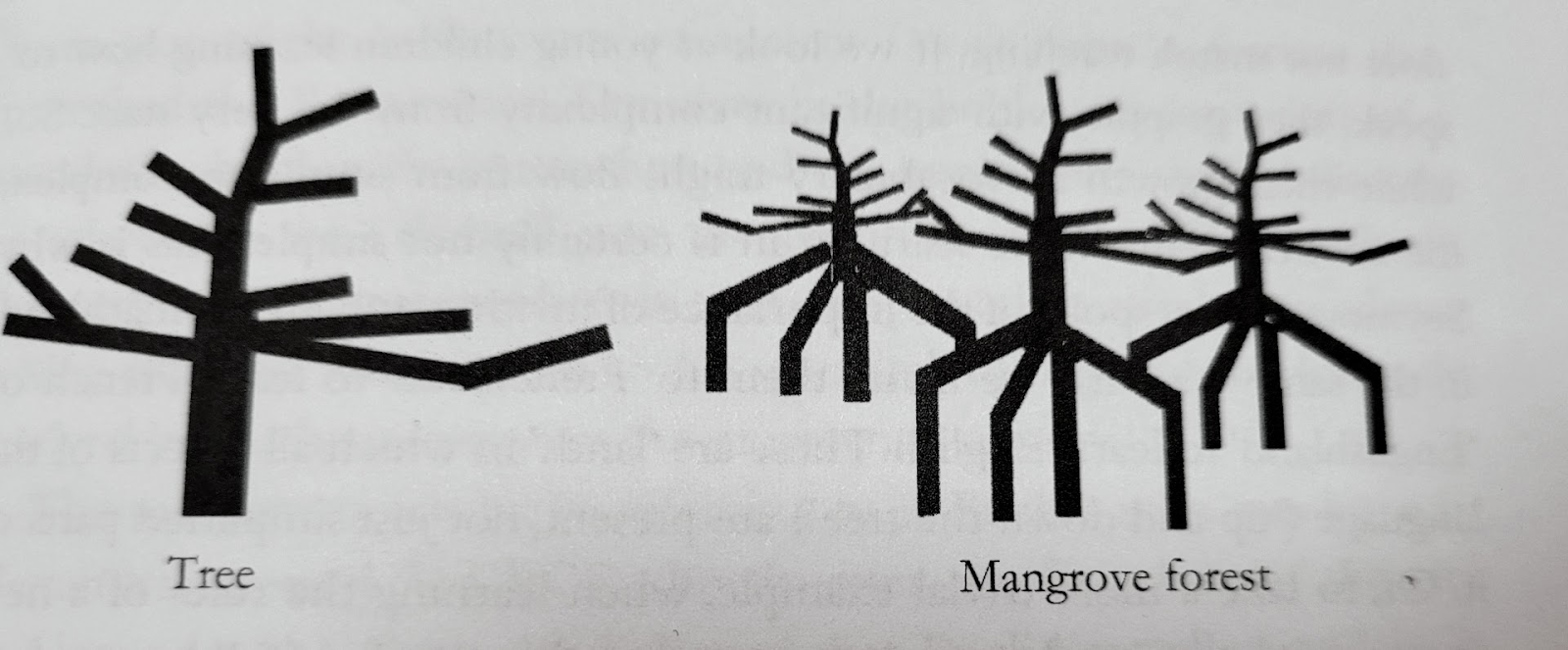
'The idea that in order to learn something, you need to start with the simplest ideas and slowly build upwards - constructing one block at a time - seems to be common sense. The primary maths curriculum in schools in most countries in the West is designed with the tree idea in mind.'

But...

'...what if our image of learning and mathematics were more like a mangrove forest than a single structure or tree? Mangroves grow as a decentralised network, each part dependent on other parts, growing upward and downward and sideways too. If there is a problem, no need to go back to the starting point; no need to find the trunk or the ground floor, since there is no one thing upon which everything else depends.'


UPDATE - You can read the authors' piece on this chapter in Mathematics Teaching issue 282.

This does really seem to go against the usual assumptions about mathematics learning.

And yet I do see it in operation in my students.

In our learning in Early Years of course, where it is children's play that leads the way, we often see the mathematics embedded in something else - maybe in building a house together. Or some other kind of arranging with blocks. Or pretending to run a shop. Or making a pattern of squares. They present their learning to themselves not in the most simplified form but in a complex context in which much of the learning is hidden from easy observation.

Often the complex task is more satisfying than the simpler one - perhaps in some sense it is more efficient, though it looks much less orderly and logical to us.

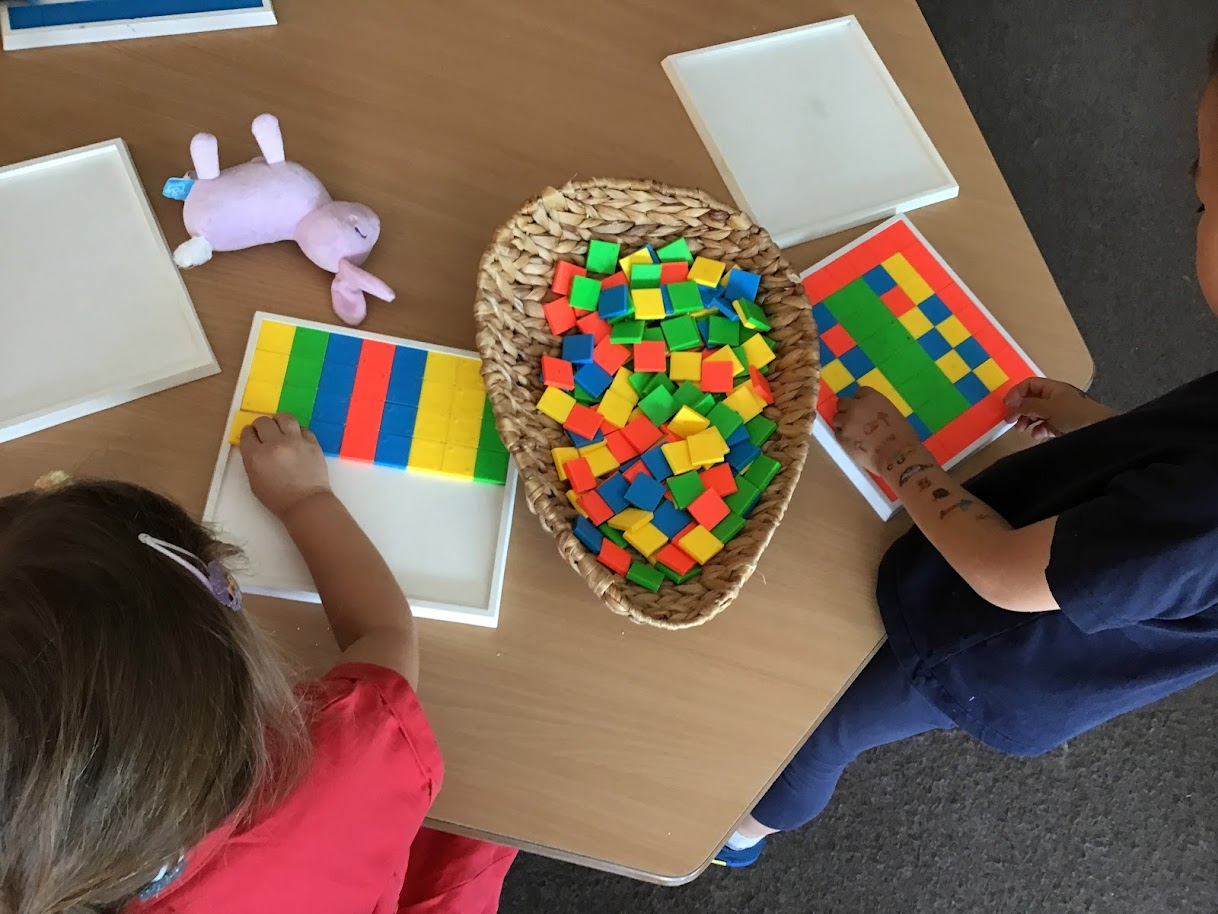
Take that thing of arranging squares. Today I saw this.

I've written before about how compelling filling a space can be for young children. In terms of motivation, it seems to beat the kind of linear ABAB patterns we teach when we begin pattern. And yet, here we are dealing with a 2D space rather than a 1D space, with a lot more complexity. And yet it is how young students seem to prefer to create their patterns. 

I've written about how one of my young students (not the only one) likes to build his Numberblocks-inspired numbers out of Polydron, rather than taking the more obvious path of simply using connecting cubes.

I've written a lot about using Cuisenaire rods (example). The authors too see the power of looking at arithmetic algebraically rather than numerically, and in their chapter on practicalities they go into detail on this. How powerful it is to see that two things are equal so vividly, and to have an easy way of saying it. 
Two reds are equal to one pink. 2r=p. Five and six year olds can get a really solid understanding of what equality means. And multiplication becomes counting. Two reds. Just like two apples. This can be a very different route from the counting and number-dependent route children usually follow.

I think there's a lot to be said for this mangrove approach - and thanks to Alf Coles and Nathalie Sinclair for articulating it so well! I'm going to be pondering this a lot more.

Tuesday, 22 February 2022

Why play?

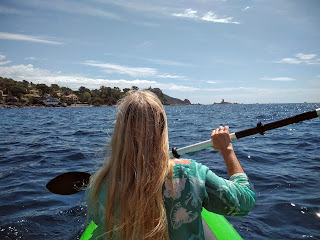
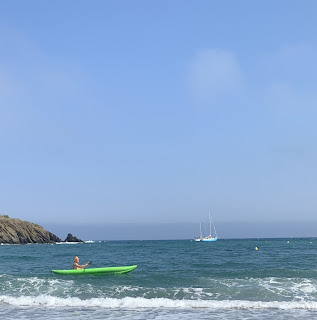
Here's a nice thing to do. Go down to the Med with your blow-up kayak. Push it out to sea, straight out to avoid the waves rocking it over, hop beaches, admire the mansions along the coast, take pictures, pull the kayak onto a beach and walk across the hot sand to a bar and sip cocktails together, looking out to sea.


All lovely. To do this, I also need to take my phone, to take pictures, and my card, to pay, and my glasses to see properly. It means we need to be quite careful with waves and water getting in the boat. This is the usual pattern, and it's a lot of fun.

But one time, I tried something different. I left my glasses, phone, and money with the people on the towels.

Oh, now there's nothing to get wet, I don't need to worry about water getting in the kayak. I can aim for the waves. I can deliberately capsize it, sit on the upside-down kayak, try, and succeed in, righting the kayak. 

This is play. I don't need to get from A to B without getting wet. I don't need to do the correct thing. In fact, I'm going to try out the incorrect thing. I'm going to take risks, try things to the limit. I will get wet, and it will be OK.

And I learn a lot from it, not that I was setting out to. I feel more connected with the kayak and with the sea. I know better what they can do together. I'm less afraid of what might happen. I know how the boat behaves in the waves at different angles. I know that if we get knocked over, I can sit on top of it, and we can right it. 

This play thing seems at right angles to the A to B functionality of the boat. It doesn't get me anywhere, it doesn't keep the boat the right way up, it doesn't keep me dry. And yet, my knowledge is now broader, more reliable, more comprehensive. 

That's what play does.

Saturday, 1 January 2022

Freedom

Over the holidays I've been reading David Graeber and David Wengrow's The Dawn of Everything, A New History of Humanity.

It's a big book, full of fascinating  and momentous ideas about the dawn of civilisation. One of the big things it does is to question evolutionary ideas about a progression from hunter gatherer innocence in small groups evolving to agriculture, to cities, to states.

There were huge sites built by hunter gatherers. There were cities all around the world that don't seem to have had kings or queens, but ran their affairs through discussion and deliberation. There were cultures that valued freedom highly and went to great lengths to avoid having that freedom taken away.

In fact some of those cultures might have brought ideas of freedom to the fore for Europeans.

Father Lallemant, a Jesuit missionary to the Huron in the early 17th century, wrote about the Huron in these terms:
From the beginning of the earth to the coming of the French, the Savages have never known what it was so solemnly to forbid anything to their people, under any penalty, however slight. They are free people each of whom considers himself of as much consequence as the others; and they submit to their chiefs only in so far as it pleases them.
The Jesuits naturally found that this 'wicked liberty of the savages' made it harder for them to submit to their authority.

Published account of indigenous Americans and their not always favourable view of Europeans were popular reading in Europe. One such account, Louis Armand, Baron de Lahontan's Curious Dialogues with a Native of Good Sense who has Travelled, published in 1703, amounted to a critique of European life, from the point of view of the Huron chief, philosopher-statesman Kandiaronk.
Lahontan: This is why the wicked need to be punished and the good rewarded. Otherwise, murder robbery and defamation would spread everywhere, and, in a word, we would become the most miserable people upon the face of the earth.

Kandiaronk: For my own part, I find it hard to see how you could be much more miserable than you already are. What kind of human, what species of creature, must Europeans be, that they have to be forced to do good, and only refrain from evil because of fear of punishment? ...
Kandiaronk saw the Europeans as lacking in both freedom and equality. Graeber and Wengrow propose that views like this from outside Europe helped shape demands in Europe for 'Liberté, Egalité, Fraternité'.

Graeber and Wengrow refer to three primordial freedoms - freedoms that are often taken away when a sovereign emerges:
  • the freedom to move;
  • the freedom to disobey;
  • the freedom to create or transform social relationships.
Naturally, I think of education in terms of some of the themes of the book, freedom in particular. School can be an institution where all those freedoms are almost completely removed.

But - and I'm thinking of the kind of play-based setting that we work in with young children - they can also be places where those freedoms are valued.

I was struck by a tweet by Ben Mardell that shows some teacher documentation of some Pre-K students talking with their teacher:
Ricardo: What does freedom mean?

Ms Hannah: That's a good question Ricardo. I'm glad you asked that.

Children's responses -

- It means you can play!

- You can move around and run.

- You can finally stop what you HAVE to do.

- When someone comes to play and you say yes.

The book has made me see freedom more specifically, and also as a value that in various times and places, sometimes in complex societies, in cities even, has been guarded jealously. Some cultures went to great lengths to make sure they could travel and be welcomed elsewhere, and to avoid arbitrary power emerging. These things are well worth guarding with our youngest students.

And that last freedom - to create and transform social relationships... I would like to have more situations where the students genuinely, as a group as well as between pairs, have more opportunity to make the most of this freedom.

Monday, 20 December 2021

Building mathematics

 One of my students, A, has been with me for over a year now. He was just three years old when he started, and without much English. His favourite thing was to get the Playmobil cars out, fill them with people, and quietly act out stories with them on his own.

He did lots of other things too. Here he is in the playground, back then in September 2020, with two other students, making a house with the giant Polydron:

We've watched lots of Numberblocks (see my post on this), where numbers are represented by blocks.
I haven't asked anyone to do this - most of the things that happen in our pre-K (Early Years) classes are child-initiated and developed - but A has been spending a lot of time exploring numbers by building cuboids out of Polydron. While others were content to use our pre-existing interlocking cubes, A wanted to make the cubes himself from squares. He makes other things too, like this house with an interesting floor plan:
But here's 8 (called 'Octoblock' in Numberblocks), built by A from individual cubes:
There is a Numbrblocks episode called Terrible Twos, where 4 splits into two 2s who tickle the other numbers while they sleep which makes them split into ones. Here is A's version in magnetic Polydron, a 4 made of two 2s.
It even comes into his story writing, which is usually about T. rexes and triceratopses:
The building continues:
Recently he's developed an interest in writing. Here he is practicing writing the numbers:
Children also play with the Numicon and tell me equations. They've heard a lot of these on Numberblocks. Here's one from A:
What I really am pleased about is that all this learning is initiated by him (in a climate of appreciation and encouragement of course). It is very much his own and at his pace. I'm pleased that all the four year old students in my class have also found their own different ways to this, enjoying representing numbers and equations. A has also influenced younger students in the class too. T in particular is a real enthusiast for creating the same kind of Polydron 3D numberblocks.
As the students do, T told me some equations linked with what he was doing, and then told me a few more he knew:
I think it's from these landmarks that young students begin to build their number sense, so what he's doing seems just right to me.

Saturday, 20 November 2021

Where mathematics comes from

 At the moment I'm reading a little about materiality in learning - how physical materials and the physical environment and what they can do are a kind of teacher as we interact with them.

It made me think about how that is true for learning mathematics. In my last post, I pondered what young children are learning as they construct a play house out of bricks together and move into it.

One of my tentative conclusions is that in arranging matter, they are learning to arrange matters in the broadest sense of the word. They are learning what it is to try things out boldly and get results, what it is to work as a team.

In an older post, I thought about the natural powers that students bring into play when they do mathematics. 

This is from John Mason and Sue Johnston-Wildery:
The kinds of powers that are relevant for learning mathematics are ones that learners will have demonstrated by the time they arrive at school. Learners have innate ability to emphasise or stress some features and to ignore others, enabling them to discern similarity and difference in many subtle ways. They can also specialise by recognising particular instances of generalisations, and they can generalise from a few specific cases. In addition, they can imagine things and express what they imagine in words, actions or pictures, together with labels or symbols.

(my emphasis) 

A couple of things about both agency and these natural powers. First, we learn them by exercising them in the world, interacting with people and things, primarily through play. Secondly, they don't serve us only in mathematics, but in all disciplines and areas of life. 

That second point is important I think. The roots of mathematics are much much broader than the 'trunk' - stretching out into all areas of play and interaction. Squashing playdough, spinning round and round, having a conversation, singing a song, jumping in puddles, listening to a story. And not just because these things have elements of geometry, measure, arrangement and number in them, as they often do - but because all our growing powers are needed for the learning of any discipline.

I often return to this: 

Maryam Mirzakhani, the first - and only! - woman to win the Fields Medal, only got into mathematics near the end of her schooling:
"What are some of your earliest memories of mathematics?"
"As a kid, I dreamt of becoming a writer. My most exciting pastime was reading novels; in fact, I would read anything I could find. I never thought I would pursue mathematics until my last year in high school."

(from here

Could Maryam Mirzakhani's love of reading have supplied important ingredients that later went into her mathematical work? I think so.

The foundations of our mathematical learning are in all our learning. 

Maybe - and I'm blundering into unfamiliar territory here - this connects with that old chestnut: 'Is mathematics discovered or invented?'

The question often seems to be answered without thinking of individual development. As if mathematics were a free-standing thing that wasn't created and recreated each time an individual explores and learns about it.

I want to say that it is very much discovered - in our first steps and first reaching we encounter magnitude. It's in the world that we learn the agency, the natural powers and all the other building blocks of mathematical thinking. It's in how we arrange the bricks in that play house, how we create an inside and outside, how we space the toy cars on top. And in the logic of how one step leads to another. The material of the world is full of the different logics of mathematics. And when we abstract it away from its inception in the physical world, again and again we return to the world at further points - we have already felt the inflection points of a curve when cycling in figures of eight on the tricycle in the playground. We know what a plane is from the many floors we have moved across well before we meet the Cartesian plane. In algebra, we often get a whiff of the idea of magnitude that lies behind the cat's cradle of manipulations we do with symbols.

And of course mathematics is invented too. The directions we take are ours. They reflect our economies and social structures. Counting for buying and selling and taxes. Measuring for sowing seeds - and taxes. Another planet would have a very different body of mathematics.

As usual, my ideas around this are half-formed, rough-draft, and probably too briefly expressed. 

Practically, working with 3-4 year olds, I'm confident that all the story reading and writing, all the conversation, all the art work, messy play, construction, games, roleplay, sensory play, small world play - and of course play with mathematically structured materials and moments - is the best thing, not just for learning in general, but for the learning of mathematics too.


Wednesday, 27 October 2021

Arranging things

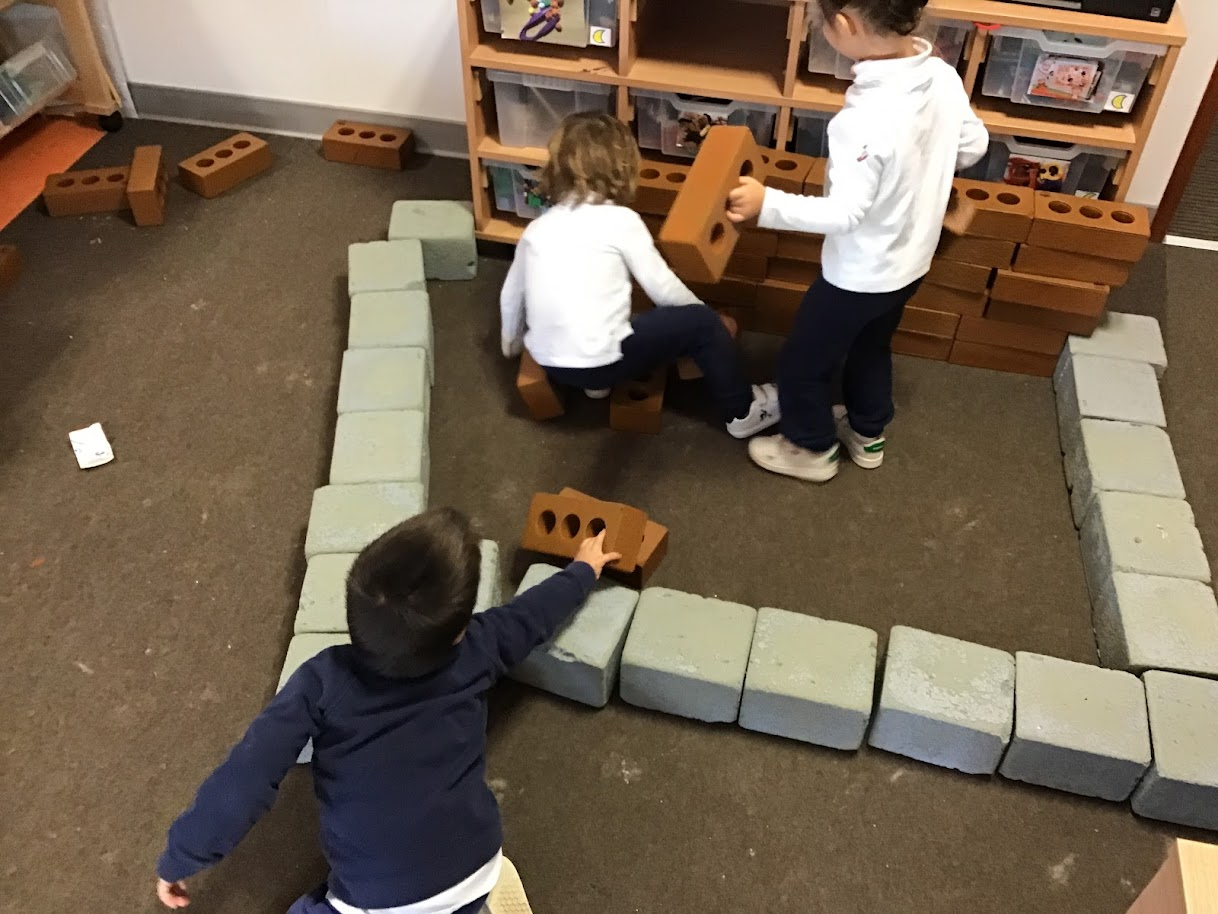
Three of my new students (aged 3 and 4) have been settling in this half term. They have been doing lots of playing alongside each other, but this was one of the first times they cooperated on a common project, building a house.

The conversation was in Spanish, so I couldn’t benefit from it. Once it was built, they had encircled themselves and they enjoyed being in the inside they had created and furnished it with sundry items to make it more of a home:

Our early years team have been working with Anne Van Dam, looking at what ‘working theories’ the children are developing in their play. This follows the work of Helen Hedges

“Working theories are present from childhood to adulthood. They represent the tentative, evolving ideas and understandings formulated by children (and adults) as they participate in the life of their families, communities and cultures and engage with others to think, ponder, wonder and make sense of the world in order to participate more effectively within it. Working theories are the result of cognitive inquiry, developed as children theorise about the world and their experiences. They are also the ongoing means of further cognitive development, because children are able to use their existing (albeit limited) understandings to create a framework for making sense of new experiences and ideas.” (Hedges & Jones, quoted here)

This concept of working theories builds on the work of Bruner, Claxton, Gopnik, and Vygotsky. It sees children as actively building their understanding through the thinking and play they do. I like it a lot for its respect of children's thinking, seeing the active way in which children make sense of their worlds.

And yet... there's something in the fit of this to the kind of loose parts play that doesn't feel quite right. I can't put my finger on it exactly...

If I were to list some of the ideas and understandings that children might be building in this activity, I might say:

  • 'I can make friends playing alongside other children'
  • 'I can get better at communicating by doing it'
  • ‘I can create a new space by enclosing it’
  • ‘I can align bricks and build them up to a wall’

  • ‘Here is a place that I belong’

  • ‘I can make this place into one I belong in even more’

  • ‘I can build’

  • ‘I can work together with others on a common goal’

  • ‘We can achieve things together, and it feels good’

  • ‘We can bring things into our space’


These are not once-for-all understandings that are achieved and then we move on, but ones that grow and grow through students’ time at school. That enclosing is a schema, ie a repeated behaviour, seems to indicate that the understanding that is built up doing it is something that needs to grow incrementally and be connected with lots of other thoughts and experiences.


The more experienced children in the class seem to have this understanding much more firmly, and to build and create together with so much more ease. 


But, like so much of children’s play, it doesn’t seem to be directly pursuing a question (like ‘Where do birds sleep?). Outwardly, it’s more directed towards making, production than it is to finding out. They are, ultimately, finding out, but the immediate impulse is one of creation. In this way the play seems to have more in common with the arts than with the sciences.


This is a thought that I’m still mulling over.

And now this sketchy diagram that I’ve drawn is making me think. The impulse to create, to make, to perform, to challenge oneself allows a feedback loop. It puts the results of our action (beige in the diagram) into the world as something that we can observe. A kind of design cycle. We are building up theories about the kinds of achievements we can have in the world.


Helen Hedges writes ‘Learning may appear somewhat disorganized, perhaps appear to move around and then return later to topics, questions and ideas, may call on invention and imagination to connect ideas…’


To me, most learning is disorganised, full of imagination and invention. So much of learning, of building theories, is devoted not to how the physical world works or even to social and cultural learning considered as learning what’s already there. A huge amount of learning seems devoted to managing possibility. I have these materials - what could I do with them? How might I deploy them, arrange them? I have this time with my friend? How might I fill it? I’ll learn to wildly invent, to put some unheard-of combination boldly into place - and I’ll see what happens then.


New Zealand’s Te Whāriki Early Childhood Curriculum has a section called Learning Dispositions and Working Theories. “Dispositions that can be useful for learning include playfulness, whakatoi (daring), persistence, resilience and imagination. Children also develop dispositions towards domain knowledge…”


What I’m trying to get a grip on doesn’t seem to simply reduce to dispositions though. It is a more disorganised-seeming, less direct way of obtaining knowledge about what daring and playfulness can achieve, what can be done with freedom and within necessity, how the social and physical environment can be remixed. It centres around agency, and uses whatever is at hand to achieve its undefined aims. It achieves its goal of developing capable and skillful being and making in the physical and social world, but its means are more indirect than what comes to mind when we think of theory-building: curiosity -> question -> search -> answers.


This simple house the children make seems to bring so many aspects of learning together. Mathematics is in there too. The straight line of the bricks, the way they are placed in the same orientation, and on top of each other to create layers. The way the lines of bricks are parallel to create the rectangular floor plan, and how the cars are arranged, spaced out evenly.

That word arrange. It means both to place things by some kind of design, and also, metaphorically I suppose, though we're no longer conscious of any metaphor, to organise anything in life. 

Maybe the play follows a similar path to the way the word has travelled? We play at organising loose parts, we learn, ultimately, to organise our lives, whatever the variables it gives us.

And now I'm curious what the roots of that word arrange are:

Ah - putting something in a ring. And there's the word rank, like ranks of soldiers.

It's always fascinating to see the proposed Proto-Indo-European root of a word, and all the offshoots of that:

I find this nexus of related words more than interesting. It's almost as if play recapitulates etymology. We encircle ourselves with loose parts, we line them up in ranks, and doing this we are researching, building working theories about our own agency, our abilities to work with others to build a home, our abilities to arrange matter and matters.


(Adapted from notes we each made for our work with Anne Van Dam)