Sunday, 23 August 2015

Looking back, looking forwards

There's been loads of developments in my maths lessons over the past year. And a lot of that’s down to the #MTBoS - the Maths Twitter Blogosphere. I'm looking back, and also looking forward to a new Year 4.


I’ve been drawing a lot from the 3-Act lesson, particularly the first act, where there is a stimulus and then space for responding to it. There are the brilliant questions What Do You Notice? and What Do You Wonder? that put the ball in the children’s court. We’re moving in a direction where the children are having a bigger slice of the mathematical authority.

We’ve been estimating like crazy with Andrew Stadel’s Estimation180, going on to develop our own estimation challenges. I owe Joe Schwartz thanks for inspiration with this.

We’ve been using counting circles lots too. Here, it’s the children that share strategies at the end of these brief sessions. They are getting used to explaining their approaches, and looking for other ones.

And we’re relating arithmetic to algebra, looking for general patterns in the way number operations work. Linked with this is valuing the claims that children make, seeking discussion on these claims, and asking if we can justify them. (Thanks: Kristin Gray especially.)

I’m always looking for ‘open middle’ activities, but I’m keen to find more that are student- initiated and open-ended, following up from their own tinkering and questions.

In fact here’s a lot of things I’d like to really start using in the coming year:
  • Keeping maths journals
  • Always, Sometimes, Never
  • Creating polygons and more with Scratch
  • True or False questions
  • Expressing equations as real life situations/stories
  • Modelling real-life situations
Alongside this I’m always keen to try new lessons. For instance I came across a couple by Federico Chialvo that I really liked recently: Number Bracelets and Squarable. And Joel David Hamkin's second booklet, Graph Theory for Kids.  And Iva Sallay's Find the Factors. Then there's Envelopes by Alan Parr, which I came across just today (on nrich too). 
And I’m usually coming up with a few ideas myself. For instance, I’d like to do a lesson discovering Thales theorem (semicircle) together – creating triangles with different angles first.
Caleb Gattegno with Cuisenaire rods

I use Cuisenaire rods lots. But I want to do so more, à la Gattegno/Goutard (thanks; Caroline Ainsworth), to give lots of hands-on awareness of arithmetic, looking for generalisations. And linked with this, I want to go further with the children making and justifying claims.

The problem, the challenge is, where do we make time for all of this? Already, there's not enough time in the year! I’m hoping to recast existing lessons that are too teacher-telling-class, or just not important enough. I've made a quick list of all my lessons last year and I'm going through it, thinking about changes to make, things to drop, add in, or move. That bullet point list will get to work on my list of the lessons. Watch this space.

Monday, 10 August 2015

Can you think of a way to show how that can be true?

Summer holidays. No WiFi. At a café now, so I can blog, but then back to limited quota of 4G.

But there are books! I’ve been going over Connecting Arithmetic to Algebra by Susan Jo Russell, Deborah Schifter and Virginia Bastable a bit more slowly than before and before. It’s such an excellent book. I really like how jargon-free it is. I also like how all the main points are illustrated by, centre around classroom discussions. And of course I like what it’s saying: children can be making generalisations about the arithmetic they do, they can be making claims and justifying them, even proving them, and by doing this they can deepen their understanding of mathematics.

I’ve been reading out this dialogue with 4th graders) to any teacher friend who will listen to me. It’s got so much in it:

Ms Schmidt: What do you know about 327 plus 245? What can you say about the sum?

Angela: It’s more than 500.

Teri: And less than 600.

Mannie: I know it will be an even.

Ms Schmidt: How do you know that?

Audrey: The numbers are both odd and if you add two odd numbers, it will be even.

Ms Schmidt: Does everyone agree? Is that always true?

Fiona: My teacher told us that last year. An odd plus an odd is even.

Samantha: Look, 7 plus 5 equals 12; 5 plus 3 equals 8; 17 plus 7 equals 24. It just is.

Ms Schmidt: But Audrey is saying this works for all pairs of odd numbers, right?

Audrey: Yes, it doesn’t matter what the numbers are.

Joshua: But there are lots and lots of numbers. I don’t think you can ever be sure.

Ms Schmidt: I hear Audrey saying that every time you add two odd numbers, you get an even number. Joshua is saying, if you haven’t tried all the numbers, how can you be sure?

Mannie: It has to be that way. We all know that.

Ms Schmidt: What does Audrey mean that it doesn’t matter what the numbers are? Can you think of a way to show how that can be true? We have been using stories or cubes to make arguments. Take a few minutes, talk to your partner, and see how stories or cubes might help you.

Ms Schmidt [after a few minutes]: I heard Mannie’s group use a story. Would you share?

Mannie: It’s like you had some people in one class and everyone has a work partner except one person. Then you have another class and it’s the same, everyone has a partner except one person. If you put the two classes together, everyone stays with his or her partner and then the ones without a partner pair up. When the two classes are together everyone has a partner.

Audrey: I can show it with cubes. These are both odd numbers. Every cube is paired up except one. I don’t even know what the number is. If every cube is paired except the one at the end, then it’s odd. When I put them together, the two end ones pair up. That makes the total even.
Look at how Ms Schmidt keeps reiterating Audrey’s claim that any two odd numbers will make an even sum. Some of the children want to leave it at “it just is”, but there’s a deeper to go, a why. It’s great that Joshua makes the counter claim – you can’t know for all numbers. Most of the children will accept that Audrey’s claim is true, but now they have to find an analogy, with blocks or a story, that will make the why make sense to themselves and others.

I really like how Ms Schmidt phrases her request for a demonstration (a proof?): “Can you think of a way to show how that can be true?” There’s an open-ness, an ease in the words, and the examples the groups come up with show that she’s put it just right. They also show that she’s given them practice at representing situations with stories and cubes, so that these are familiar tools ready for use.

- - -

This coming year, I’d really love to see more of this kind of thing in the Year 4 classes. We do a lot of using cubes, and Cuisenaire rods of course, to represent equations. But I haven’t really done that thing of getting the children to represent arithmetic in story form. It’s another great tool, that gives meaning to abstract equations, and can be used for the kind of analogy that Mannie’s group produced so brilliantly. I’d like other people in the school to see this too, even if it’s only this short dialogue: it touches on a lot of themes in the book, and has the kind of respectful partnership between the teacher and students that we will recognise in ourselves on our best days.

Saturday, 25 July 2015

Equality, equivalence, sameness

I've already blogged about equivalence. But there's a philosophical discussion children could have here.

What does it mean when we say things are the same?

Heraclitus famously said, "You can't step into the same river twice." The water, of course, has changed.

This statement, I think, could be a great starting point, stimulus, for discussion. Peter Worley suggests the line could be taken away from Heraclitus and given to Tina, talking to her brother Timmy, while they're visiting a river.

There does seem to be a lot to think about here, and it relates to the idea of equality in maths.
Peter James Jackson in one of his wonderful videos wants us to say = as "is equivalent to".


Why? Maybe to emphasise the idea of the balanced equations, rather than, as with the  = button on the calculator, "gives the answer..." This is good, but I'd like to get equals to be associated with balanced equations too.

Maybe too, to stress that the two are different but the same. But then I'd say that equality has the idea of difference in it.

Parmenides famously "answered" Heraclitus by saying, "You can't step into the same river once."

For a long time I thought he was just being ridiculous. Well, he was in a way, but within that craziness, there is, for me now anyway, a serious kernel.

Whenever we call two things the same, they are also different in some way. They're maybe in a different place, or a different time. They may be in a different form.

For instance, if we say that two celebrities arrived at an event in the same dress, we never mean that they've both squeezed into the one dress. They are wearing two separate dresses in all-too-slightly different places, with all kinds of subtle differences, definitely taking different shapes, possibly different sizes.

So same never means "completely the same". That's what Parmenides is saying: you have to have two (at least) different things to have sameness. Those things will be the same in some important way, but will be different in others.

Now I wouldn't say all this with my class, of course. Or even lead towards any of it particularly. But I know it's there, a linguistic and thought territory to be explored, every bit as "out there" as the little forest behind the houses across the road from school where children come back with all sorts of insects I can't immediately identify.

I think it would be good to have the philosophical discussion and the maths discussion about equality at roughly the same time, preferably near the beginning of year. I'm looking forward to hearing what my new class have to say!

Wednesday, 15 July 2015

Which One Doesn't Belong?

I really like the Which One Doesn't Belong? idea, that Christopher Danielson has made such a good book of! It's becoming a phenomenon, with a twitter account and a great website created by Mary Bourassa devoted to assembling the growing body of WODBs.

Here's one of mine:
Something's niggling me about them, and I must just get it clear in my head. I wondered if I'd got it wrong, especially when John Golden asked
Perhaps I should be making my differences more different?

 What do I mean? Well take this one, by Barb Seaton:
It works like a good WODB - you can find a reason for any of the four. Take the top right one: you could say, "It's the only brown one. The rest are white." How would that be, if they were all different colours? Like this:
Could you still say, "The top right one - because it's dark brown"? I've been - in my slow way- pondering the difference between these two cases.

 In the first one there's a binary difference: there's the brown dog and considering the category of colour the others are all the same - white. In the second case, as far as colour is concerned, you could pick on any of them and say it's different because it's such and such a colour and the others aren't. It's not binary in quite the same way: there are four values for the category of colour.

Christopher Danielson goes for both kinds of difference in his original example:
He says (my notes in brackets):
  • The bottom left shape doesn’t belong because it’s not shaded in. (Binary)
  • The top left shape doesn’t belong because it only has three sides, while the others have four. (Binary)
  • The top right doesn’t belong because it is the only square. (Not binary - there are three shapes. He could have said, "It has right angles." Somehow that feels a little more binary as right angle- not right angle is such a major distinction with angles.)
  • The bottom right doesn’t belong because it’s the only one resting on a side. (Binary)
I'm kind of pleased that even this one has a not binary example in it. It seems to open up the possibilities a bit, to relax the whole thing. Of course, binary is satisfying.

I only did one lesson on Christopher Danielson's book. It was worthwhile, but I didn't pay attention to the distinction I'm making, and how the students were relating to it.

Just recently, Dani  Ruiz Aguilera has posted a good pattern-block example:

I wonder if he had in mind the not-binary category of order of rotational symmetry? Certainly there are lots of other features you could pick as well, some of them binary.

 I'm intrigued by these shapes and see lots of interesting things in them. Like, that you can transform the top right one into the others with a bit of internal rotation:
I wonder, what is the proper formal language for this binary-not binary distinction in differences?
Does it matter? Do you have a preference?

Sunday, 12 July 2015

#tiling again

Well, John Golden has posted about his pattern block explorations, so I will too. Along with Dani Ruiz Aguilera he should accept a little of the "blame" for me spending so much time shuffling small shapes around. Dani has been doing some industrial-scale pattern block workshops himself:
I don't know whether I should put this post here or over on seekecho.blogspot.fr. I put my own things over there usually, including some of the things I've done with pattern blocks. But, although I've kind of "got the bug" with this, hopefully there are spin-offs for the classroom, like Teflon in space travel and the kitchen.

I've posted about some of the work I did in the class with a particular set of pattern blocks, the square, the hexagon and the thin white rhombus, already.

We've used Math Toybox's great Pattern Block tool - and a great thing about this is that you can save your creations onto the gallery, and even edit them again later on. John used it to respond to what we'd done in class:
I liked it that there were some interesting rules for these line patterns:
We looked at that and one or two other things, and then I asked them to work in bigger groups to extend one of them:
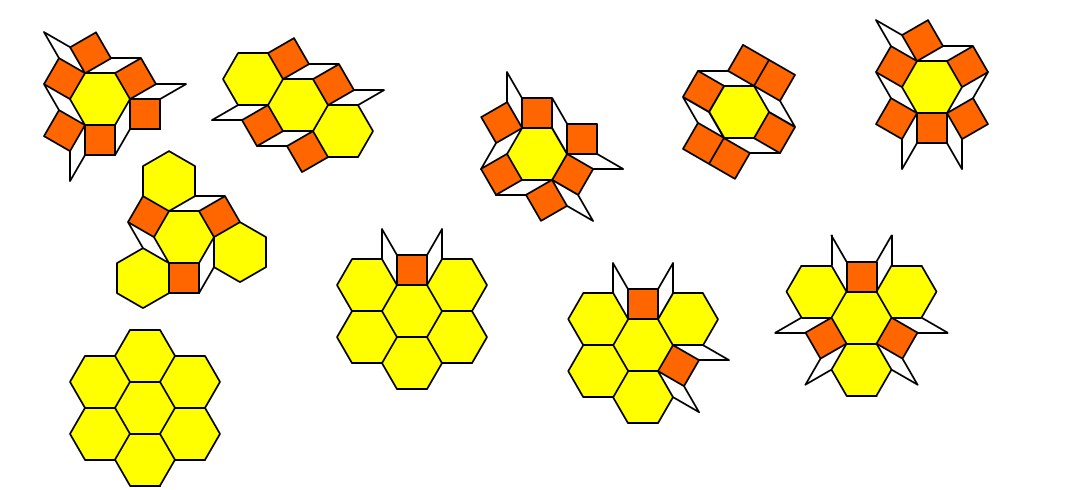
Meanwhile, something was intriguing me: a non-periodic, almost free-form, tiling using these shapes:
It has a really interesting balance between being forced to put the tiles in certain places, and having some freedom. To start with, if you begin with a hexagon, there are a lot of different ways of surrounding it. Here are some of them:
Similarly, there are a lot of ways of surrounding a square (finding them all might be an interesting task). You can see I've restricted myself. I never put two rhombuses against each other. Or two squares. I've got a lot of questions about this, and here are some of them:
  1. It feels like it would carry on forever in all sorts of ways. Can we prove it does?
  2. Once there's a "line" of squares and rhombuses, the line won't go away. What are the rules for it's behaviour?
  3. I've got an intuitive feel for an algorithm for making it carry on. Can we write down an algorithm for making sure it continues to grow without getting into any "impossible" situations?
  4. It feels like this could make a good game. What would the rules be?
  5. You can get areas of different regular tessellation - how many kinds of these are possible? 
  6. Can we - it feels like we can - create writing or pictures with this?
  7. Can I have a large public space, St Mark's Square in Venice for instance, to tile in this way? Or failing that, a playground?
Meanwhile, I was exploring other patterns:
Another thing that caught my attention was dodecagons.
Those holes can hold a dodecagon:
These can "point" in one of twelve directions. The idea of embedding these pointers and maybe other dodecagons, in the tessellatin grabbed me, and for a while I thought about how numbers can be patterned in this kind of space.
(At the same time, I've been reading Roger Penrose on, among other things, his work on non-periodic tiling. I guess I'm thinking about those 17 wallpaper groups, and trying to push other symmetries embedded within a simple translation.)

On a more practical note, I saw that you can get pattern block stickers!
These would really help the students recording a creation directly into their books. And something they could do this for - why hadn't I thought of it before? - popped into my head: pattern block equations:
 As Mary Pardoe tweeted:

Tuesday, 7 July 2015

Coordinates

Everyone teaches coordinates, and these are the three lessons I did with my class just before the end of term.
First of all, battleships. This is usually played in the spaces between lines rather than on the intersections of lines, so I adapted it to be more like Descartes would have wanted:
Here we are playing. (Somehow the logistics of playing two games at once, and marking what you're attacking as well as what you're defending was a tiny bit confusing for some children.)
I took the same grid and suparimposed it on an aerial photo of the school, so that we could do a coordinates treasure hunt game.
One player writes down the coordinates of where they've "hidden" the treasure. The other player then guesses where it is, giving coordinates. If they're right next to it ("hot") they're given a red cube, if they're a bit further ("warm") a yellow cube, and further away still ("cold") a blue cube.
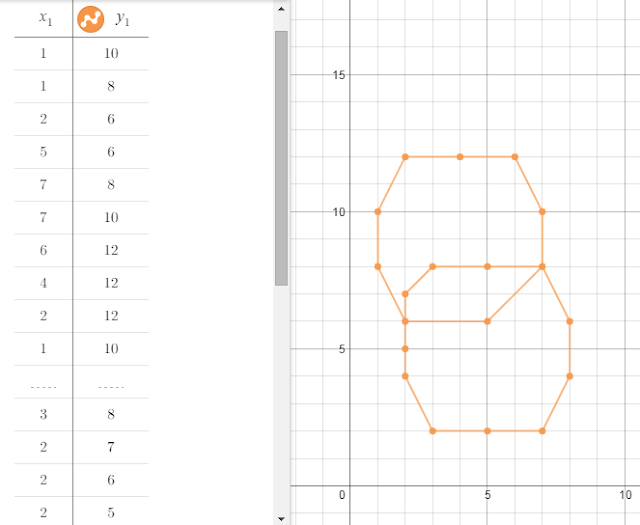
But the activity I like best is to use Desmos to draw something by entering the coordinates. My stipulation was that their designs should "go round in some kind of circle sort of thing". It didn't matter what, as long as it returned to the start again. This, I think, took the pressure off thinking too hard about exactly what to draw. I especially like this for the freedom it gives, and the instant feedback on how you're doing!


Monday, 29 June 2015

Mathematical reasoning

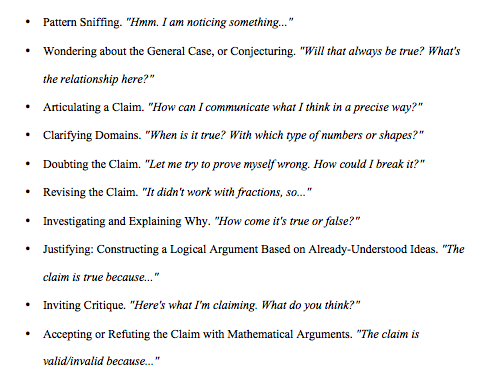
I've been thinking more about articulating claims, and proof, this term so I was pleased when Tracy tweeted:
Sometimes tweets are too short. Kristin Gray needed to respond with a blog post.

Mike Flynn had an addition:
Let me go through this and add a few of my thoughts.


  • Of course, all this happens within a situation where the initial pattern sniffing is encouraged. The slow-time question, "what do you notice?" is great for catalysing this kind of thinking Another set up is to give out resources and constraints and ask for exploring and noticing. And there's the kind of number talk when you're looking at something like this, and someone notices another way of constructing a number sequence.

  • If we hadn't already had a packed lesson, I might have got the Cuisenaire rods to try and construct the sequence in the way the red numbers show. Then everyone would have had the chance to experience that understanding.


  • Which brings me on to my next thought, which is that Kristin is right about the “Extending Pattern Using the Pattern”stage. Students need to play a little here. Does it work if I carry it on? It's great with rods or other manipulatives, but whiteboards and pens or pencil and paper are fine for experimenting too.
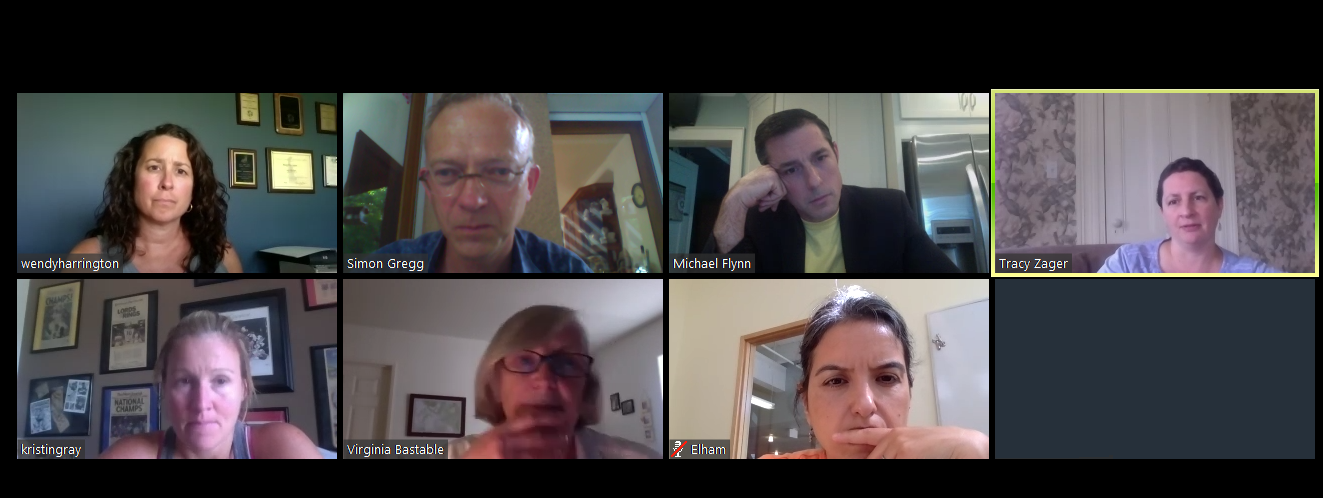
I was privileged to talk with Tracy, Mike, Kristen, Elham and Virginia Bastable (co-author of the great Connecting Arithmetic to Algebra) tonight!  I also encountered Wendy for the first time. Here we are, looking very pensive:

  • And talking with Tracy tonight (talking!) she says words to the effect: we don't have to expect children to work through these somehow programatically or sequentially. I know what she means. The teacher would be taking back the torch from the children. Virginia Bastable agreed, you can just focus on part of this progression for a while, then later take on another part. This is liberating for anyone, which includes me, who feels getting the "full house" might be wonderful, but also wonderfully rare. All this can be diachronic -happening over time. Record it on the claims board, come back to it later, when you and the students have all had time to reflect, or to come at it with fresh eyes.

Saturday, 27 June 2015

Jumping, Sliding, Swapping

We've just  completed four lessons that involve jumping, sliding and swapping. This was Julie's idea; not something we'd tried before, but full of great maths. They all have a playing phase; and then with three of them there was the phase of looking at number patterns. (Click on the heading links to go to the Year 4 blog for more detail.)

Solitaire

This was one we just played, on different-shaped boards. The aim is to end up with just one ball. You remove balls by jumping over them into an empty space (not diagonally though). In hindsight we could have looked at how many moves are necessary on different-sized boards. I'd have to investigate this a bit myself first, but maybe there's mileage in this.

I mentioned to the class that my solitaire board can't be played down to just one ball if the empty space is in the centre. Perhaps I might have shared the proof of this as it's a really simple satisfying one. I don't know. I'll share it with you anyway.
If assign three colours to the holes like this, each colour is present twelve times (and so with an even number of each colour):

Whenever there's a jump the number of each colour either increases or decreases by one. For instance:

And so there are now odd numbers of each colour. As this continues, there will always be all even, or all odd numbers of all the colours. So, there can never be just one ball left - one odd, and two even colours.

➋ Three Cats Three Dogs

There were three things about this activity (source), which involved swapping pairs of cats and dogs to sort them into all-cat  and all-dog groups.

  1. It was explicitly about groups of threes (randomly chosen "thinking threes" as we call them) working well as a group, and making sure each member contributed. This was successful, even though my boys aren't always great at working with the girls.
  2. I asked the groups to invent a notation to record what they'd done. This I was really pleased with: it was simple to do, they needed to do it completely on their own, and there was more than one way to do it.
  3. We started to look closely at the minimum number of swaps necessary with varying numbers of animals. This turns out to be a pattern of triangular numbers, which the class could understand, even though we didn't make the link with triangular numbers (which we'd looked at before explicitly).

❸ Towers of Hanoi

This time in pairs, again inventing notation. We used Cuisenaire rods to represent the disks.
 There was a different pattern of numbers that emerged here, this time powers of two, minus one:
This powers of two really grabbed the class, and we took them up, and down to fractions together.
A few people wanted to carry on doubling while the rest of the class were doing some coordinates work, and I let them go for it:

Jumping Frogs

Here frogs may either slide one place, or hop over one frog into an empty space; the aim being to have the pinks on the right and the blues on the left. There's a great nrich app that helps with this, but I also printed out some lilly pads for work with counters.
This puzzle was perhaps the hardest for the class to solve, but they kept at it!
Again we looked at the number pattern for different numbers of frogs, this time based on square numbers. Wanting to link in to our coordinates work I used desmos to tabulate and graph our results for the minimum number of moves for one frog at each end, two frogs at each end, and three frogs at each end. Then we looked at the three points on the graph, saw that they weren't in a straight line, and estimated where the curved line would cross the line going up from four on the x axis. I then added in the line. Samyak saw that you could get the progression by adding successive odd numbers:

I've now, following a really thought-provoking discussion with Paula Beardell Krieg, decided that I want to drop in this kind of graphing more often, to really get the feel of how we do this and the relationships look. Estimating was a good idea, and that it went well makes me feel like we could do this with more curves.

All-in-all, I was surprised how much maths we got from these four puzzles. I knew they would be playful and need lots of hard thinking, but the different number patterns that we uncovered added enough to make it really worthwhile. You could do this with older year groups and take it further.
I'll be on the lookout for puzzles like this which embody different number sequences, and probably use these activities next year.