Sunday, 12 July 2015

#tiling again

Well, John Golden has posted about his pattern block explorations, so I will too. Along with Dani Ruiz Aguilera he should accept a little of the "blame" for me spending so much time shuffling small shapes around. Dani has been doing some industrial-scale pattern block workshops himself:
I don't know whether I should put this post here or over on seekecho.blogspot.fr. I put my own things over there usually, including some of the things I've done with pattern blocks. But, although I've kind of "got the bug" with this, hopefully there are spin-offs for the classroom, like Teflon in space travel and the kitchen.

I've posted about some of the work I did in the class with a particular set of pattern blocks, the square, the hexagon and the thin white rhombus, already.

We've used Math Toybox's great Pattern Block tool - and a great thing about this is that you can save your creations onto the gallery, and even edit them again later on. John used it to respond to what we'd done in class:
I liked it that there were some interesting rules for these line patterns:
We looked at that and one or two other things, and then I asked them to work in bigger groups to extend one of them:
Meanwhile, something was intriguing me: a non-periodic, almost free-form, tiling using these shapes:
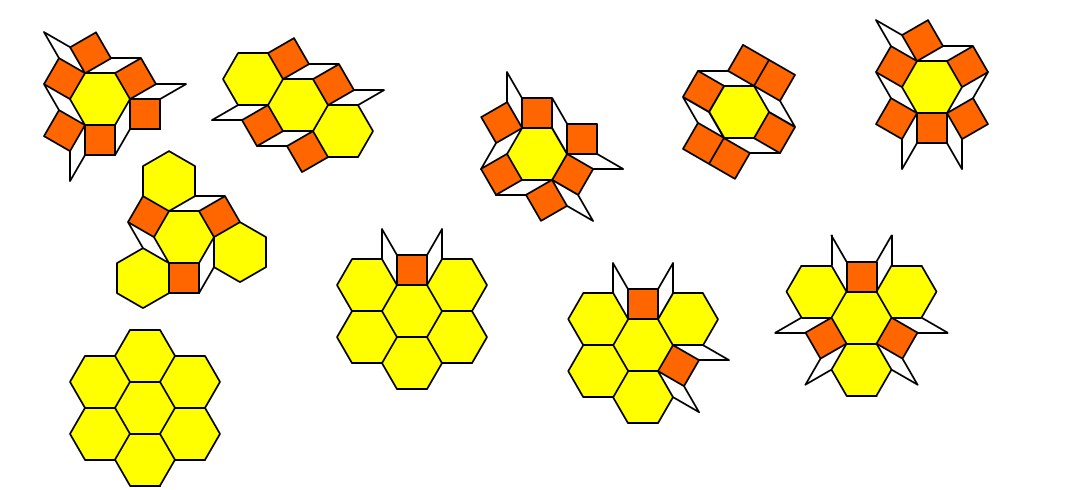
It has a really interesting balance between being forced to put the tiles in certain places, and having some freedom. To start with, if you begin with a hexagon, there are a lot of different ways of surrounding it. Here are some of them:
Similarly, there are a lot of ways of surrounding a square (finding them all might be an interesting task). You can see I've restricted myself. I never put two rhombuses against each other. Or two squares. I've got a lot of questions about this, and here are some of them:
  1. It feels like it would carry on forever in all sorts of ways. Can we prove it does?
  2. Once there's a "line" of squares and rhombuses, the line won't go away. What are the rules for it's behaviour?
  3. I've got an intuitive feel for an algorithm for making it carry on. Can we write down an algorithm for making sure it continues to grow without getting into any "impossible" situations?
  4. It feels like this could make a good game. What would the rules be?
  5. You can get areas of different regular tessellation - how many kinds of these are possible? 
  6. Can we - it feels like we can - create writing or pictures with this?
  7. Can I have a large public space, St Mark's Square in Venice for instance, to tile in this way? Or failing that, a playground?
Meanwhile, I was exploring other patterns:
Another thing that caught my attention was dodecagons.
Those holes can hold a dodecagon:
These can "point" in one of twelve directions. The idea of embedding these pointers and maybe other dodecagons, in the tessellatin grabbed me, and for a while I thought about how numbers can be patterned in this kind of space.
(At the same time, I've been reading Roger Penrose on, among other things, his work on non-periodic tiling. I guess I'm thinking about those 17 wallpaper groups, and trying to push other symmetries embedded within a simple translation.)

On a more practical note, I saw that you can get pattern block stickers!
These would really help the students recording a creation directly into their books. And something they could do this for - why hadn't I thought of it before? - popped into my head: pattern block equations:
 As Mary Pardoe tweeted:

Tuesday, 7 July 2015

Coordinates

Everyone teaches coordinates, and these are the three lessons I did with my class just before the end of term.
First of all, battleships. This is usually played in the spaces between lines rather than on the intersections of lines, so I adapted it to be more like Descartes would have wanted:
Here we are playing. (Somehow the logistics of playing two games at once, and marking what you're attacking as well as what you're defending was a tiny bit confusing for some children.)
I took the same grid and suparimposed it on an aerial photo of the school, so that we could do a coordinates treasure hunt game.
One player writes down the coordinates of where they've "hidden" the treasure. The other player then guesses where it is, giving coordinates. If they're right next to it ("hot") they're given a red cube, if they're a bit further ("warm") a yellow cube, and further away still ("cold") a blue cube.
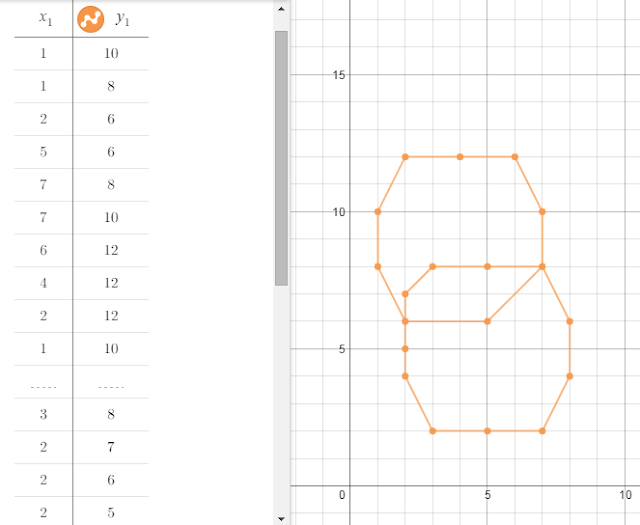
But the activity I like best is to use Desmos to draw something by entering the coordinates. My stipulation was that their designs should "go round in some kind of circle sort of thing". It didn't matter what, as long as it returned to the start again. This, I think, took the pressure off thinking too hard about exactly what to draw. I especially like this for the freedom it gives, and the instant feedback on how you're doing!


Monday, 29 June 2015

Mathematical reasoning

I've been thinking more about articulating claims, and proof, this term so I was pleased when Tracy tweeted:
Sometimes tweets are too short. Kristin Gray needed to respond with a blog post.

Mike Flynn had an addition:
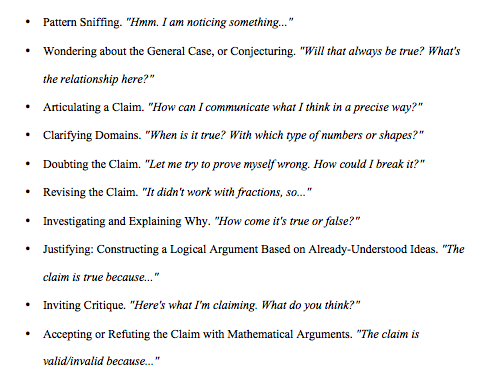
Let me go through this and add a few of my thoughts.


  • Of course, all this happens within a situation where the initial pattern sniffing is encouraged. The slow-time question, "what do you notice?" is great for catalysing this kind of thinking Another set up is to give out resources and constraints and ask for exploring and noticing. And there's the kind of number talk when you're looking at something like this, and someone notices another way of constructing a number sequence.

  • If we hadn't already had a packed lesson, I might have got the Cuisenaire rods to try and construct the sequence in the way the red numbers show. Then everyone would have had the chance to experience that understanding.


  • Which brings me on to my next thought, which is that Kristin is right about the “Extending Pattern Using the Pattern”stage. Students need to play a little here. Does it work if I carry it on? It's great with rods or other manipulatives, but whiteboards and pens or pencil and paper are fine for experimenting too.
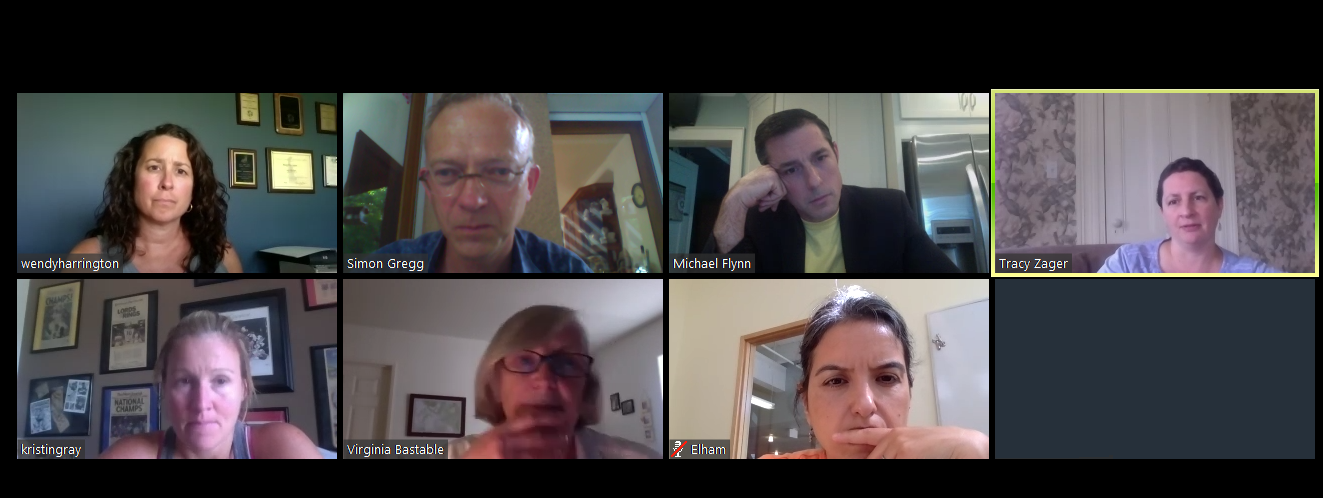
I was privileged to talk with Tracy, Mike, Kristen, Elham and Virginia Bastable (co-author of the great Connecting Arithmetic to Algebra) tonight!  I also encountered Wendy for the first time. Here we are, looking very pensive:

  • And talking with Tracy tonight (talking!) she says words to the effect: we don't have to expect children to work through these somehow programatically or sequentially. I know what she means. The teacher would be taking back the torch from the children. Virginia Bastable agreed, you can just focus on part of this progression for a while, then later take on another part. This is liberating for anyone, which includes me, who feels getting the "full house" might be wonderful, but also wonderfully rare. All this can be diachronic -happening over time. Record it on the claims board, come back to it later, when you and the students have all had time to reflect, or to come at it with fresh eyes.

Saturday, 27 June 2015

Jumping, Sliding, Swapping

We've just  completed four lessons that involve jumping, sliding and swapping. This was Julie's idea; not something we'd tried before, but full of great maths. They all have a playing phase; and then with three of them there was the phase of looking at number patterns. (Click on the heading links to go to the Year 4 blog for more detail.)

➊ Solitaire

This was one we just played, on different-shaped boards. The aim is to end up with just one ball. You remove balls by jumping over them into an empty space (not diagonally though). In hindsight we could have looked at how many moves are necessary on different-sized boards. I'd have to investigate this a bit myself first, but maybe there's mileage in this.

I mentioned to the class that my solitaire board can't be played down to just one ball if the empty space is in the centre. Perhaps I might have shared the proof of this as it's a really simple satisfying one. I don't know. I'll share it with you anyway.
If assign three colours to the holes like this, each colour is present twelve times (and so with an even number of each colour):

Whenever there's a jump the number of each colour either increases or decreases by one. For instance:

And so there are now odd numbers of each colour. As this continues, there will always be all even, or all odd numbers of all the colours. So, there can never be just one ball left - one odd, and two even colours.

➋ Three Cats Three Dogs

There were three things about this activity (source), which involved swapping pairs of cats and dogs to sort them into all-cat  and all-dog groups.

  1. It was explicitly about groups of threes (randomly chosen "thinking threes" as we call them) working well as a group, and making sure each member contributed. This was successful, even though my boys aren't always great at working with the girls.
  2. I asked the groups to invent a notation to record what they'd done. This I was really pleased with: it was simple to do, they needed to do it completely on their own, and there was more than one way to do it.
  3. We started to look closely at the minimum number of swaps necessary with varying numbers of animals. This turns out to be a pattern of triangular numbers, which the class could understand, even though we didn't make the link with triangular numbers (which we'd looked at before explicitly).

❸ Towers of Hanoi

This time in pairs, again inventing notation. We used Cuisenaire rods to represent the disks.
 There was a different pattern of numbers that emerged here, this time powers of two, minus one:
This powers of two really grabbed the class, and we took them up, and down to fractions together.
A few people wanted to carry on doubling while the rest of the class were doing some coordinates work, and I let them go for it:

❹ Jumping Frogs

Here frogs may either slide one place, or hop over one frog into an empty space; the aim being to have the pinks on the right and the blues on the left. There's a great nrich app that helps with this, but I also printed out some lilly pads for work with counters.
This puzzle was perhaps the hardest for the class to solve, but they kept at it!
Again we looked at the number pattern for different numbers of frogs, this time based on square numbers. Wanting to link in to our coordinates work I used desmos to tabulate and graph our results for the minimum number of moves for one frog at each end, two frogs at each end, and three frogs at each end. Then we looked at the three points on the graph, saw that they weren't in a straight line, and estimated where the curved line would cross the line going up from four on the x axis. I then added in the line. Samyak saw that you could get the progression by adding successive odd numbers:

I've now, following a really thought-provoking discussion with Paula Beardell Krieg, decided that I want to drop in this kind of graphing more often, to really get the feel of how we do this and the relationships look. Estimating was a good idea, and that it went well makes me feel like we could do this with more curves.

All-in-all, I was surprised how much maths we got from these four puzzles. I knew they would be playful and need lots of hard thinking, but the different number patterns that we uncovered added enough to make it really worthwhile. You could do this with older year groups and take it further.
I'll be on the lookout for puzzles like this which embody different number sequences, and probably use these activities next year.

Friday, 26 June 2015

37 + 25 = ■ + ●

I've posted about Connecting Arithmetic to Algebra before. This slide, based on the book, is one of a number of useful ones from Kristin Gray's blog:

Today, before the main part of the maths lesson, we looked at an equation on the board. I asked them not to calculate it (although some couldn't resist of course);

37 + 25 = ■ + ●
I asked, "What do you notice?"
Aditi started us off by saying it was balanced. Brilliant! We'd done some work on balanced equations earlier in the year, so I was really pleased to hear this as the first thing.
There were some other good points, and then Justus said the two numbers could be instead:

38 + 25

We looked slowly at what he'd done. Justus said that you could always do this, take it from one addend and give it to the other. Most of the class agreed. 
That's going up on the Claims Board.

"What other pairs of numbers could we have?" I asked.
And then there were a flood of answers.
Alonso gave us:
-1 + 63
and then there were lots of sums with minus numbers in too!
James gave us:
-38 + 100
And Annie:
It's another reason to start a lot more writing in their maths journals next year. There is a lot of great thinking, and it's getting wiped out, rather than pondered over for a bit longer and looked back on. The class were evidently enjoying the freedom of the exploration and talk, but not everyone joined in the discussion. Writing would give more time for everyone to get their thoughts together and put them into words. In September...

On other occasions (like this), I've used Cuisenaire rods to help in representing the pattern. Today the ideas seemed to flow so well without this, but another time I might use them again for something like this.